Thank you for visiting SNEWPapers!
Sign up free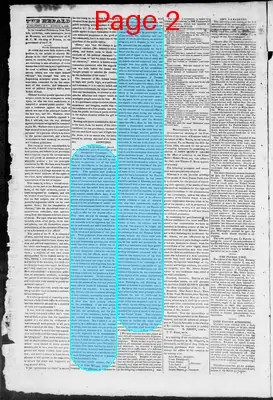
The Alexandria Herald
Alexandria, Virginia
What is this article about?
An anonymous letter to the Alexandria Herald critiques John Quincy Adams' candidacy for president in the 1824 election, accusing him of political betrayal, corruption, and compromising national interests through intrigues and the slave trade treaty, urging voters to choose a unifying figure to counter sectional divisions.
Clipping
OCR Quality
Full Text
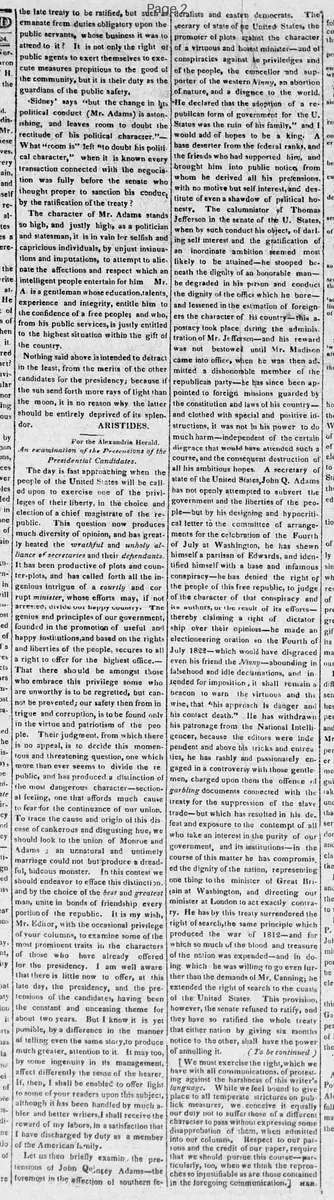
An examination of the Pretensions of the Presidential Candidates.
The day is fast approaching when the people of the United States will be called upon to exercise one of the privileges of their liberty, in the choice and election of a chief magistrate of the republic. This question now produces much diversity of opinion, and has greatly heated the wrathful and unholy alliance of secretaries and their dependants.
It has been productive of plots and counter-plots, and has called forth all the ingenious intrigue of a courtly and corrupt minister, whose efforts may, if not arrested, divide our happy country. The genius and principles of our government, founded in the promotion of useful and happy institutions, and based on the rights and liberties of the people, secures to all a right to offer for the highest office.
That there should be amongst those who embrace this privilege some who are unworthy is to be regretted, but cannot be prevented; our safety then from intrigue and corruption, is to be found only in the virtue and patriotism of the people. Their judgment, from which there is no appeal, is to decide this momentous and threatening question, one which more than ever seems to divide the republic, and has produced a distinction of the most dangerous character--sectional feeling, one that affords much cause to fear for the continuance of our union.
To trace the cause and origin of this disease of cankerous and disgusting hue, we should look to the union of Monroe and Adams; an unnatural and untimely marriage could not but produce a dreadful, hideous monster. In this contest we should endeavor to efface this distinction, and by the choice of the best and greatest man, unite in bonds of friendship every portion of the republic. It is my wish, Mr. Editor, with the occasional privilege of your columns, to examine some of the most prominent traits in the characters of those who have already offered for the presidency. I am well aware that there is little now to offer, at this late day, the presidency, and the pretensions of the candidates, having been the constant and unceasing theme for about two years. But I know it is yet possible, by a difference in the manner of telling even the same story, to produce much greater attention to it. It may too, by some ingenuity in its management affect differently the sense of the hearer.
If, then, I shall be enabled to offer light to some of your readers upon this subject, although it has been handled by much abler and better writers, I shall receive the reward of my labors, in a satisfaction that I have discharged my duty as a member of the American family.
Let us then briefly examine, the pretensions of John Quincy Adams--the foremost in the affection of southern federalists and eastern democrats. The secretary of state of the United States, the promoter of plots against the character of a virtuous and honest minister--and of conspiracies against the privileges and of the people, the counsellor and supporter of the western Minny, an abortion of nature, and a disgrace to the world.
He declared that the adoption of a republican form of government for the U. States was the ruin of his family--and I would add of hopes to be a king: A base deserter from the federal ranks, and the friends who had supported him, and brought him into public notice, from whom he derived all his pretensions, with no motive but self interest, and destitute of even a shadow of political honesty. The calumniator of Thomas Jefferson in the senate of the U. States, when by such conduct his object, of daring self interest and the gratification of an inordinate ambition seemed most likely to be attained--he stooped beneath the dignity of an honorable man--he degraded in his person and conduct the dignity of the office which he bore--and lessened in the estimation of foreigners the character of his country--this apostacy took place during the administration of Mr. Jefferson--and his reward was not bestowed until Mr. Madison came into office, when he was then admitted a dishonorable member of the republican party--he has since been appointed to foreign missions guarded by the constitution and laws of his country--and clothed with special and positive instructions, it was not in his power to do much harm--independent of the certain disgrace that would have attended such a course, and the consequent destruction of all his ambitious hopes. A secretary of state of the United States, John Q. Adams has not openly attempted to subvert the government and the liberties of the people--but by his designing and hypocritical letter to the committee of arrangements for the celebration of the Fourth of July at Washington, he has shewn himself a partisan of Edwards, and identified himself with a base and infamous conspiracy--he has denied the right of the people of this free republic, to judge of the character of that conspiracy and its authors, or the result of its efforts--thereby claiming a right of dictatorship over their opinions--he made an electioneering oration on the Fourth of July 1822--which would have disgraced even his friend the Minny--abounding in falsehood and idle declamations, and intended for imposition, it shall remain a beacon to warn the virtuous and the wise, that "his approach is danger and his contact death." He has withdrawn his patronage from the National Intelligencer, because the editors were independent and above his tricks and entreaties, he has rashly and passionately engaged in a controversy with those gentlemen, charged upon them the offence of garbling documents connected with the treaty for the suppression of the slave trade--but which has resulted in his defeat and exposure to the contempt of all who take an interest in the purity of our government, and its institutions--in the course of this matter he has compromised the dignity of the nation, representing one thing to the minister of Great Britain at Washington, and directing our minister at London to act exactly contrary. He has by this treaty surrendered the right of search, the same principle which produced the war of 1812--and for which so much of the blood and treasure of the nation was expended--and in doing which he was willing to go even further than the demands of Mr. Canning: he extended the right of search to the coasts of the United States. This provision, however, the senate refused to ratify, and they have so ratified the whole treaty that either nation by giving six months notice to the other, shall have the power of annulling it.
(To be continued)
What sub-type of article is it?
What themes does it cover?
What keywords are associated?
What entities or persons were involved?
Letter to Editor Details
Recipient
Mr. Editor
Main Argument
john quincy adams is unfit for the presidency due to his history of political betrayal, self-interest, calumny against figures like jefferson, involvement in conspiracies, and compromising policies like the slave trade treaty that surrender national rights; voters should choose a virtuous leader to unite the republic against sectional divisions.
Notable Details