Thank you for visiting SNEWPapers!
Sign up free
Norfolk Gazette And Publick Ledger
Norfolk, Virginia
What is this article about?
Following the French army's defeat at Waterloo on June 18, 1815, Napoleon abdicates on June 22. The Chambers of Peers and Representatives accept the abdication, proclaim Napoleon II briefly, form a provisional government led by Fouche, Carnot, and Grenier, and seek peace with the allied powers to preserve French independence.
Clipping
OCR Quality
Full Text
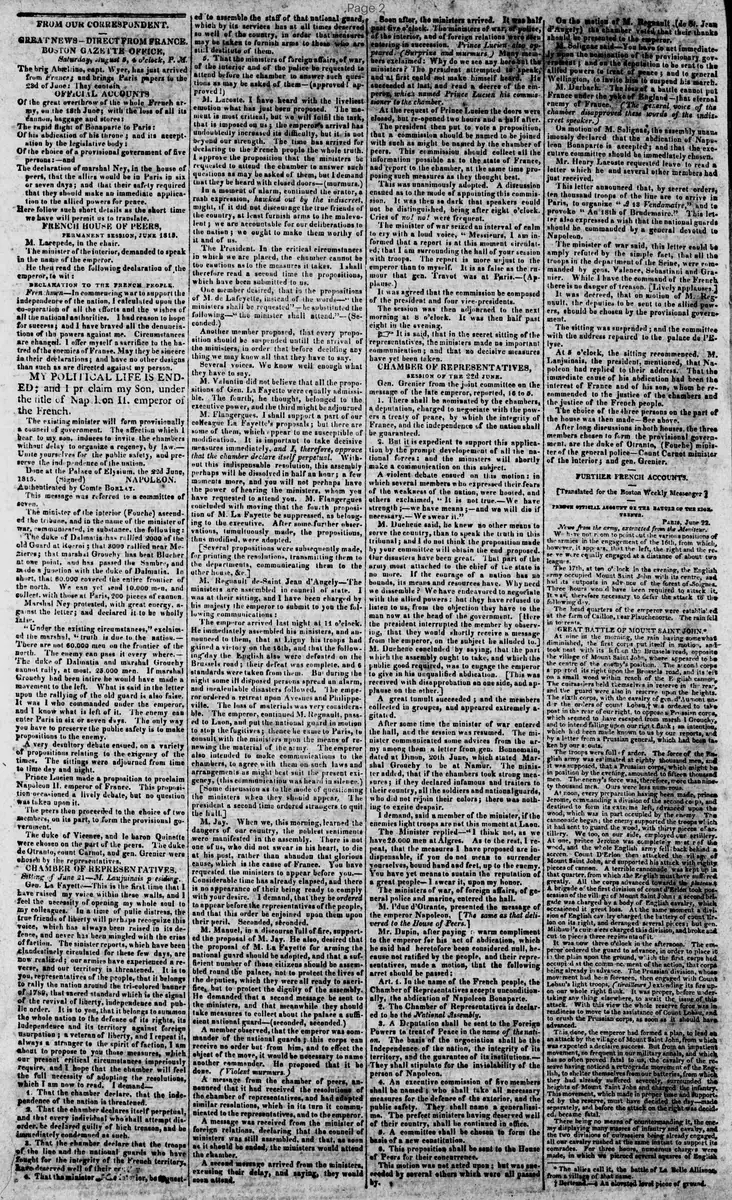
GREAT NEWS - DIRECT FROM FRANCE
BOSTON GAZETTE OFFICE.
Saturday August 5, 4 o'clock, P. M.
The brig Achille, capt. Wyer, has just arrived from France; and brings Paris papers to the 28th of June: They contain
OFFICIAL ACCOUNTS
Of the great overthrow of the whole French army, on the 18th June; with the loss of all its Cannon, baggage and stores
The rapid flight of Bonaparte to Paris:
Of his abdication of his throne; and its acceptance by the legislative body:
Of the choice of a provisional government of five persons:-and
The declaration of marshal Ney, in the house of peers, that the allies would be in Paris in six or seven days; and that their safety required that they should make an immediate application to the allied powers for peace.
Here follow such short details as the short time we have will permit us to translate.
FRENCH HOUSE OF PEERS,
PERMANENT SESSION, JUNE 1815.
M. Lacepede, in the chair.
The minister of the interior, demanded to speak in the name of the emperor.
He then read the following declaration of the emperor, to wit :
DECLARATION TO THE FRENCH PEOPLE.
Frenchmen-In commencing war to support the independence of the nation, I calculated upon the co-operation of all the efforts and the wishes of all the national authorities. I had reason to hope for success: and I have braved all the denunciations of the powers against me. Circumstances are changed. I offer myself a sacrifice to the hatred of the enemies of France. May they be sincere in their declarations; and have no other designs than such as are directed against my person.
MY POLITICAL LIFE IS ENDED: and I proclaim my Son, under the title of Napoleon II. emperor of the French.
The existing ministers will form provisionally a council of government. The affection which I bear to my son, induces me to invite the chambers without delay to organize a regency, by law.--
Unite yourselves for the public safety, and preserve the independence of the nation.
Done at the Palace of the Elysee, the 22d June, 1815.
(signed)
NAPOLEON.
Authenticated by Comte Borlase.
This message was referred to a committee of seven.
The minister of the interior (Fouche) ascended the tribune, and in the name of the minister of war, communicated, in substance, the following :
The duke of Dalmatia has rallied 2000 of the old Guard at Corbeil ; that 8000 rallied near Metzieres; that marshal Grouchy has beat Blucher at one point, and has passed the Sambre, and made a junction with the duke of Dalmatia. In short, that 60,000 covered the entire frontier of the north. We can yet send 10,000 men, and collect, with those at Paris, 200 pieces of cannon.
Marshal Ney protested, with great energy, against the letter; and declared it to be wholly false.
"Under the existing circumstances," exclaimed the marshal. "truth is due to the nation.-- There are not 60,000 men on the frontier of the north. The enemy can pass it every where.-- The duke of Dalmatia and marshal Grouchy cannot rally, at most, 25,000 men. If marshal Grouchy had been entire he would have made a movement to the left. What is said in the letter upon the rallying of the old guard is also false. It was I who commanded under the emperor. and I know what is left of it. The enemy can enter Paris in six or seven days. The only way you have to preserve the public safety is to make propositions to the enemy."
A very desultory debate ensued, on a variety of propositions relating to the exigency of the times. The sittings were adjourned from time to time day and night.
Prince Lucien made a proposition to proclaim Napoleon II. emperor of France. This proposition occasioned a lively debate, but no question was taken upon it.
The peers then proceeded to the choice of two members, on its part, to form the provisional government.
The duke of Vicenza, and le baron Quinette were chosen on the part of the peers. The duke de Otranto, count Carnot, and gen. Grenier were chosen by the representatives.
CHAMBER OF REPRESENTATIVES.
Sitting of June 21-M. Lanjuinais presiding
Gen. La Fayette- This is the first time that I have raised my voice within these walls, and I feel the necessity of opening my whole soul to my colleagues. In a time of public distress, the true friends of liberty will perhaps recognize this voice, which has always been raised in its defence, and never has been mingled with the cries of faction. The sinister reports, which have been clandestinely circulated for these few days, are now realized; our armies have experienced a reverse, and our territory is threatened. It is to you, representatives of the people, that it belongs to rally the nation around the tri-colored banner of 1789, that sacred standard which is the signal of the revival of liberty, independence and public order. It is to you, that it belongs to summon the whole nation to the defence of its rights, its independence and its territory against foreign usurpation ; a veteran of liberty, and I repeat it, always a stranger to the spirit of faction, I am about to propose to you those measures, which our present critical circumstances imperiously require, and I hope that the chamber will feel the full necessity of adopting the resolutions, which I am now to read. I demand-.
1. That the chamber declare, that the independence of the nation is threatened.
2. That the chamber declares itself perpetual, and that every individual who shall attempt disorder, be declared guilty of high treason, and be immediately condemned as such.
3. That the chamber declare that the troops of the line and the national guards who have fought for the integrity of the French territory, have deserved well of their country
4. That the minister of the interior, be requested to assemble the staff of that national guard: which by its services has at all times deserved so well of the country, in order that measures may be taken to furnish arms to those who are still destitute of them.
5. That the ministers of foreign affairs of war, of the interior and of the police be requested to attend before the chamber to answer such questions as may be asked of them-(approved! approved !)
M. Lacoste. I have heard with the liveliest emotion what has just been proposed. The moment is most critical, but we will fulfil the task, that is imposed on us; the emperor's arrival has undoubtedly increased its difficulty, but it is not beyond our strength. The time has arrived for declaring to the French people the whole truth. I approve the proposition that the ministers be requested to attend the chamber to answer such questions as may be asked of them, but I demand that they be heard with closed doors--(murmurs.)
In a moment of alarm, continued the orator, a rash expression, hazarded out by the indiscreet, might, if it did not discourage the true friends of the country, at least furnish arms to the malevolent; we are accountable for our deliberations to the nation; we ought to make them worthy of it and of us.
The President. In the critical circumstances in which we are placed, the chamber cannot be too cautious as to the measures it takes. I shall therefore read a second time the propositions, which have been submitted to us.
One member desired, that in the propositions of M. de La Fayette, instead of the words-- "the ministers shall be requested" -be substituted the following--" the ministers shall attend."--(Seconded.)
Another member proposed, that every proposition should be suspended until the arrival of the ministers, in order that before deciding any thing we may know all that they have to say.
Several voices. We know well enough what they have to say.
M. Valantin did not believe that all the propositions of Gen. La Fayette were equally admissible. The fourth; he thought, belonged to the executive power, and the third might be adjourned
M. Flangergues. I shall support a part of our colleague La Fayette's proposals; but there are some of them, which appear to me susceptible of modification. It is important to take decisive measures immediately, and I, therefore, approve that the chamber declare itself perpetual. Without this indispensable resolution, this assembly perhaps will be dissolved in half an hour; a few moments more, and you will not perhaps have the power of hearing the ministers, whom you have requested to attend you. M. Flangergues concluded with moving that the fourth proposition of M. La Fayette be suppressed, as belonging to the executive. After some further observations, tumultuously made, the propositions thus modified, were adopted.
Several propositions were subsequently made, for printing the resolutions, transmitting them to the departments, communicating them to the other house, &c.
M. Regnault de-Saint Jean d'Angely--The ministers are assembled in council of state. I was at their sitting, and I have been charged by his majesty the emperor to submit to you the following communications :
The emperor arrived last night at 11 o'clock. He immediately assembled his ministers, and announced to them, that at Ligny his troops had gained a victory on the 16th, and that the following day the English also were defeated on the Brussels road; their defeat was complete, and 6 standards were taken from them. But during the night some ill disposed persons spread an alarm, and incalculable disasters followed. The emperor ordered a retreat upon Avesnes and Philippeville. The loss of materials was very considerable. The emperor, continued M. Regnault, passed to Laon, and put the national guard in motion to stop the fugitives; thence he came to Paris, to consult with the ministers upon the means of renewing the material of the army. The emperor also intended to make communications to the chambers, to agree with them on such laws and arrangements as might best suit the present exigency, (this communication was heard in silence.)
[Some discussion as to the mode of questioning the ministers when they should appear. The president a second time ordered strangers to quit the hall.]
M. Jay. When we, this morning, learned the dangers of our country, the noblest sentiments were manifested in the assembly. There is not one of us, who did not swear in his heart, to die at his post, rather than abandon that glorious cause, which is the cause of France. You have requested the ministers to appear before you.-- Considerable time has already elapsed, and there is no appearance of their being ready to comply with your desire. I demand, that they be ordered to appear before the representatives of the people and that this order be enjoined upon them upon their peril. Seconded, seconded.
M. Manuel, in a discourse full of fire, supported the proposal of M. Jay. He also, desired that the proposal of M. La Fayette for arming the national guard should be adopted, and that a sufficient number of those citizens should be assembled round the palace, not to protect the lives of the deputies, which they were all ready to sacrifice, but to protect the dignity of the assembly. He demanded that a second message be sent to the ministers, and that meanwhile they should take measures to collect about the palace a sufficient national guard--(seconded, seconded.)
A member observed, that the emperor was commander of the national guards ; this corps can receive no order but from him, and to effect the object of the move, it would be necessary to name another commander. He proposed that it be done. (Violent murmurs.)
A message from the chamber of peers, announced that it had received the resolutions of the chamber of representatives, and had adopted similar resolutions, which in its turn it communicated to the representatives, and to the emperor.
A message was received from the minister of foreign relations, declaring that the council of ministers was still assembled, and that, as soon as it should be ended, the ministers would attend the chamber.
A second message arrived from the ministers, excusing their delay, and saying, they would soon attend.
Soon after, the ministers arrived. It was half past five o'clock. The ministers of war, of police of the interior, and of foreign relations were seen entering in succession. Prince Lucien also appeared (Surprise and murmurs) Many members exclaimed: Why do we see any here but the ministers? The president attempted to speak and at first could not make himself heard. He succeeded at last, and read a decree of the emperor, which named Prince Lucien his commissioner to the chamber.
At the request of Prince Lucien the doors were closed, but re-opened two hours and a half after.
The president then put to vote a proposition, that a commission should be named to be joined with such as might be named by the chamber of peers. This commission should collect all the information possible as to the state of France, and report to the chamber, at the same time proposing such measures as they thought best.
This was unanimously adopted. A discussion ensued as to the mode of appointing this commission. It was then so dark that speakers could not be distinguished, being after eight o'clock. Cries of no! no! were frequent.
The minister of war seized an interval of calm to cry with a loud voice, " Messieurs, I am informed that a report is at this moment circulated; that I am surrounding the hall of your session with troops. The report is more unjust to the emperor than to myself. It is as false as the rumour that gen. Travot was at Paris.-(Applause.)
It was agreed that the commission be composed of the president and four vice-presidents.
The session was then adjourned to the next morning at 8 o'clock. It was then half past eight in the evening.
It is said, that in the secret sitting of the representatives, the ministers made no important communication; and that no decisive measures have yet been taken.
CHAMBER OF REPRESENTATIVES,
SESSION OF THE 22d JUNE.
Gen. Grenier from the joint committee on the message of the late emperor, reported, 16 to 1.
1. There shall be nominated by the chambers, a deputation, charged to negotiate with the powers a treaty of peace, by which the integrity of France, and the independence of the nation shall be guaranteed.
2. But it is expedient to support this application by the prompt development of all the national forces: and the ministers will shortly make a communication on this subject.
A violent debate ensued on this motion: in which several members who expressed their fears of the weakness of the nation, were hooted, and others exclaimed, " It is not true.-We have strength;--we have means;-and we will die if necessary.-We swear it."
M. Duchene said, he knew no other means to serve the country, than to speak the truth in this tribunal; and I do not think the proposition made by your committee will obtain the end proposed. Our disasters have been great. That part of the army most attached to the chief of the state is no more. If the courage of a nation has no bounds, its means and resources have. Why need we dissemble? We have endeavored to negotiate with the allied powers : but they have refused to listen to us, from the objection they have to the man now at the head of the government. Here the president interrupted the member by observing, that they would shortly receive a message from the emperor, on the subject he alluded to.]
M. Duchene concluded by saying, that the part which the assembly ought to take, and which the public good required, was to engage the emperor to give in his unqualified abdication. [This was received with disapprobation on one side, and applause on the other.]
A great tumult succeeded ; and the members collected in groups, and appeared extremely agitated.
After some time the minister of war entered the hall, and the session was resumed. The minister communicated some advices from the army among them a letter from gen. Bonnemain, dated at Dinant, 20th June, which stated Marshal Grouchy to be at Namur. The minister added, that if the chambers took strong measures; if they declared infamous and traitors to their country, all the soldiers and national guards, who did not rejoin their colors; there was nothing to excite despair.
I demand, said a member of the minister, if the enemies light troops are not this moment at Laon.
The Minister replied-" I think not, as we have 26,000 men at Aisne. As to the rest, I repeat, that the measures I have proposed are indispensable, if you do not mean to surrender yourselves, bound hand and feet, up to the enemy. You have yet means to sustain the reputation of a great people- I swear it, upon my honor."
The ministers of war, of foreign affairs, of general police and marine, entered the hall.
M. le duc d'Otrante, presented the message of the emperor Napoleon, [The same as that delivered to the House of Peers.]
Mr. Dupin, after paying a warm compliment to the emperor on his act of abdication, which he said had heretofore been considered null, because not ratified by the people, and their representatives, made a motion, that the following arret should be passed:
Art. 1. In the name of the French people, the Chamber of Representatives accepts unconditionally, the abdication of Napoleon Bonaparte.
2. The Chamber of Representatives is declared to be the National Assembly.
3. A Deputation shall be sent to the Foreign Powers to treat of Peace in the name of the nation. The basis of the negotiation shall be the Independence, of the nation, the integrity of its territory, and the guarantee of its institutions...
They shall stipulate for the inviolability of the person of Napoleon.
4. An executive commission of five members shall be named ; who shall take all necessary measures for the defence of the exterior, and the public safety. They shall name a generalissimo. The present ministers having deserved well of their country, shall be continued in office.
5. A committee shall be chosen to form the basis of a new constitution.
6. This proposition shall be sent to the House of Peers for their concurrence.
This motion was not acted upon; but was succeeded by several others which were all passed
On the motion of M. Regnault (de St. Jean d'Angely) the address should be presented to the emperor
M. Solignac said You have to act immediately upon the nomination of the provisional government ; and on the deputation to be sent to the allied powers to treat of peace; and to general Wellington, to invite him to suspend his march.
M. Durbach. The loss of a battle cannot put France under the yoke of England -that eternal enemy of France, The general voice of the chamber disapproved these words of the indiscreet speaker.)
On motion of M. Solignac, the assembly unanimously declared that the abdication of Napoleon Bonaparte is accepted; and that the executive committee should be immediately chosen.
Mr. Henry Lacoste requested leave to read a letter which he and several other members had just received.
This letter announced that, by secret orders, ten thousand troops of the line are to arrive in Paris, to organize " A 18 Fructidor," and to provoke " An 18th of Brumaire." This letter also expressed a wish that the national guards should be commanded by a general devoted to Napoleon.
The minister of war said, this letter could be amply refuted by the simple fact, that all the troops in the department of the Seine, were commanded by gens. Valence, Sebastiani and Granier. While I have the command of the French there is no danger of treason. Lively applauses.
It was decreed, that on motion of M. Regnault. the deputies to be sent to the allied powers, should be chosen by the provisional government.
The sitting was suspended ; and the committee with the address repaired to the, palace de l'Elysee.
At 5 o'clock, the sitting recommenced. M. Lanjuinais, the president, mentioned, that Napoleon had replied to their address. That the immediate cause of his abdication had been the interest of France and of his son, whom he recommended to the justice of the chambers and the justice of the French people.
The choice of the three persons on the part of the house was then made-See above.
After long discussions in both houses the three members chosen to form the provisional government, are the duke of Otranto, (Fouche) minister of the general police- Count Carnot minister of the interior; and gen. Grenier.
FURTHER FRENCH ACCOUNTS
[Translated for the Boston Weekly Messenger ]
PROPER OFFICIAL ACCOUNT ON THE BATTLE OF THE EIGHTEENTH.
Paris, June 22.
News from the army, extracted from the Moniteur.
We have not room to point out the various positions of the armies in the engagement of the 16th, from which, however, it appears, that the left, the right and the reserve were equally engaged at a distance of about two leagues.
The 17th, at ten o'clock in the evening, the English army occupied Mount Saint John with its centre, and had its outposts in advance of the forest of Soignes. Three hours would have been required to attack it. It was, therefore necessary to defer the attack to the following day.
The head quarters of the emperor were established at the farm of Quatre Bras, near Genappe. The rain fell in torrents.
GREAT BATTLE OF MOUNT SAINT JOHN.
At nine in the morning, the rain having somewhat diminished, the first corps put itself in motion, and took post with its left on the Brussels road, opposite the village of Mount Saint John, Where appeared to be the centre of the enemy's position. The second corps supported its right upon the Brussels road, and its left on a small wood within reach of the English cannon The cuirassiers held themselves in reserve in the rear and the guard were also in reserve upon the heights.
The sixth corps, with the cavalry of gen. d' Aumont under the orders of count Lobau. was ordered to take post in the rear of our right., to oppose a Prussian corps, which seemed to have escaped from marshal Grouchy and to intend falling upon our right flank; an intention, which had been made known to us by our reports, and by a letter from a Prussian general, which had been taken by our scouts.
The troops were full of ardor. The force of the English army was estimated at eighty thousand men, and it was supposed, that a Prussian corps, which might be in position by the evening, amounted to fifteen thousand men. The enemy's force was, therefore, more than ninety thousand men. Ours were less numerous.
At noon, every preparation having been made, prince Jerome, commanding a division of the second corps, and destined to form its extreme left, advanced upon the wood, which was in part occupied by the enemy, The cannonade began; the enemy supported the troops which it had sent to guard the wood, with thirty pieces of artillery. We too, on our side, employed our artillery.
At one, prince Jerome was completely master of the wood, and the whole English army fell back behind screen. -Count D'Erlon then attacked the village of Mount Saint John, and supported his attack with eighty pieces of cannon. A terrible cannonade was kept up in that quarter. from which the English must have suffered greatly. All the corps advanced towards the plateau.
A brigade of the first division of count d Erlon took possession of the village of Mount Saint John; a second brigade was charged by a body of English cavalry, which occasioned it great loss. At the same moment a division of English cavalry charged the battery of count Erlon on its right, and deranged several pieces; but gen. Milhaud's cuirassiers charged this division, and broke and cut to pieces three regiments of it.
It was now three o'clock in the afternoon. The emperor ordered the guard to advance, in order to place it in the plain upon the ground, which the first corps had occupied at the commencement of the action, that corps being already in advance. The Prussian division, whose movement had been foreseen, then engaged with Count Lobau's light troops, (tirailleurs ) extending its fire upon our whole right flank. It was proper, before undertaking any thing elsewhere, to await the issue of this attack. With this view the whole reserve forces were in readiness to move to the assistance of Count Lobau and to crush the Prussian corps, as soon as it should have advanced.
This done, the emperor had formed a plan, to lead on an attack by the village of Mount Saint John, from which was expected a decisive success. But from an impatient movement, so frequent in our military annals, and which has so often proved fatal to us, the cavalry of the reserve having noticed a retrograde movement of the English, to shelter themselves from our batteries. from which they had already suffered severely, surrounded the heights of Mount Saint John and charged the infantry.
This movement, which made in proper time and supported by the reserve, must have decided the day--made separately, and before the attack on the right was decided, became fatal.
There being no means of countermanding it, the enemy displaying many masses of infantry and cavalry, and the two divisions of cuirassiers being already engaged. all our cavalry rushed at the same instant to support its comrades. For three hours, numerous charges were made, in which we pierced several squares of English
The allies call it, the battle of La Belle Alliance from a village of that name.
What sub-type of article is it?
What keywords are associated?
What entities or persons were involved?
Where did it happen?
Foreign News Details
Primary Location
Paris
Event Date
June 1815
Key Persons
Outcome
french army defeated at waterloo on june 18 with loss of all cannon, baggage, and stores; napoleon abdicates on june 22, proclaims napoleon ii; abdication accepted; provisional government of five formed including fouche, carnot, grenier; peace negotiations initiated with allies.
Event Details
After the defeat at Waterloo, Napoleon returns to Paris and abdicates on June 22, offering himself as sacrifice and proclaiming his son emperor. French Chambers debate crisis, hear ministers, accept abdication, form provisional government, and plan peace treaty with allies to guarantee French independence. Detailed accounts of sessions in House of Peers and Chamber of Representatives include speeches by Ney warning of imminent allied advance, Lafayette proposing national defense measures, and adoption of resolutions for perpetual chamber and ministerial accountability. Official battle report describes French positions and failed cavalry charge leading to defeat.