Thank you for visiting SNEWPapers!
Sign up free
Republican Herald
Providence, Providence County, Rhode Island
What is this article about?
Extract from the Globe detailing U.S. Congress proceedings from April 9-13, including Senate and House debates on revolutionary war pensions, appropriations bills, military matters, District of Columbia legislation, and various reports and motions.
Clipping
OCR Quality
Full Text
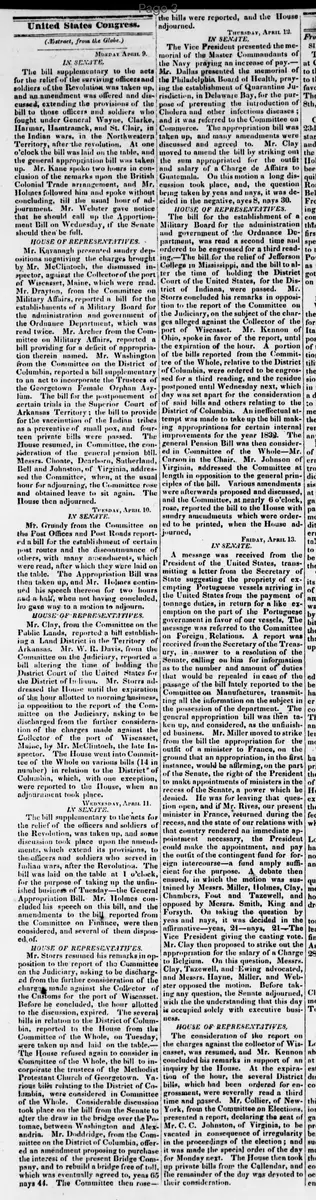
(Extract from the Globe.)
Monday, April 9.
IN SENATE.
The bill supplementary to the acts for the relief of the surviving officers and soldiers of the Revolution was taken up, and an amendment was offered and discussed, extending the provisions of the bill to those officers and soldiers who fought under General Wayne, Clarke, Harmar, Hamtramck, and St. Clair, in the Indian wars, in the Northwestern Territory, after the Revolution. At one o'clock the bill was laid on the table, and the general appropriation bill was taken up. Mr. Kane spoke two hours in conclusion of the remarks upon the British Colonial Trade arrangement, and Mr. Holmes followed him and spoke without concluding, till the usual hour of adjournment. Mr. Webster gave notice that he should call up the Apportionment Bill on Wednesday, if the Senate should then be full.
HOUSE OF REPRESENTATIVES.
Mr. Kavanagh presented sundry depositions negativing the charges brought by Mr. McClintock, the dismissed inspector, against the Collector of the port of Wiscasset, Maine, which were read. Mr. Drayton, from the Committee on Military Affairs, reported a bill for the establishment of a Military Board for the administration and government of the Ordnance Department, which was read twice. Mr. Archer from the Committee on Military Affairs, reported a bill providing for a deficit of appropriation therein named. Mr. Washington from the Committee on the District of Columbia, reported a bill supplementary to an act to incorporate the Trustees of the Georgetown Female Orphan Asylum. The bill for the postponement of certain trials in the Superior Court of Arkansas Territory; the bill to provide for the vaccination of the Indian tribes as a preventive of small pox, and fourteen private bills were passed. The House resumed, in Committee, the consideration of the general pension bill. Messrs. Choate, Dearborn, Sutherland, Bell and Johnston, of Virginia, addressed the Committee, when, at the usual hour for adjourning, the Committee rose and obtained leave to sit again. The House then adjourned.
TUESDAY, APRIL 10.
IN SENATE.
Mr. Grundy from the Committee on the Post Offices and Post Roads reported a bill for the establishment of certain post routes and the discontinuance of others, with many amendments, which were read, after which they were laid on the table. The Appropriation Bill was then taken up, and Mr. Holmes continued his speech thereon for two hours and a half, when not having concluded, he gave way to a motion to adjourn.
HOUSE OF REPRESENTATIVES.
Mr. Clay, from the Committee on the Public Lands, reported a bill establishing a Land District in the Territory of Arkansas. Mr. W. R. Davis, from the Committee on the Judiciary, reported a bill altering the time of holding the District Court of the United States for the District of Indiana. Mr. Storrs addressed the House until the expiration of the hour allotted to morning business, in opposition to the report of the Committee on the Judiciary, asking to be discharged from the further consideration of the charges made against the Collector of the port of Wiscasset, Maine, by Mr. McClintock, the late Inspector. The House went into Committee of the Whole on various bills (14 in number) in relation to the District of Columbia, which, with one exception, were reported to the House, when an adjournment took place.
Wednesday, April 11.
IN SENATE.
The bill supplementary to the acts for the relief of the officers and soldiers of the Revolution, was taken up, and some discussion took place upon the amendments, which extend its provisions to the officers and soldiers who served in Indian wars, after the Revolution. The bill was laid on the table at 1 o'clock, for the purpose of taking up the unfinished business of Tuesday—the General Appropriation Bill. Mr. Holmes concluded his speech on this bill, and the amendments to the bill reported from the Committee on Finance, were then considered, and several of them disposed of.
HOUSE OF REPRESENTATIVES.
Mr. Storrs resumed his remarks in opposition to the report of the Committee on the Judiciary, asking to be discharged from the further consideration of the charges made against the Collector of the Customs for the port of Wiscasset. Before he concluded, the hour allotted to the discussion, expired. The several bills in relation to the District of Columbia, reported to the House from the Committee of the Whole, on Tuesday; were taken up and laid on the table. The House refused again to consider in Committee of the Whole, the bill to incorporate the trustees of the Methodist Protestant Church of Georgetown. Various bills relating to the District of Columbia, were considered in Committee of the Whole. Considerable discussion took place on the bill from the Senate to alter the draw in the bridge over the Potomac, between Washington and Alexandria. Mr. Doddridge, from the Committee on the District of Columbia, offered an amendment proposing to purchase the interest of the present Bridge Company, and to rebuild a bridge free of toll, which was eventually agreed to, yeas 65, nays 44. The Committee then rose—the bills were reported, and the House adjourned.
Thursday, April 12.
IN SENATE.
The Vice President presented the memorial of the Master Commandants of the Navy praying an increase of pay.—Mr. Dallas presented the memorial of the Philadelphia Board of Health, praying the establishment of Quarantine Jurisdiction, in Delaware Bay, for the purpose of preventing the introduction of Cholera and other infectious diseases; and it was referred to the Committee on Commerce. The appropriation bill was taken up, and many amendments were discussed and agreed to. Mr. Clay moved to amend the bill by striking out the sum appropriated for the outfit and salary of a Charge de Affairs to Guatemala. On this motion a long discussion took place, and, the question being taken by yeas and nays, it was decided in the negative, ayes 8, nays 30.
HOUSE OF REPRESENTATIVES.
The bill for the establishment of a Military Board for the administration and government of the Ordnance Department, was read a second time and ordered to be engrossed for a third reading.—The bill for the relief of Jefferson College in Mississippi, and the bill to alter the time of holding the District Court of the United States, for the District of Indiana, were passed. Mr. Storrs concluded his remarks in opposition to the report of the Committee on the Judiciary, on the subject of the charges alleged against the Collector of the port of Wiscasset. Mr. Kennon of Ohio, spoke in favor of the report, until the expiration of the hour. A portion of the bills reported from the Committee of the Whole, relative to the District of Columbia, were ordered to be engrossed for a third reading, and the residue postponed until Wednesday next, which day was set apart for the consideration of said bills and others relating to the District of Columbia. An ineffectual attempt was made to take up the bill making appropriations for certain internal improvements for the year 1832. The general Pension Bill was then considered in Committee of the Whole—Mr. Carson in the Chair. Mr. Johnson of Virginia, addressed the Committee at length in opposition to the general principles of the bill. Various amendments were afterwards proposed and discussed and the Committee, at nearly 6 o'clock, rose, reported the bill to the House with sundry amendments which were ordered to be printed, when the House adjourned.
Friday, April 13.
IN SENATE.
A message was received from the President of the United States, transmitting a letter from the Secretary of State suggesting the propriety of exempting Portuguese vessels arriving in the United States from the payment of tonnage duties, in return for a like exemption on the part of the Portuguese government in favor of our vessels. The message was referred to the Committee on Foreign Relations. A report was received from the Secretary of the Treasury, in answer to a resolution of the Senate, calling on him for information as to the number and amount of duties that would be repealed in case of the passage of the bill lately reported to the Committee on Manufactures, transmitting all the information on the subject in the possession of the department. The general appropriation bill was then taken up, and considered, as the unfinished business. Mr. Miller moved to strike from the bill the appropriation for the outfit of a minister to France, on the ground that an appropriation, in the first instance, would be affirming, on the part of the Senate, the right of the President to make appointments of ministers in the recess of the Senate, a power which he denied. He was for leaving that question open, and if Mr. Rives, our present minister in France, returned during the recess, and the state of our relations with that country rendered an immediate appointment necessary, the President could make the appointment, and pay the outfit out of the contingent fund for foreign intercourse—a fund amply sufficient for the purpose. A debate then ensued, in which the motion was sustained by Messrs. Miller, Holmes, Clay, Chambers, Foot and Tazewell, and opposed by Messrs. Smith, King and Forsyth. On taking the question by yeas and nays, it was decided in the affirmative—yeas, 21—nays, 21—The Vice President giving the casting vote. Mr. Clay then proposed to strike out the appropriation for the salary of a Charge to Belgium. On this question, Messrs. Clay, Tazewell, and Ewing advocated, and Messrs. Hayne, Miller, and Webster opposed the motion. Before taking any question, the Senate adjourned, with the understanding that this day is occupied solely with executive business.
HOUSE OF REPRESENTATIVES.
The consideration of the report on the charges against the collector of Wiscasset, was resumed, and Mr. Kennon concluded his remarks in support of an inquiry by the House. At the expiration of the hour, the several District bills, which had been ordered for engrossment, were severally read a third time and passed. Mr. Collier, of New York, from the Committee on Elections, presented a report, declaring the seat of Mr. C. C. Johnston, of Virginia, to be vacated in consequence of irregularity in the proceedings of the election; and it was made the special order of the day for Monday next. The House then took up private bills from the Calendar, and the remainder of the day was devoted to their consideration.
What sub-type of article is it?
What keywords are associated?
What entities or persons were involved?
Where did it happen?
Domestic News Details
Primary Location
Washington, D.C.
Event Date
April 9 13, 1832
Key Persons
Outcome
various bills passed, amendments discussed and voted on, including pension extensions, appropriations, military boards, and district of columbia matters; some motions defeated.
Event Details
Daily proceedings in the U.S. Senate and House of Representatives, including discussions on bills for revolutionary war pensions extended to Indian wars veterans, general appropriations, military affairs, post routes, land districts, court times, charges against a collector, District of Columbia legislation, memorials on navy pay and quarantine, foreign relations messages, and private bills.