Thank you for visiting SNEWPapers!
Sign up free
The Liberator
Boston, Suffolk County, Massachusetts
What is this article about?
Dr. John Doy and his son Charles, early Kansas settlers and abolitionists, were kidnapped by Missouri border ruffians in 1859, subjected to mob violence in Weston, imprisoned in Platte City jail's iron cell for nearly two months, enduring abuse and threats before rescue.
Merged-components note: Continuation of the narrative about Dr. Doy's experiences in jail, with sequential reading order across pages.
Clippings
1 of 2
OCR Quality
Full Text
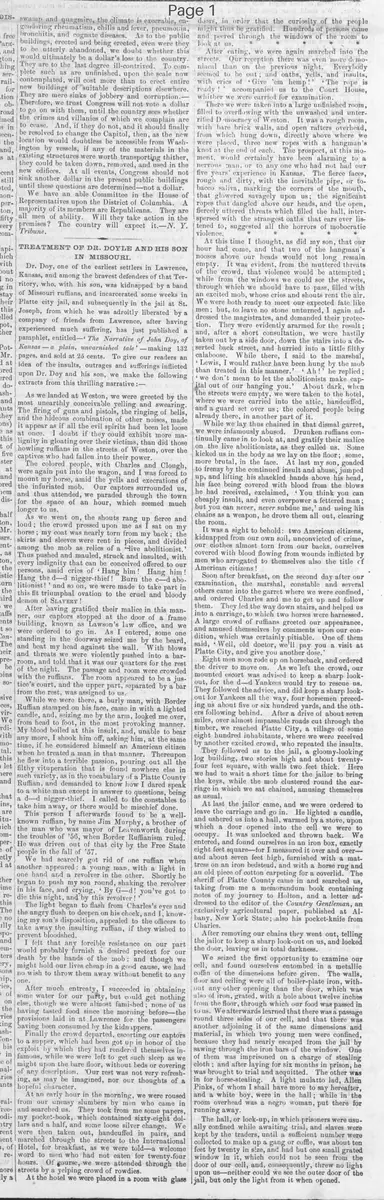
Dr. Doy, one of the earliest settlers in Lawrence, Kansas, and among the bravest defenders of that Territory, who, with his son, was kidnapped by a band of Missouri ruffians, and incarcerated some weeks in Platte city jail, and subsequently in the jail at St. Joseph, from which he was adroitly liberated by a company of friends from Lawrence, after having experienced much suffering, has just published a pamphlet, entitled—' The Narrative of John Doy, of Kansas —a plain, unvarnished tale'—making 132 pages, and sold at 25 cents. To give our readers an idea of the insults, outrages and sufferings inflicted upon Dr. Doy and his son, we make the following extracts from this thrilling narrative:-
As we landed at Weston, we were greeted by the most unearthly conceivable yelling and swearing. The firing of guns and pistols, the ringing of bells, and the hideous combination of other noises, made it appear as if all the evil spirits had been let loose at once. I doubt if they could exhibit more malignity in gloating over their victims, than did those howling ruffians in the streets of Weston, over the captives who had fallen into their power.
The colored people, with Charles and Clough, were again put into the wagon, and I was forced to mount my horse, amid the yells and execrations of the infuriated mob. Our captors surrounded us, and thus attended, we paraded through the town for the space of an hour, which seemed much longer to us.
As we went on, the shouts rang up fierce and loud; the crowd pressed upon me as I sat on my horse; my coat was nearly torn from my back; the skirts and sleeves were rent in pieces, and divided among the mob as relics of a 'die abolitionist.'
Thus pushed and mauled, struck and insulted, with every indignity that can be conceived offered to our persons, amid cries of 'Hang him! Hang him! Hang the d—d nigger-thief! Burn the c—d abolitionist! ' and so on, we were made to take part in this fit triumphal ovation to the cruel and bloody demon of SLAVERY!
After having gratified their malice in this manner, our captors stopped at the door of a frame building, known as Lawson's law office, and we were ordered to go in. As I entered, some one standing in the doorway seized me by the beard, and beat my head against the wall. With blows and threats we were violently pushed into a bar-room, and told that it was our quarters for the rest of the night. The passage and room were crowded with the ruffians. The room appeared to be a justice's court, and the upper part, separated by a bar from the rest, was assigned to us.
While we were there, a burly man, with Border Ruffian stamped on his face, came in with a lighted candle, and, seizing me by the arm, looked me over, from head to foot, in the most provoking manner. My blood boiled at this insult, and, unable to bear any more, I shook him off, asking him, at the same time, if he considered himself an American citizen when he treated a man in that manner. Thereupon he flew into a terrible passion, pouring out all the filthy vituperation that is found nowhere else in such variety, as in the vocabulary of a Platte County Ruffian, and demanded to know how I dared speak to a white man except in answer to questions, being a d—d nigger-thief. I called to the constables to take him away, or there would be mischief done.
This person I afterwards found to be a well-known ruffian, by name Jim Murphy, a brother of the man who was mayor of Leavenworth during the troubles of '56, when Border Ruffianism ruled. He was driven out of that city by the Free State people in the fall of '57.
We had scarcely got rid of one ruffian when another appeared: a young man, with a light in one hand and a revolver in the other. Shortly he began to push my son round, shaking the revolver in his face, and crying, 'By G—d! you've got to die this night, and by this revolver!'
The light began to flash from Charles's eyes and the angry flush to deepen on his cheek, and I, knowing my son's disposition, appealed to the officers to take away the insulting ruffian, if they wished to prevent bloodshed.
I felt that any forcible resistance on our part would probably furnish a desired pretext for our death by the hands of the mob; and though we might hold our lives cheap in a good cause, we had no wish to throw them away without benefit to any one.
After much entreaty, I succeeded in obtaining some water for our party, but could get nothing else, though we were almost famished; none of us having tasted food since the morning before—the provisions laid in at Lawrence for the passengers having been consumed by the kidnappers.
Finally the crowd departed, escorting our captors to a supper, which had been got up in honor of the exploit by which they had rendered themselves infamous, while we were left to get such sleep as we might upon the bare floor, without beds or covering of any description. Our rest was not very refreshing, as may be imagined, nor our thoughts of a hopeful character.
At an early hour in the morning, we were roused from our uneasy slumbers by men who came in and searched us. They took from me some papers, my pocket-book, which contained sixty-eight dollars and a half, and some loose silver change. We were then taken out, handcuffed in pairs, and marched through the streets to the International Hotel, for breakfast, as we were told—a welcome word to men who had not eaten for twenty-four hours. Of course, we were attended through the streets by a yelping crowd of rowdies.
At the hotel we were placed in a room with glass doors, in order that the curiosity of the people might thus be gratified. Hundreds of persons came and peered through the windows of the room to look at us.
After eating. we were again marched into the streets. Our reception there was even more demoniacal than on the previous night. Everybody seemed to be out: and oaths, yells, and insults, with cries of 'Give 'em hemp!' The rope is ready !' accompanied us to the Court House, whither we were carried for examination.
There we were taken into a large unfinished room, filled to overflowing with the unwashed and unterrified Democracy of Weston. It was a rough room, with bare brick walls, and open rafters overhead, from which hung down, directly above where we were placed, three new ropes with a hangman's knot at the end of each. The prospect, at this moment, would certainly have been alarming to a nervous man, or to any one who had not had our five years' experience in Kansas. The fierce faces, rough and dirty, with the inevitable pipe, or tobacco saliva, marking the corners of the mouth, that glowered savagely upon us; the significant ropes that dangled above our heads, and the open, fiercely uttered threats which filled the hall, interspersed with the strangest oaths that ears ever listened to, suggested all the horrors of mobocratic violence.
At this time I thought, as did my son, that our hour had come, and that two of the hangman's nooses above our heads would not long remain empty. It was evident, from the muttered threats of the crowd, that violence would be attempted; while from the windows we could see the streets, through which we should have to pass, filled with an excited mob, whose cries and shouts rent the air.
We were both ready to meet our expected fate like men; but, to leave no stone unturned, I again addressed the magistrates, and demanded their protection. They were evidently alarmed for the result; and, after a short consultation, we were hastily taken out by a side door, down the stairs into a deserted back street, and hurried into a little filthy calaboose. While there, I said to the marshal, 'Lewis, I would rather have been hung by the mob than treated in this manner.' 'Ah!' he replied; 'we don't mean to let the abolitionists make capital out of our hanging you.' About dark, when the streets were empty, we were taken to the hotel, where we were carried into the attic, handcuffed, and a guard set over us; the colored people being already there, in another part of it.
While we lay thus chained in that dismal garret, we were infamously abused. Drunken ruffians continually came in to look at, and gratify their malice on the live abolitionists, as they called us. Some kicked us in the body as we lay on the floor; some, more brutal, in the face. At last my son, goaded to frenzy by the continued insult and abuse, jumped up, and lifting his shackled hands above his head, his face being covered with blood from the blows he had received, exclaimed, 'You think you can cheaply insult, and even overpower a fettered man; but you can never, never subdue me,' and using his chains as a weapon, he drove them all out, clearing the room.
It was a sight to behold: two American citizens, kidnapped from our own soil, unconvicted of crime, our clothes almost torn from our backs, ourselves covered with blood flowing from wounds inflicted by men who arrogated to themselves also the title of American citizens!
Soon after breakfast, on the second day after our examination, the marshal, constable and several others came into the garret where we were confined, and ordered Charles and me to get up and follow them. They led the way down stairs, and helped us into a carriage, to which two horses were harnessed. A large crowd of ruffians greeted our appearance, and amused themselves by comments upon our condition, which was certainly pitiable. One of them said, 'Well, old doctor, we'll pay you a visit at Platte City, and give you another dose.'
Eight men soon rode up on horseback, and ordered the driver to move on. As we left the crowd, our mounted escort was advised to keep a sharp look-out, for the d—d Yankees would try to rescue us. They followed the advice, and did keep a sharp look-out for Yankees all the way, four horsemen preceding us about five or six hundred yards, and the others following behind. After a drive of about seven miles, over almost impassable roads cut through the timber, we reached Platte City, a village of some eight hundred inhabitants, where we were received by another excited crowd, who repeated the insults. They followed us to the jail, a gloomy-looking log building, two stories high and about twenty-four feet square, with walls two feet thick. Here we had to wait a short time for the jailor to bring the keys, while the mob clustered round the carriage in which we sat chained, amusing themselves as usual.
At last the jailor came, and we were ordered to leave the carriage and go in. He lighted a candle, and ushered us into a hall, warmed by a stove, upon which a door opened into the cell we were to occupy. It was unlocked and thrown back. We entered, and found ourselves in an iron box, exactly eight feet square—for I measured it over and over—and about seven feet high, furnished with a mattress on an iron bedstead, and with a horse rug and an old piece of cotton carpeting for a coverlid. The sheriff of Platte County came in and searched us, taking from me a memorandum book containing notes of my journey to Holton, and a letter addressed to the editor of the Country Gentleman, an exclusively agricultural paper, published at Albany, New York State; also his pocket-knife from Charles.
After removing our chains they went out, telling the jailor to keep a sharp look-out on us, and locked the door, leaving us in total darkness.
We seized the first opportunity to examine our cell, and found ourselves entombed in a metallic coffin of the dimensions before given. The walls, floor and ceiling were all of boiler-plate iron, without any other opening than the door, which was also of iron, grated, with a hole about twelve inches from the floor, through which our food was passed in to us. We afterwards learned that there was a passage round three sides of our cell, and that there was another adjoining it of the same dimensions and material, in which two young men were confined, because they had nearly escaped from the jail by sawing through the iron bars of the window. One of them was imprisoned on a charge of stealing cloth : and after laying for six months in prison, he was brought to trial and acquitted. The other was in for horse-stealing. A light mulatto lad, Allen Pinks, of whom I shall have more to say hereafter, and a white boy, were in the hall; while in the room overhead was a negro woman, put there for running away.
The hall, or lock-up, in which prisoners were usually confined while awaiting trial, and slaves were kept by the traders, until a sufficient number were collected to make up a gang or coffle, was about ten feet by twenty in size, and had but one small grated window in it, which could not be seen from the door of our cell, and, consequently, threw no light upon us—neither could we see the outer door of the jail, but only the light from it when opened.
Some days after we were thus immured, when the jailor's son brought us our dinner, we saved the fat of the meat, and put it into a tin plate; then we manufactured a wick by unraveling some of the threads of our cotton coverlid, and getting some matches from the slaves confined in the hall, lighted our improvised lamp; and this was the only light we had until my wife brought us some candles.
We entered Platte County jail on the 28th January, 1859, and remained inclosed in the iron coffin I have described until the 24th March. That cell we were not allowed to leave until called before the Grand Jury a few days before our departure.
There was no other furniture than that mentioned, except an iron bucket with a broken lid—which often remained unemptied for weeks—and a Bible which it would almost seem, was put there in mockery. We were thrust in as we came from the hands of the Weston mob. For more than a week we had not enough water to drink, and none to wash with, but were compelled to remove the blood from our faces by rubbing them with the old horse-rug, moistened with spittle. No clothes were furnished to us, nor did we get a change until my wife, after the lapse of three weeks, found out where we were, and brought some to us. Our condition may be better imagined than described.
About eight o'clock every evening, a guard of two men came, and remained in the hall through the night. The jailor came in occasionally. During the first week of our imprisonment, there was a regular camp of some three hundred Border Ruffians round the jail. They were armed with muskets and rifles, and had a brass cannon planted in front of the door. The first night they fired the cannon in triumph at our arrival, and, as the jailor informed us, broke every window in the Court House.
A description of that night will answer for every other. We could hear them all night shouting, yelling, screeching, firing guns, and threatening the Yankees, Jim Lane and the Kansas abolitionists, with the direst vengeance. All this preparation was to meet and prevent the rescue which it was supposed John Brown and Jim Lane would attempt. Fifty determined Kansas men would have sent them all running.
Shortly after our imprisonment, a public meeting was held in the town, at which highly inflammatory resolutions respecting us were passed, and the people talked of hanging and burning the 'd-d abolitionists then in prison for stealing niggers.'
Late that evening, some one came to the jail, and shouted to the prisoner in the cell adjoining ours, to 'tell the old Doctor and his son to get ready and say their prayers, for twenty-five men have voted in the meeting to come down, take them out and hang them, and they'll be here soon.' Soon after, another person came to the jail, and in a loud voice called to me and communicated the same information.
We resolved to be prepared to meet the ruffians, and to sell our lives as dearly as possible. So we called to our fellow-prisoners in the hall to pass us some sticks of fire-wood through the hole in our door, which they did, after cutting them to the right length for clubs, and smoothing one end for a handle. With means and light which they also furnished, we wrote a note to the family, informing them of our situation and probable fate, and bidding them farewell. This was sent to a prisoner in the other cell, who expected to be out in a few days, and he promised to mail it for Lawrence at the first opportunity. We then barricaded our door with the iron bedstead, so that it could be only partially opened, and stood till dawn in readiness to meet the expected hangmen; but no one appeared to molest us.
This soul-quickening narrative may be obtained at the Anti-Slavery Office, 21 Cornhill, and at Bela Marsh's, 14 Bromfield street, Boston. As Dr. Doy lost everything at the hands of the Border Ruffians in Kansas, we hope it will be readily purchased that he and his family may derive some pecuniary benefit from it.
What sub-type of article is it?
What themes does it cover?
What keywords are associated?
What entities or persons were involved?
Where did it happen?
Story Details
Key Persons
Location
Weston And Platte City, Missouri
Event Date
28th January 1859 To 24th March 1859
Story Details
Dr. Doy and son Charles, kidnapped from Kansas for aiding fugitive slaves, endure mob violence, threats of lynching, and harsh imprisonment in an iron cell in Platte City jail amid border conflicts.