Thank you for visiting SNEWPapers!
Sign up free
Southern Christian Advocate
Charleston, Charleston County, South Carolina
What is this article about?
The General Conference of the Methodist Episcopal Church South convened in New Orleans on April 4, 1866. Bishop Andrew presided, delegates from multiple conferences answered roll call, Dr. Summers was elected secretary, committees were appointed, and resolutions on church unity and other matters were debated and partially withdrawn. A message from Bishop Soule was read and sympathetically received.
Clipping
OCR Quality
Full Text
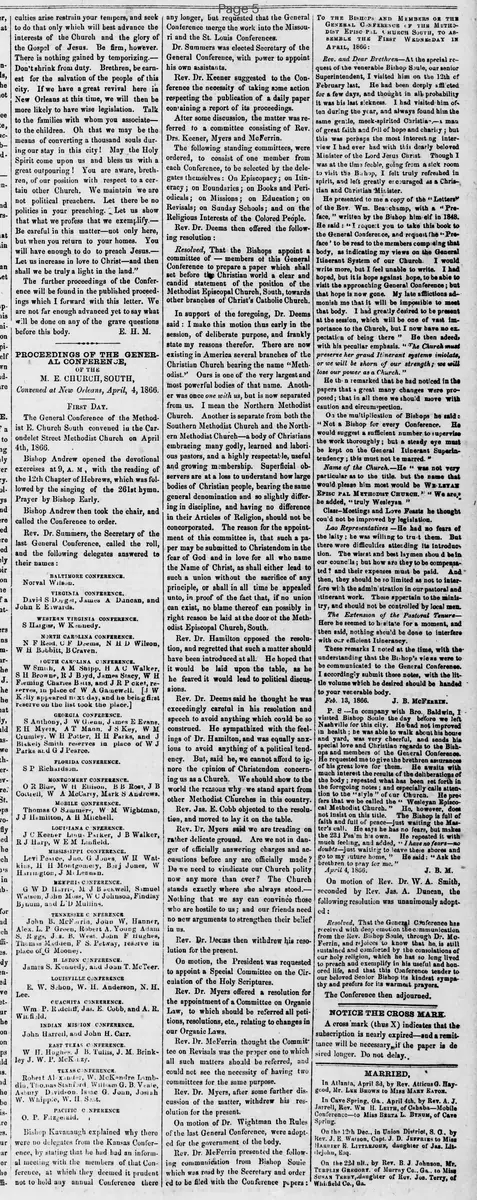
Convened at New Orleans, April 4, 1866.
FIRST DAY.
The General Conference of the Methodist E. Church South convened in the Carondelet Street Methodist Church on April 4th, 1866.
Bishop Andrew opened the devotional exercises at 9, A. M., with the reading of the 12th Chapter of Hebrews, which was followed by the singing of the 261st hymn. Prayer by Bishop Early.
Bishop Andrew then took the chair, and called the Conference to order.
Rev. Dr. Summers, the Secretary of the last General Conference, called the roll, and the following delegates answered to their names:
BALTIMORE CONFERENCE.
Norval Wilson.
VIRGINIA CONFERENCE.
David S. Doggett, James A. Duncan, and John E. Edwards.
WESTERN VIRGINIA CONFERENCE.
S. Haigiss, W. Kennedy.
NORTH CAROLINA CONFERENCE.
N. F. Reid, C. F. Deems, N. H. D. Wilson, W. H. Bobbitt, B. Craven.
SOUTH CAROLINA CONFERENCE.
W. Smith, A. M. Shipp, H. A. C. Walker, S. H. Browne, R. J. Boyd, James Stacy, W. H. Fleming, Charles Betts, and J. R. Pickett, reserves, in place of W. A. Gamewell. J. W. Kelly appeared next day, and he being first reserve on the list took the place.
GEORGIA CONFERENCE.
S. Anthony, J. W. Glenn, James E. Evans, E. H. Myers, A. T. Mann, J. S. Key, W. M. Crumley, W. H. Potter, H. H. Parks, and J. Blakely. Smith reserves in place of W. J. Parks and G. J. Pearce.
FLORIDA CONFERENCE.
S. P. Richardson.
MONTGOMERY CONFERENCE.
O. R. Blue, W. H. Elison, B. B. Ross, J. B. Cottrell, W. A. McCarty, Mark S. Andrews.
MOBILE CONFERENCE.
Thomas O. Summers, W. M. Wightman, J. J. Hamilton, A. H. Mitchell.
LOUISIANA CONFERENCE.
J. C. Keener, Linn Parker, J. B. Walker, R. J. Harp, W. E. M. Linfield.
MISSISSIPPI CONFERENCE.
Levi Pearce, Jno. G. Jones, W. H. Watkins, H. H. Montgomery, B. F. Jones, W. Harrington, J. M. Lennan.
MEMPHIS CONFERENCE.
G. W. D. Harris, M. J. Blackwell, Samuel Watson, John Moss, W. C. Johnson, Findlay Bynum, and L. D. Mullins.
TENNESSEE CONFERENCE.
John B. McFerrin, John W. Haney, Alex. L. P. Green, Robert A. Young, Adam S. Riggs, J. S. B. West, John F. Hughes, Thomas Madden, F. S. Petway, reserve in place of G. Mooney.
HOLSTON CONFERENCE.
James S. Kennedy, and John T. McTeer.
LOUISVILLE CONFERENCE.
E. W. Sehon, W. H. Anderson, N. H. Lee.
CHATTANOOGA CONFERENCE.
Wm. P. Richardson, Jas. E. Cobb, and A. R. Wilfield.
INDIAN MISSION CONFERENCE.
John Harrell, and John H. Carr.
EAST TEXAS CONFERENCE.
W. H. Hughes, J. B. Tullis, J. M. Brinkley, J. W. P. McKenzie.
TEXAS CONFERENCE.
Robert Alexander, W. McKendree Lambdin, Thomas Stanford, William G. B. Veale, Asbury Davidson, Isaac G. John, Josiah W. Whipple, W. H. Sexton.
PACIFIC CONFERENCE.
O. P. Fitzgerald.
Bishop Kavanaugh explained why there were no delegates from the Kansas Conference, by stating that he had had an informal meeting with the members of that Conference, at which they deemed it prudent not to hold any annual Conference there any longer, but requested that the General Conference merge the work into the Missouri and the St. Louis Conferences.
Dr. Summers was elected Secretary of the General Conference, with power to appoint his own assistants.
Rev. Dr. Keener suggested to the Conference the necessity of taking some action respecting the publication of a daily paper containing a report of its proceedings. After some discussion, the matter was referred to a committee consisting of Rev. Drs. Keener, Myers and McFerrin.
The following standing committees were ordered, to consist of one member from each Conference, to be selected by the delegates themselves: On Episcopacy; on Itineracy; on Boundaries; on Books and Periodicals; on Missions; on Education; on Revisals; on Sunday Schools; and on the Religious Interests of the Colored People.
Rev. Dr. Deems then offered the following resolution:
Resolved, That the Bishops appoint a committee of — members of this General Conference to prepare a paper which shall set before the Christian world a clear and candid statement of the position of the Methodist Episcopal Church, South, towards other branches of Christ's Catholic Church.
In support of the foregoing, Dr. Deems said: I make this motion thus early in the session, of deliberate purpose, and frankly state my reasons therefor. There are now existing in America several branches of the Christian Church bearing the name "Methodist." Ours is one of the very largest and most powerful bodies of that name. Another was once one with us, but is now separated from us. I mean the Northern Methodist Church. Another is separate from both the Southern Methodist Church and the Northern Methodist Church—a body of Christians embracing many godly, learned and laborious pastors, and a highly respectable, useful and growing membership. Superficial observers are at a loss to understand how large bodies of Christian people, bearing the same general denomination and so slightly differing in discipline, and having no difference in their Articles of Religion, should not be incorporated. The reason for the appointment of this committee is, that such a paper may be submitted to Christendom in the fear of God and in love for all who name the Name of Christ, as shall either lead to such a union without the sacrifice of any principle, or shall in all time be appealed unto, in proof of the fact that, if no union can exist, no blame thereof can possibly in right reason be laid at the door of the Methodist Episcopal Church, South.
Rev. Dr. Hamilton opposed the resolution, and regretted that such a matter should have been introduced at all. He hoped that it would be laid upon the table, as he feared it would lead to political discussions.
Rev. Dr. Deems said he thought he was exceedingly careful in his resolution and speech to avoid anything which could be so construed. He sympathized with the feelings of Dr. Hamilton, and was equally anxious to avoid anything of a political tendency. But, said he, we cannot afford to ignore the opinion of Christendom concerning us as a Church. We should show to the world the reasons why we stand apart from other Methodist Churches in this country.
Rev. Jas. E. Cobb objected to the resolution, and moved to lay it on the table.
Rev. Dr. Myers said we are treading on rather delicate ground. Are we not in danger of officially answering charges and accusations before any are officially made? Do we need to vindicate our Church polity now any more than ever? The Church stands exactly where she always stood.—Nothing that we say can convince those who are hostile to us; and our friends need no new arguments to strengthen their belief in us.
Rev. Dr. Deems then withdrew his resolution for the present.
On motion, the President was requested to appoint a Special Committee on the Circulation of the Holy Scriptures.
Rev. Dr. Myers offered a resolution for the appointment of a Committee on Organic Law, to which should be referred all petitions, resolutions, etc., relating to changes in our Organic Laws.
Rev. Dr. McFerrin thought the Committee on Revisals was the proper one to which all such matters should be referred, and could not see the necessity of having two committees for the same purpose.
Rev. Dr. Myers, after some further discussion of the matter, withdrew his resolution for the present.
On motion of Dr. Wightman the Rules of the last General Conference were adopted for the government of the body.
Rev. Dr. McFerrin presented the following communication from Bishop Soule which was read by the Secretary and ordered to be filed with the Conference papers:
TO THE BISHOPS AND MEMBERS OF THE GENERAL CONFERENCE OF THE METHODIST EPISCOPAL CHURCH SOUTH, TO ASSEMBLE THE FIRST WEDNESDAY IN APRIL, 1866:
Rev. and Dear Brethren—At the special request of the venerable Bishop Soule, our senior Superintendent, I visited him on the 12th of February last. He had been deeply afflicted for a few days, and thought in all probability it was his last sickness. I had visited him often during the year, and always found him the same gentle, meek-spirited Christian man of great faith and full of hope and charity; but this was perhaps the most interesting interview I had ever had with this dearly beloved Minister of the Lord Jesus Christ. Though I was at the time feeble, going from a sick room to visit the Bishop, I felt truly refreshed in spirit, and left greatly encouraged as a Christian and Christian Minister.
He presented to me a copy of the "Letters of the Rev. Wm. Beauchamp, with a "Preface," written by the Bishop himself in 1848. He said: "I request you to take this book to the General Conference, and request the "Preface" to be read to the members composing that body, as indicating my views on the General Itinerant System of our Church. I would write more, but I feel unable to write. I had hoped, but it is hope against hope, to be able to visit the approaching General Conference; but that hope is now gone. My late afflictions admonish me that it will be impossible to meet that body. I had greatly desired to be present at the session, which will be one of vast importance to the Church, but I now have no expectation of being there." He then added, with his peculiar emphasis, "The Church must preserve her grand Itinerant system inviolate, or we will be shorn of our strength: we will lose our power as a Church."
He then remarked that he had noticed in the papers that great many changes were proposed; that in all these we should move with caution and circumspection.
On the multiplication of Bishops he said: "Not a Bishop for every Conference. He would suggest a sufficient number to supervise the work thoroughly; but a steady eye must be kept on the General Itinerant Superintendency; this must not be marred."
Name of the Church.—He "was not very particular as to the title, but the name that would please him most would be Wesleyan Episcopal Methodist Church." "We are," he added, "truly Wesleyan."
Class-Meetings and Love Feasts he thought could not be improved by legislation.
Lay Representatives—He had no fears of the laity; he was willing to trust them. But there were difficulties attending its introduction. The wisest and best laymen should be in our councils; but how are they to be compensated? and their expenses must be paid. And then, they should be so limited as not to interfere with the administration in our pastoral and itinerant work. These appertain to the ministry, and should not be controlled by local men.
The Extension of the Pastoral Tenure—Here he seemed to hesitate for a moment, and then said, nothing should be done to interfere with our efficient Itinerancy.
These remarks I noted at the time, with the understanding that the Bishop's views were to be communicated to the General Conference. I accordingly submit these notes, with the little volume which he desired should be handed to your venerable body.
Feb. 13, 1866.
J. B. McFERRIN.
P. S.—In company with Bro. Baldwin, I visited Bishop Soule the day before we left Nashville for this city. He had not improved in health; he was able to walk about his house and yard, was very cheerful, and sends his special love and Christian regards to the Bishops and members of the General Conference. He requested me to give the brethren assurances of his great love for them. He awaits with much interest the results of the deliberations of the body; repeated what has been set forth in the foregoing notes; and especially calls attention to the "style" of our Church. He prefers that we be called the "Wesleyan Episcopal Methodist Church." He, however, does not insist on this title. The Bishop is full of faith and full of peace—just waiting the Master's call. He says he has no fears, but makes the 23d Psalm his own. He repeated it with much feeling, and added, "I have no fears—no doubts—just waiting to leave these shores and go to my future home."
He said: "Ask the brethren to pray for me."
April 4, 1866.
J. B. M.
On motion of Rev. Dr. W. A. Smith, seconded by Rev. Jas. A. Duncan, the following resolution was unanimously adopted:
Resolved, That the General Conference has received with deep emotion the communication from the Rev. Bishop Soule, through Dr. McFerrin, and rejoices to know that he is still sustained and comforted by the consolations of our holy religion, which he has so long lived to preach and exemplify in his useful and honored life, and that this Conference tender to our beloved Senior Bishop its kindest sympathy and prefers for its warmest prayers.
The Conference then adjourned.
What sub-type of article is it?
What keywords are associated?
What entities or persons were involved?
Where did it happen?
Domestic News Details
Primary Location
New Orleans
Event Date
April 4, 1866
Key Persons
Outcome
dr. summers elected secretary; committees appointed on various topics; resolutions on church unity, daily paper, holy scriptures circulation, and organic law debated and some withdrawn; message from bishop soule received with sympathy; rules from last conference adopted; conference adjourned.
Event Details
The General Conference convened at Carondelet Street Methodist Church. Devotional exercises led by Bishop Andrew, roll call of delegates from multiple conferences, explanation for no Kansas delegates, election of secretary, suggestion for daily paper referred to committee, standing committees ordered, resolution by Dr. Deems on church position toward other branches debated and withdrawn, special committee on Holy Scriptures requested, resolution on Organic Law withdrawn, rules adopted, communication from Bishop Soule presented and resolution of sympathy passed.