Thank you for visiting SNEWPapers!
Sign up free
Lynchburg Virginian
Lynchburg, Virginia
What is this article about?
A correspondent from Charleston, SC, in November 1844 reports on the Democratic victory of James K. Polk over Whig Henry Clay in the US presidential election. Southerners celebrate it as a triumph for Southern rights, free trade, and annexation of Texas, with speeches by Elmore and Pickens. The writer, a Whig, laments the loss but praises Clay's character.
Clipping
OCR Quality
Full Text
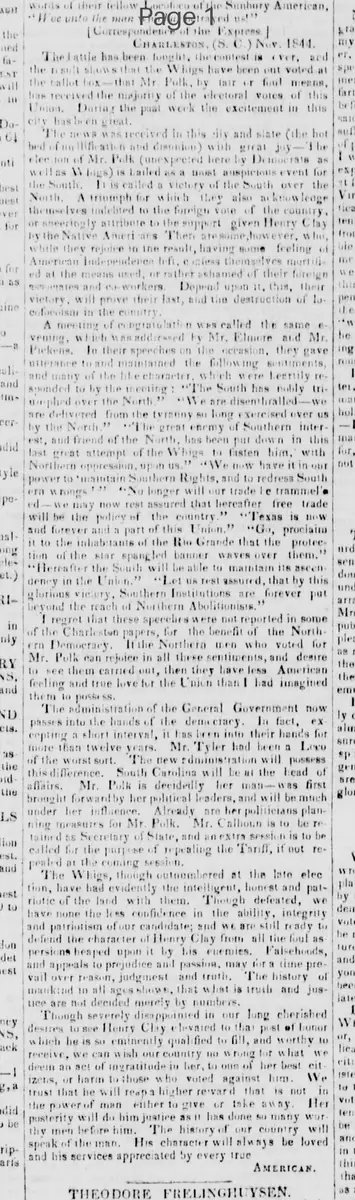
CHARLESTON, (S.C.) NOV. 1844.
The battle has been fought, the contest is over, and the result shows that the Whigs have been outvoted at the ballot boxes—that Mr. Polk, by fair or foul means, has received the majority of the electoral votes of this Union. During the past week the excitement in this city has been great.
The news was received in this city and state (the hot bed of Nullification) with great joy—The election of Mr. Polk (unrestricted here by Democrats as well as Whigs) is hailed as a most auspicious event for the South. It is called a victory of the South over the North. A triumph for which—they also acknowledge themselves to be indebted to the foreign vote of the country, or sneeringly attribute to the support given Henry Clay by the Native Americans. Their truer ones, however, who, while they rejoice in the result, having some feeling of American Independence left, evince themselves mortified at the means used, or rather ashamed of their foreign allies and co-workers. Depend upon it, this, their victory, will prove their last, and the destruction of locofocoism in the country.
A meeting for congratulation was called the same evening, which was addressed by Mr. Elmore and Mr. Pickens. In their speeches on the occasion, they gave utterance to and explained the following sentiments, and unity of like character, which were firmly responded to by the meeting: "The South has nobly triumphed over the North" "We are disenthralled—we are delivered from the tyranny so long exercised over us by the North" …The great enemy of Southern interests, and friend of the North, has been put down in this last great attempt of the Whigs to fasten him, with Northern oppression, upon us." "we now have it in our power to 'maintain Southern Rights, and to redress Southern wrongs'" "No longer will our trade be trammeled—we may now rest assured that hereafter free trade will be the policy of the country." "Texas is now and forever a part of this Union." "Go, proclaim it to the inhabitants of the Rio Grande that the protection of the star spangled banner waves over them." "Hereafter the South will be able to maintain its ascendency in the Union." "Let us rest assured, that by this glorious victory, Southern Institutions are forever put beyond the reach of Northern Abolitionists."
I regret that these speeches were not reported in some of the Charleston papers, for the benefit of the Northern Democracy. If the Northern men who voted for Mr. Polk can rejoice in all these sentiments, and desire to see them carried out, then they have less American feeling and true love for the Union than I had imagined them to possess.
The administration of the General Government now passes into the hands of the democracy. In fact, excepting a short interval, it has been into their hands for more than twelve years. Mr. Tyler had been a Loco of the worst sort. The new administration will possess this difference. South Carolina will be at the head of affairs. Mr. Polk is decidedly her man—was first brought forward by her political leaders, and will be much under her influence. Already are her politicians planning measures for Mr. Polk. "Mr. Calhoun is to be retained as Secretary of State, and an extra session is to be called for the purpose of repealing the Tariff, if not repealed at the coming session."
The Whigs, though outnumbered at the late election, have had evidently the intelligent, honest and patriotic of the land with them. Though defeated, we have none the less confidence in the ability, integrity and patriotism of our candidate; and we are still ready to defend the character of Henry Clay from all the foul aspersions heaped upon it by his enemies. Falsehoods, and appeals to prejudice and passion, may for a time prevail over reason, judgment and truth. The history of mankind in all ages shows, that what is truth and justice are not decided merely by numbers.
Though severely disappointed in our long cherished desires to see Henry Clay elevated to that post of honor which he is so eminently qualified to fill, and worthy to receive, we can wish our country no wrong for what we deem an act of ingratitude in her, to one of her best citizens, or harm to those who voted against him. We trust that he will reap a higher reward that is not in the power of man either to give or take away. Her posterity will do him justice as it has done so many worthy men before him. The history of our country will speak of the man. His character will always be loved and his services appreciated by every true AMERICAN.
What sub-type of article is it?
What themes does it cover?
What keywords are associated?
What entities or persons were involved?
Where did it happen?
Story Details
Key Persons
Location
Charleston, S.C.
Event Date
Nov. 1844
Story Details
Whig correspondent reports Democratic victory of Polk over Clay, celebrated in Charleston as Southern triumph over Northern tyranny, with speeches proclaiming free trade, Texas annexation, and protection of Southern institutions; writer laments loss but upholds Clay's honor.