Thank you for visiting SNEWPapers!
Sign up free
The Virginia Gazette
Richmond, Williamsburg, Richmond County, Virginia
What is this article about?
London report from April 25, 1775, details British Administration's receipt of General Gage's March 18 advices from Boston: orders to apprehend colonial leaders like Adams and Hancock for trial in England, but harsher execution orders not yet received; Gage fears fatal clash with 15,000 trained Massachusetts militia blocking roads; hopes for order reversal and reinforcement; notes rising colonial resistance at Salem and Administration's regrets over harsh measures.
Clipping
OCR Quality
Full Text
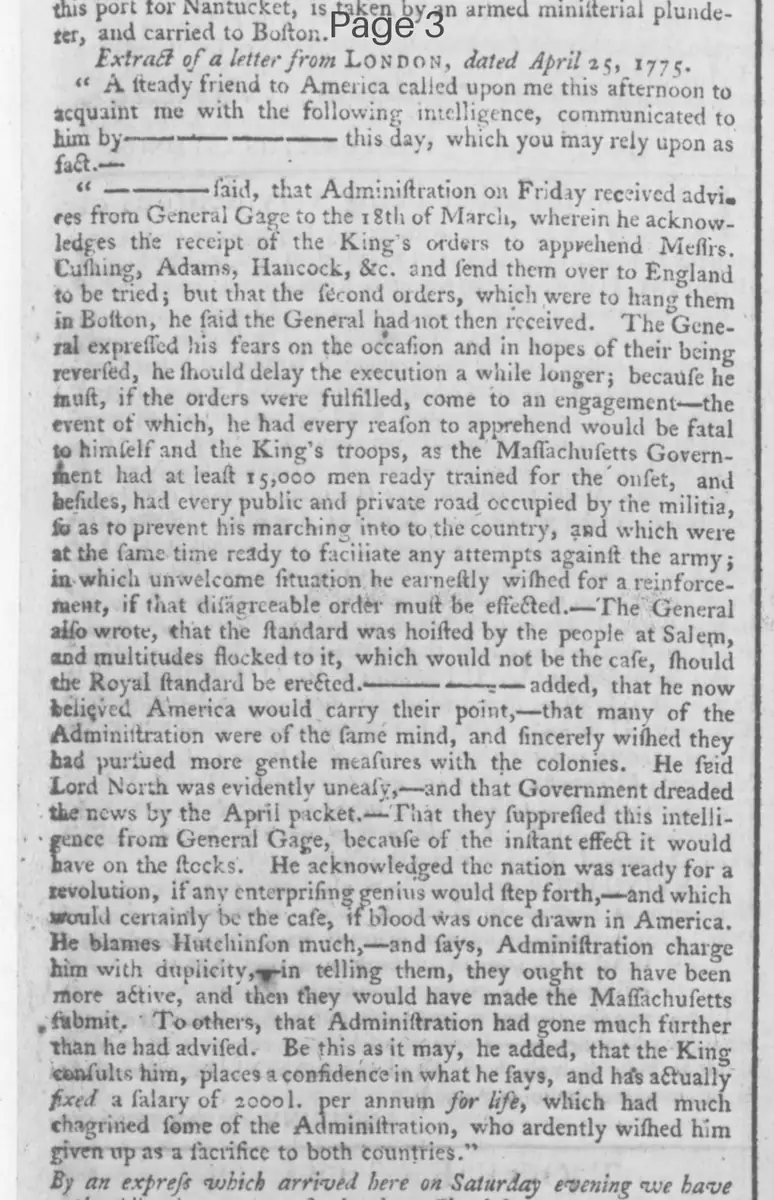
"A steady friend to America called upon me this afternoon to acquaint me with the following intelligence, communicated to him by [66] this day, which you may rely upon as fact. - He said, that Administration on Friday received advices from General Gage to the 18th of March, wherein he acknowledges the receipt of the King's orders to apprehend Mess. Cushing, Adams, Hancock, &c. and send them over to England to be tried; but that the second orders, which were to hang them in Boston, he said the General had not then received. The General expressed his fears on the occasion and in hopes of their being reversed, he should delay the execution a while longer; because he must, if the orders were fulfilled, come to an engagement—the event of which, he had every reason to apprehend would be fatal to himself and the King's troops, as the Massachusetts Government had at least 15,000 men ready trained for the onset, and besides, had every public and private road occupied by the militia, so as to prevent his marching into the country, and which were at the same time ready to facilitate any attempts against the army; in which unwelcome situation he earnestly wished for a reinforcement, if that disagreeable order must be effected. The General also wrote, that the standard was hoisted by the people at Salem, and multitudes flocked to it, which would not be the case, should the Royal standard be erected. - He added, that he now believed America would carry their point,—that many of the Administration were of the same mind, and sincerely wished they had pursued more gentle measures with the colonies. He said Lord North was evidently uneasy,—and that Government dreaded the news by the April packet.—That they suppressed this intelligence from General Gage, because of the instant effect it would have on the stocks. He acknowledged the nation was ready for a revolution, if any enterprising genius would step forth,—and which would certainly be the case, if blood was once drawn in America. He blames Hutchinson much,—and says, Administration charge him with duplicity, in telling them, they ought to have been more active, and then they would have made the Massachusetts submit. To others, that Administration had gone much further than he had advised. Be this as it may, he added, that the King consults him, places a confidence in what he says, and has actually fixed a salary of £2000. per annum for life, which had much chagrined some of the Administration, who ardently wished him given up as a sacrifice to both countries."
What sub-type of article is it?
What keywords are associated?
What entities or persons were involved?
Where did it happen?
Foreign News Details
Primary Location
Massachusetts
Event Date
As Of March 18, 1775
Key Persons
Outcome
no engagement yet; gage delays execution of orders fearing fatal outcome for british troops against 15,000 massachusetts militia; potential revolution if blood drawn
Event Details
Administration received Gage's advices acknowledging orders to apprehend and try colonial leaders in England, but not harsher hanging orders; Gage fears clash with trained militia occupying roads, requests reinforcement, notes colonial standard at Salem drawing crowds; informant believes America will succeed, regrets harsh measures, notes national readiness for revolution and Hutchinson's blamed duplicity