Thank you for visiting SNEWPapers!
Sign up free
Editorial
February 7, 1832
Richmond Enquirer
Richmond, Richmond County, Virginia
What is this article about?
This editorial condemns the U.S. Senate's rejection of Martin Van Buren's nomination as Minister, portraying it as driven by partisan strife and personal vengeance, particularly by Senator Henry Clay, whose speech is criticized for lacking substantive objections and revealing malicious motives.
Clipping
OCR Quality
95%
Excellent
Full Text
FOR THE ENQUIRER.
MR. VAN BUREN'S REJECTION.
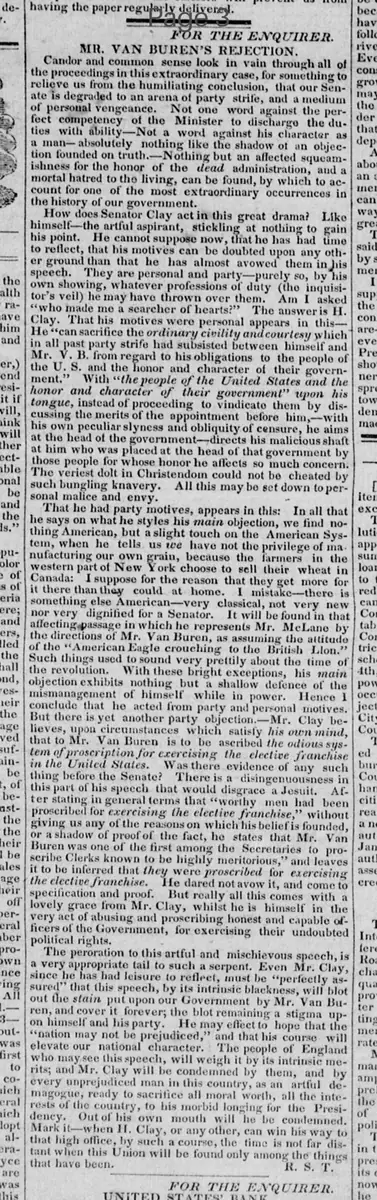
Candor and common sense look in vain through all of the proceedings in this extraordinary case, for something to relieve us from the humiliating conclusion, that our Senate is degraded to an arena of party strife, and a medium of personal vengeance. Not one word against the perfect competency of the Minister to discharge the duties with ability-Not a word against his character as a man—absolutely nothing like the shadow of an objection founded on truth.-Nothing but an affected squeamishness for the honor of the dead administration, and a mortal hatred to the living, can be found, by which to account for one of the most extraordinary occurrences in the history of our government.
How does Senator Clay act in this great drama? Like himself the artful aspirant, stickling at nothing to gain his point. He cannot suppose now, that he has had time to reflect, that his motives can be doubted upon any other ground than that he has almost avowed them in his speech. They are personal and party-purely so, by his own showing, whatever professions of duty (the inquisitor's veil) he may have thrown over them.
Am I asked "who made me a searcher of hearts?" The answer is H. Clay. That his motives were personal appears in this— He "can sacrifice the ordinary civility and courtesy which in all past party strife had subsisted between himself and Mr. V. B. from regard to his obligations to the people of the U. S. and the honor and character of their government." With "the people of the United States and the honor and character of their government" upon his tongue, instead of proceeding to vindicate them by discussing the merits of the appointment before him,-with his own peculiar slyness and obliquity of censure, he aims at the head of the government-directs his malicious shaft at him who was placed at the head of that government by those people for whose honor he affects so much concern. The veriest dolt in Christendom could not be cheated by such bungling knavery. All this may be set down to personal malice and envy.
That he had party motives, appears in this: In all that he says on what he styles his main objection, we find nothing American, but a slight touch on the American System, when he tells us we have not the privilege of manufacturing our own grain, because the farmers in the western part of New York choose to sell their wheat in Canada: I suppose for the reason that they get more for it there than they could at home. I mistake--there is something else American-very classical, not very new nor very dignified for a Senator. It will be found in that affecting passage in which he represents Mr. McLane by the directions of Mr. Van Buren, as assuming the attitude of the "American Eagle crouching to the British Lion." Such things used to sound very prettily about the time of the revolution.
With these bright exceptions, his main objection exhibits nothing but a shallow defence of the mismanagement of himself while in power. Hence I conclude that he acted from party and personal motives.
But there is yet another party objection.-Mr. Clay believes, upon circumstances which satisfy his own mind, that to Mr. Van Buren is to be ascribed the odious system of proscription for exercising the elective franchise in the United States. Was there evidence of any such thing before the Senate? There is a disingenuousness in this part of his speech that would disgrace a Jesuit. After stating in general terms that "worthy men had been proscribed for exercising the elective franchise," without giving us any of the reasons on which his belief is founded, or a shadow of proof of the fact, he states that Mr. Van Buren was one of the first among the Secretaries to proscribe Clerks known to be highly meritorious," and leaves it to be inferred that they were proscribed for exercising the elective franchise. He dared not avow it, and come to specification and proof. But really all this comes with a lovely grace from Mr. Clay, whilst he is himself in the very act of abusing and proscribing honest and capable officers of the Government, for exercising their undoubted political rights.
The peroration to this artful and mischievous speech, is a very appropriate tail to such a serpent. Even Mr. Clay, since he has had leisure to reflect, must be "perfectly assured" that this speech, by its intrinsic blackness, will blot out the stain put upon our Government by Mr. Van Buren, and cover it forever; the blot remaining a stigma upon himself and his party. He may affect to hope that the "nation may not be prejudiced," and that his course will elevate our national character. The people of England who may see this speech, will weigh it by its intrinsic merits; and Mr. Clay will be condemned by them, and by every unprejudiced man in this country, as an artful demagogue, ready to sacrifice all moral worth, all the interests of the country, to his morbid longing for the Presidency. Out of his own mouth will he be condemned. Mark it—when H. Clay, or any other, can win his way to that high office, by such a course, the time is not far distant when this Union will be found only among the things that have been.
R. S. T.
MR. VAN BUREN'S REJECTION.
Candor and common sense look in vain through all of the proceedings in this extraordinary case, for something to relieve us from the humiliating conclusion, that our Senate is degraded to an arena of party strife, and a medium of personal vengeance. Not one word against the perfect competency of the Minister to discharge the duties with ability-Not a word against his character as a man—absolutely nothing like the shadow of an objection founded on truth.-Nothing but an affected squeamishness for the honor of the dead administration, and a mortal hatred to the living, can be found, by which to account for one of the most extraordinary occurrences in the history of our government.
How does Senator Clay act in this great drama? Like himself the artful aspirant, stickling at nothing to gain his point. He cannot suppose now, that he has had time to reflect, that his motives can be doubted upon any other ground than that he has almost avowed them in his speech. They are personal and party-purely so, by his own showing, whatever professions of duty (the inquisitor's veil) he may have thrown over them.
Am I asked "who made me a searcher of hearts?" The answer is H. Clay. That his motives were personal appears in this— He "can sacrifice the ordinary civility and courtesy which in all past party strife had subsisted between himself and Mr. V. B. from regard to his obligations to the people of the U. S. and the honor and character of their government." With "the people of the United States and the honor and character of their government" upon his tongue, instead of proceeding to vindicate them by discussing the merits of the appointment before him,-with his own peculiar slyness and obliquity of censure, he aims at the head of the government-directs his malicious shaft at him who was placed at the head of that government by those people for whose honor he affects so much concern. The veriest dolt in Christendom could not be cheated by such bungling knavery. All this may be set down to personal malice and envy.
That he had party motives, appears in this: In all that he says on what he styles his main objection, we find nothing American, but a slight touch on the American System, when he tells us we have not the privilege of manufacturing our own grain, because the farmers in the western part of New York choose to sell their wheat in Canada: I suppose for the reason that they get more for it there than they could at home. I mistake--there is something else American-very classical, not very new nor very dignified for a Senator. It will be found in that affecting passage in which he represents Mr. McLane by the directions of Mr. Van Buren, as assuming the attitude of the "American Eagle crouching to the British Lion." Such things used to sound very prettily about the time of the revolution.
With these bright exceptions, his main objection exhibits nothing but a shallow defence of the mismanagement of himself while in power. Hence I conclude that he acted from party and personal motives.
But there is yet another party objection.-Mr. Clay believes, upon circumstances which satisfy his own mind, that to Mr. Van Buren is to be ascribed the odious system of proscription for exercising the elective franchise in the United States. Was there evidence of any such thing before the Senate? There is a disingenuousness in this part of his speech that would disgrace a Jesuit. After stating in general terms that "worthy men had been proscribed for exercising the elective franchise," without giving us any of the reasons on which his belief is founded, or a shadow of proof of the fact, he states that Mr. Van Buren was one of the first among the Secretaries to proscribe Clerks known to be highly meritorious," and leaves it to be inferred that they were proscribed for exercising the elective franchise. He dared not avow it, and come to specification and proof. But really all this comes with a lovely grace from Mr. Clay, whilst he is himself in the very act of abusing and proscribing honest and capable officers of the Government, for exercising their undoubted political rights.
The peroration to this artful and mischievous speech, is a very appropriate tail to such a serpent. Even Mr. Clay, since he has had leisure to reflect, must be "perfectly assured" that this speech, by its intrinsic blackness, will blot out the stain put upon our Government by Mr. Van Buren, and cover it forever; the blot remaining a stigma upon himself and his party. He may affect to hope that the "nation may not be prejudiced," and that his course will elevate our national character. The people of England who may see this speech, will weigh it by its intrinsic merits; and Mr. Clay will be condemned by them, and by every unprejudiced man in this country, as an artful demagogue, ready to sacrifice all moral worth, all the interests of the country, to his morbid longing for the Presidency. Out of his own mouth will he be condemned. Mark it—when H. Clay, or any other, can win his way to that high office, by such a course, the time is not far distant when this Union will be found only among the things that have been.
R. S. T.
What sub-type of article is it?
Partisan Politics
What keywords are associated?
Van Buren Rejection
Clay Motives
Senate Partisanship
Political Proscription
Personal Vengeance
What entities or persons were involved?
Mr. Van Buren
Senator Clay
Mr. Mclane
U.S. Senate
Editorial Details
Primary Topic
Criticism Of Senate Rejection Of Van Buren Nomination
Stance / Tone
Strongly Critical Of Clay And Senate Partisanship
Key Figures
Mr. Van Buren
Senator Clay
Mr. Mclane
U.S. Senate
Key Arguments
No Substantive Objections To Van Buren's Competency Or Character
Clay's Motives Are Personal Malice And Envy
Clay's Speech Attacks The President Instead Of The Nomination
Party Motives Defend Clay's Past Mismanagement
Hypocrisy In Accusing Van Buren Of Proscription While Engaging In It
Clay's Actions Degrade The Senate And Threaten The Union