Thank you for visiting SNEWPapers!
Sign up free
Story
September 28, 1867
The Shasta Courier
Shasta, Shasta County, California
What is this article about?
Milton Barlow's American planetarium, a mechanical model simulating solar system motions, is showcased at the Paris Exhibition. It accurately depicts planetary positions over time, purchased by US government for universities.
Clipping
OCR Quality
95%
Excellent
Full Text
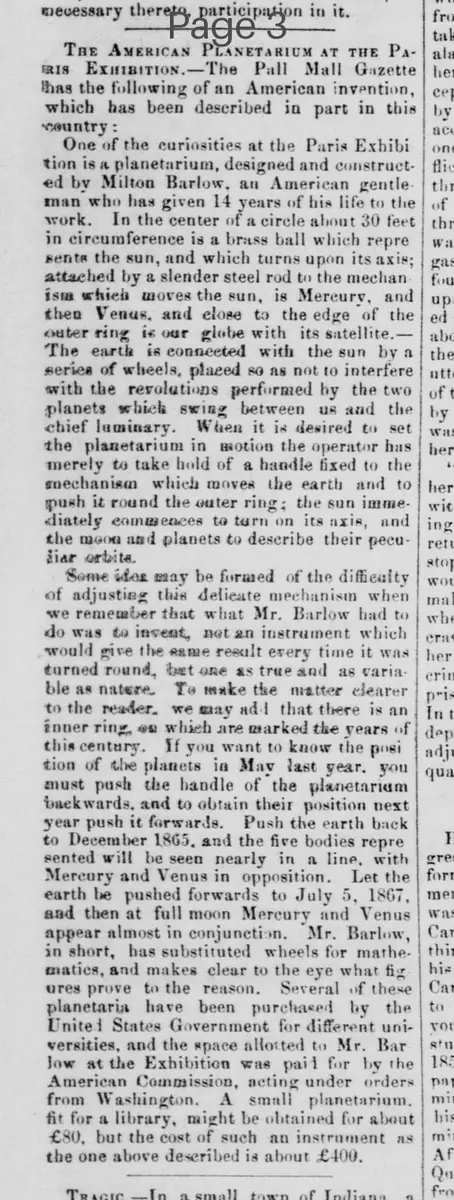
The American Planetarium at the Paris Exhibition.
The Pall Mall Gazette has the following of an American invention, which has been described in part in this country:
One of the curiosities at the Paris Exhibition is a planetarium, designed and constructed by Milton Barlow, an American gentleman who has given 14 years of his life to the work. In the center of a circle about 30 feet in circumference is a brass ball which represents the sun, and which turns upon its axis: attached by a slender steel rod to the mechanism which moves the sun, is Mercury, and then Venus, and close to the edge of the outer ring is our globe with its satellite. The earth is connected with the sun by a series of wheels, placed so as not to interfere with the revolutions performed by the two planets which swing between us and the chief luminary. When it is desired to set the planetarium in motion the operator has merely to take hold of a handle fixed to the mechanism which moves the earth and to push it round the outer ring: the sun immediately commences to turn on its axis, and the moon and planets to describe their peculiar orbits.
Some idea may be formed of the difficulty of adjusting this delicate mechanism when we remember that what Mr. Barlow had to do was to invent not an instrument which would give the same result every time it was turned round, but one as true and as variable as nature. To make the matter clearer to the reader, we may add that there is an inner ring on which are marked the years of this century. If you want to know the position of the planets in May last year, you must push the handle of the planetarium backwards, and to obtain their position next year push it forwards. Push the earth back to December 1865, and the five bodies represented will be seen nearly in a line, with Mercury and Venus in opposition. Let the earth be pushed forwards to July 5, 1867, and then at full moon Mercury and Venus appear almost in conjunction. Mr. Barlow, in short, has substituted wheels for mathematics, and makes clear to the eye what figures prove to the reason. Several of these planetaria have been purchased by the United States Government for different universities, and the space allotted to Mr. Barlow at the Exhibition was paid for by the American Commission, acting under orders from Washington. A small planetarium, fit for a library, might be obtained for about £80, but the cost of such an instrument as the one above described is about £100.
The Pall Mall Gazette has the following of an American invention, which has been described in part in this country:
One of the curiosities at the Paris Exhibition is a planetarium, designed and constructed by Milton Barlow, an American gentleman who has given 14 years of his life to the work. In the center of a circle about 30 feet in circumference is a brass ball which represents the sun, and which turns upon its axis: attached by a slender steel rod to the mechanism which moves the sun, is Mercury, and then Venus, and close to the edge of the outer ring is our globe with its satellite. The earth is connected with the sun by a series of wheels, placed so as not to interfere with the revolutions performed by the two planets which swing between us and the chief luminary. When it is desired to set the planetarium in motion the operator has merely to take hold of a handle fixed to the mechanism which moves the earth and to push it round the outer ring: the sun immediately commences to turn on its axis, and the moon and planets to describe their peculiar orbits.
Some idea may be formed of the difficulty of adjusting this delicate mechanism when we remember that what Mr. Barlow had to do was to invent not an instrument which would give the same result every time it was turned round, but one as true and as variable as nature. To make the matter clearer to the reader, we may add that there is an inner ring on which are marked the years of this century. If you want to know the position of the planets in May last year, you must push the handle of the planetarium backwards, and to obtain their position next year push it forwards. Push the earth back to December 1865, and the five bodies represented will be seen nearly in a line, with Mercury and Venus in opposition. Let the earth be pushed forwards to July 5, 1867, and then at full moon Mercury and Venus appear almost in conjunction. Mr. Barlow, in short, has substituted wheels for mathematics, and makes clear to the eye what figures prove to the reason. Several of these planetaria have been purchased by the United States Government for different universities, and the space allotted to Mr. Barlow at the Exhibition was paid for by the American Commission, acting under orders from Washington. A small planetarium, fit for a library, might be obtained for about £80, but the cost of such an instrument as the one above described is about £100.
What sub-type of article is it?
Curiosity
What themes does it cover?
Triumph
What keywords are associated?
Planetarium
American Invention
Paris Exhibition
Milton Barlow
Solar System Model
Planetary Motions
What entities or persons were involved?
Milton Barlow
Where did it happen?
Paris Exhibition
Story Details
Key Persons
Milton Barlow
Location
Paris Exhibition
Story Details
Milton Barlow's planetarium mechanically simulates the sun, Mercury, Venus, Earth, and Moon's motions around a 30-foot circle, allowing demonstration of planetary positions from 1865 to 1867 and beyond, replacing mathematical calculations with visual mechanics.