Thank you for visiting SNEWPapers!
Sign up free
Gazette Of The United States, & Philadelphia Daily Advertiser
Philadelphia, Philadelphia County, Pennsylvania
What is this article about?
Samuel J. Cabell defends his congressional circular letters against a Richmond grand jury presentment under Judge Iredell's charge, which he sees as an attack on freedom of opinion. He criticizes federal judges for political preaching and warns of British efforts to provoke a US-France quarrel for alliance with Britain, advocating strict neutrality.
Clipping
OCR Quality
Full Text
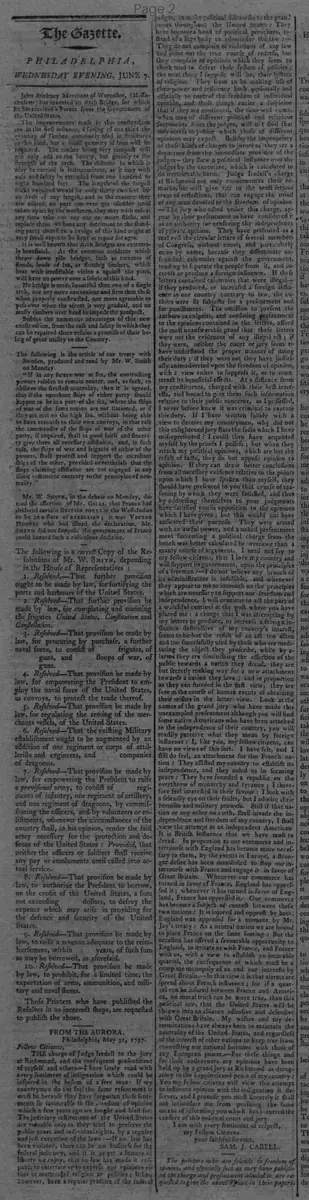
Philadelphia, May 31, 1797
Fellow Citizens,
THE charge of Judge Iredell to the jury at Richmond, and the consequent presentment of myself and others—I have lately read with every sentiment of indignation which could be inspired in the bosom of a free man: If my countrymen do not feel the same resentment it must be because they have forgotten those sentiments so favourable to the freedom of opinion which a few years ago we fought and bled for.
The judiciary institutions of the United States are valuable only as they tend to preserve the public peace and individual rights, by a regular and just execution of the laws:—If no law has been violated, there can be no business for the federal judiciary, and it is as yet a feature of liberty we enjoy, that no law has made it culpable to entertain or to express our opinions either in matters of religion or politics; It has, however, been a regular practice of the federal judges, to make political discourses to the grand jurors throughout the United States: They have become a band of political preachers, instead of a sage body to administer the law:—They do not complain of violations of any law and point out the true course of redress, but they complain of opinions which they seem to think tend to defeat their system of politics; the next thing I suppose will be, their system of religion. They seem to be making use of their power and influence both personally and officially to control the freedom of individual opinion, and these things excite a suspicion that if they are continued, the time will come, when men of different political and religious sentiments from the judges, will not find that easy access to justice which those of different opinions may expect. Besides the impropriety of these kinds of charges to jurors as they are a departure from the immediate province of the judges—they shew a political influence over the judges by the executive, which is calculated to do irretrievable harm. Judge Iredell's charge at Richmond not only countenances these remarks, but will give rise to the most serious train of reflections, that can engage the mind of any man devoted to the freedom of opinion.
—The jury who acted under this charge, appear by their presentment to have considered it as an authority for censuring the independence of private opinion. They have presented as a real evil the circular letters of several members of Congress, without name, and particularly mine by name, because they disseminate unfounded calumnies against the government, tending to separate the people from it, and increase or produce a foreign influence. If these letters contained calumnies that were illegal—if they produced, or increased a foreign influence in our country contrary to law, the authors were fit subjects for a presentment and for punishment. The omission to present the authors as culprits, and confining presentment to the opinions contained in the letters, afford the most unanswerable proof that these letters were not the evidences of any illegal act; if they were, neither the court or jury seem to have understood the proper manner of doing their duty; if they were not they have judicially animadverted upon the freedom of opinion, with a view either to suppress it, or to counteract its beneficial effects. At a distance from my constituents, charged with their best interests, and bound to give them such information relative to their public concerns, as I possessed, I never before knew it was criminal to execute this duty. If I have written falsely with a view to deceive my countrymen, why did not this enlightened jury state the facts which I have misrepresented? I could then have acquitted myself by the proofs I possess; but when they attack my political opinions, which are but the result of facts, they do but oppose opinion to opinion. If they can draw better conclusions from necessary evidence relative to the points upon which I have spoken than myself, they should have presented to you that course of reasoning by which they were satisfied, and thus by addressing themselves to your judgments have satisfied you in opposition to the opinions which I have given; but this would not have answered their purpose. They were armed with an awful power, and a naked presentment succeeding a political charge from the bench was better calculated to overawe than a manly course of argument. I need not say—to my fellow-citizens, that I love my country and will support its government, upon the principles of a freeman: I do not believe any branch of its administrators is infallible, and whenever they appear to me to encroach on the principles which are necessary to support our freedom and independence, I will continue to act the part of a watchful sentinel at the post where you have placed me: a charge that I was attempting by my letters to produce, or increase a foreign influence destructive of my country's interests, seems to be but the result of an art too often and too successfully used by those who are meditating the object they proscribe, while by alarms they are diminishing the affection of the public towards a nation they dread, they are but secretly making way for a new attachment towards a nation they love; and in proportion as they can succeed in the first view, they are sure in the course of human events of obtaining their wishes in the latter view. Look at the names of the grand jury who have made this unexampled presentment although you will find some native Americans who have been attached to the independence of their country, you will readily perceive what they mean by foreign influence: I, like you, my fellow citizens, can have no views of this sort. I have felt, and I still do feel, an attachment for the French nation: They aided my country to establish its independence, and they aided us in securing peace: They have founded a republic on the overthrow of monarchy and tyranny; I therefore feel interested in their favour: I look with a friendly eye on their faults, but I admire their heroism and military prowess. Still if that nation or any other on earth, shall invade the independence and freedom of my country, I shall view the attempt as an independent American It is British influence that we have most to dread. In proportion as our commerce and intercourse with England has become more necessary to them, by the events in Europe, a stronger desire has been manifested to stop our intercourse with France and engage it in favor of Great Britain. Whenever our commerce has turned in favor of France, England has oppressed it; whenever it has turned in favor of England, France has oppressed it. Our commerce has become a subject of contest between these two nations: It is injured and oppressed by both. England was appeased for a moment by Mr. Jay's treaty: As a neutral nation we are bound to place France on the same footing: But the occasion has offered a favourable opportunity to England, to irritate us with France, and France with us, with a view to establish an incurable quarrel, the consequence of which must be a complete monopoly of us and our interests by Great Britain.—In this view it is that alarms are spread about French influence; for if a quarrel can be insured between France and America, no moral truth can be more true, than this political one, that the United States will be thrown into an alliance offensive and defensive with Great Britain. My wishes and my determinations have always been to maintain the neutrality of the United States, and regardless of the interest of other nations to keep free from connecting our national fortunes with those of any European power.—For these things and for these endeavours my opinions have been held up by a grand jury at Richmond as derogatory to the happiness and peace of my country. You my fellow citizens will view this attempt to influence opinion with the indignation it deserves, and I promise you most sincerely it shall not intimidate me from pursuing the same means of informing you which has incurred the censure of this political court and jury.
I am with every sentiment of respect,
my Fellow Citizens.
your faithful servant,
SAM. J. CABELL.
The printers who are friends to freedom of opinion, and especially such as may have published the charge and presentment alluded to are requested to give the above a place in their papers.
What sub-type of article is it?
What themes does it cover?
What keywords are associated?
What entities or persons were involved?
Letter to Editor Details
Author
Sam. J. Cabell
Recipient
Fellow Citizens
Main Argument
cabell indignantly defends his right to express political opinions via circular letters, criticizing judge iredell's charge and the richmond grand jury's presentment as improper attacks on freedom of opinion rather than legal violations, and warns that such actions stem from executive influence and aim to counter french sympathy by promoting british interests, advocating us neutrality.
Notable Details