Thank you for visiting SNEWPapers!
Sign up free
The Daily Advertiser
New York, New York County, New York
What is this article about?
Pseudonymous letter to the Daily Advertiser urges New York legislature to use state convicts to clear Hudson River obstructions with boats, enhancing navigation for agricultural transport, boosting economy and revenue, while reforming prisoners and deterring crime better than current wheelbarrow labor. Signed TIMON.
Merged-components note: These two components are the continuation of the same letter to the editor discussing the employment of criminals for public works, signed TIMON.
Clipping
OCR Quality
Full Text
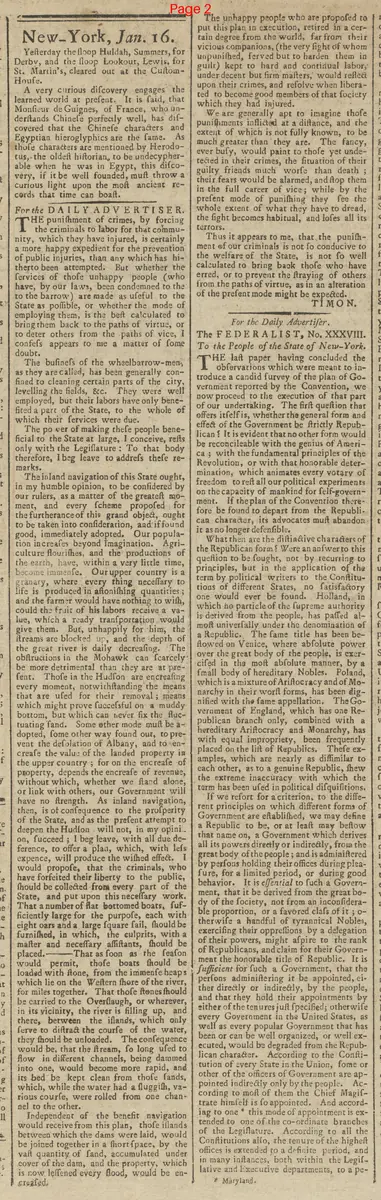
...that community, which they have injured, is certainly a more happy expedient for the prevention of public injuries, than any which has hitherto been attempted. But whether the services of those unhappy people (who have, by our laws, been condemned to the barrow) are made as useful to the State as possible, or whether the mode of employing them, is the best calculated to bring them back to the paths of virtue, or to deter others from the paths of vice. I confess appears to me a matter of some doubt.
The business of the wheelbarrow-men—as they are called, has been generally confined to cleaning certain parts of the city, levelling the fields, &c. They were well employed, but their labors have only benefited a part of the State, to the whole of which their services were due.
The power of making these people beneficial to the State at large, I conceive, rests only with the Legislature: To that body therefore, I beg leave to address these remarks.
The inland navigation of this State ought, in my humble opinion, to be considered by our rulers, as a matter of the greatest moment, and every scheme proposed for the furtherance of this grand object, ought to be taken into consideration, and if found good, immediately adopted. Our population increases beyond imagination. Agriculture flourishes, and the productions of the earth, have, within a very little time, become immense. Our upper country is a granary, where every thing necessary to life is produced in astonishing quantities; and the farmer would have nothing to wish, could the fruit of his labors receive a value, which a ready transportation would give them. But, unhappily for him, the streams are blocked up, and the depth of the great river is daily decreasing. The obstructions in the Mohawk can scarcely be more detrimental than they are at present. Those in the Hudson are increasing every moment, notwithstanding the means that are used for their removal; means which might prove successful on a muddy bottom, but which can never fix the fluctuating sand. Some other mode must be adopted, some other way found out, to prevent the desolation of Albany, and to increase the value of the landed property in the upper country; for on the increase of property, depends the increase of revenue, without which, whether we stand alone, or link with others, our Government will have no strength. As inland navigation, then, is of consequence to the prosperity of the State, and as the present attempt to deepen the Hudson will not, in my opinion, succeed; I beg leave, with all due deference, to offer a plan, which, with less expense, will produce the wished effect. I would propose, that the criminals, who have forfeited their liberty to the public, should be collected from every part of the State, and put upon this necessary work. That a number of flat bottomed boats, sufficiently large for the purpose, each with eight oars and a large square sail, should be furnished, in which, the culprits, with a master and necessary assistants, should be placed. That as soon as the season would permit, those boats should be loaded with stone, from the immense heaps which lie on the Western shore of the river, for miles together. That those stones should be carried to the Overlaugh, or wherever, in its vicinity, the river is filling up, and there, between the islands, which only serve to distract the course of the water, they should be unloaded. The consequence would be, that the stream, so long used to flow in different channels, being dammed into one, would become more rapid, and its bed be kept clean from those sands, which, while the water had a sluggish, various course, were rolled from one channel to the other.
Independent of the benefit navigation would receive from this plan, those islands between which the dams were laid, would be joined together in a short space, by the vast quantity of sand, accumulated under cover of the dam, and the property, which is now lessened every flood, would be increased.
The unhappy people who are proposed to put this plan in execution, retired in a certain degree from the world, far from their vicious companions, (the very sight of whom unpunished, served but to harden them in guilt) kept to hard and continual labor, under decent but firm masters, would reflect upon their crimes, and resolve when liberated to become good members of that society which they had injured.
We are generally apt to imagine those punishments inflicted at a distance, and the extent of which is not fully known, to be much greater than they are. The fancy, ever busy, would paint to those yet undetected in their crimes, the situation of their guilty friends much worse than death; their fears would be alarmed, and stop them in the full career of vice; while by the present mode of punishing they see the whole extent of what they have to dread, the sight becomes habitual, and loses all its terrors.
Thus it appears to me, that the punishment of our criminals is not so conducive to the welfare of the State, is not so well calculated to bring back those who have erred, or to prevent the straying of others from the paths of virtue, as in an alteration of the present mode might be expected.
TIMON.
What sub-type of article is it?
What themes does it cover?
What keywords are associated?
What entities or persons were involved?
Letter to Editor Details
Author
Timon.
Recipient
The Legislature
Main Argument
the author proposes that the state legislature collect convicted criminals from across the state and employ them in boats to remove obstructions from the hudson river, improving inland navigation, benefiting agriculture and revenue, reforming the criminals through labor, and deterring vice more effectively than current punishments.
Notable Details