Thank you for visiting SNEWPapers!
Sign up free
Story
December 30, 1907
The Beatrice Daily Express
Beatrice, Gage County, Nebraska
What is this article about?
German clockmaker H. Rosin constructs a intricate clock mechanism inside a bottle in Gommer near Magdeburg, detailing the disassembly and reassembly process through the narrow neck.
Clipping
OCR Quality
98%
Excellent
Full Text
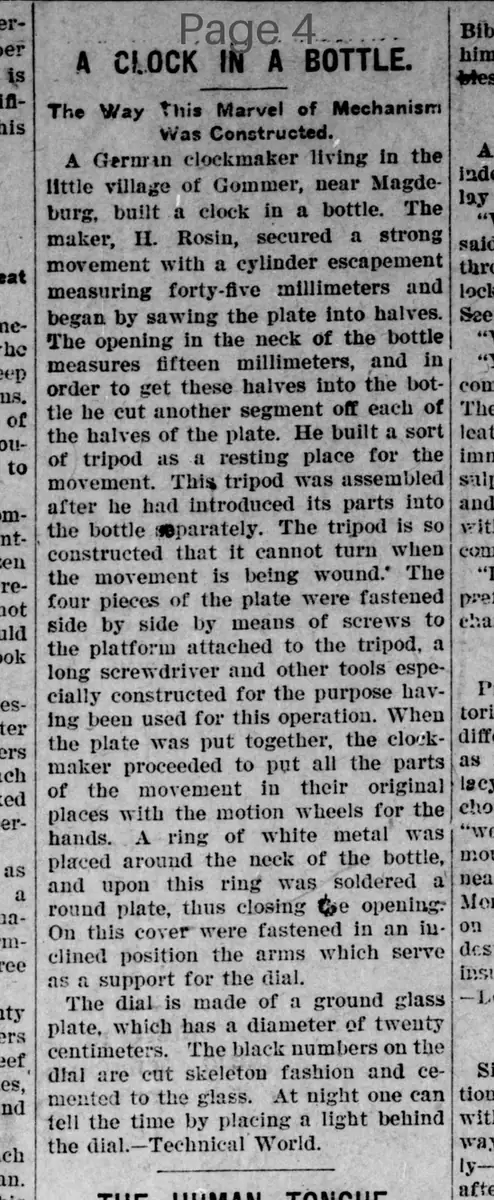
A CLOCK IN A BOTTLE.
The Way this Marvel of Mechanism Was Constructed.
A German clockmaker living in the little village of Gommer, near Magdeburg, built a clock in a bottle. The maker, H. Rosin, secured a strong movement with a cylinder escapement measuring forty-five millimeters and began by sawing the plate into halves.
The opening in the neck of the bottle measures fifteen millimeters, and in order to get these halves into the bottle he cut another segment off each of the halves of the plate. He built a sort of tripod as a resting place for the movement. This tripod was assembled after he had introduced its parts into the bottle separately. The tripod is so constructed that it cannot turn when the movement is being wound. The four pieces of the plate were fastened side by side by means of screws to the platform attached to the tripod, a long screwdriver and other tools especially constructed for the purpose having been used for this operation. When the plate was put together, the clockmaker proceeded to put all the parts of the movement in their original places with the motion wheels for the hands. A ring of white metal was placed around the neck of the bottle, and upon this ring was soldered a round plate, thus closing the opening. On this cover were fastened in an inclined position the arms which serve as a support for the dial.
The dial is made of a ground glass plate, which has a diameter of twenty centimeters. The black numbers on the dial are cut skeleton fashion and cemented to the glass. At night one can tell the time by placing a light behind the dial. - Technical World.
The Way this Marvel of Mechanism Was Constructed.
A German clockmaker living in the little village of Gommer, near Magdeburg, built a clock in a bottle. The maker, H. Rosin, secured a strong movement with a cylinder escapement measuring forty-five millimeters and began by sawing the plate into halves.
The opening in the neck of the bottle measures fifteen millimeters, and in order to get these halves into the bottle he cut another segment off each of the halves of the plate. He built a sort of tripod as a resting place for the movement. This tripod was assembled after he had introduced its parts into the bottle separately. The tripod is so constructed that it cannot turn when the movement is being wound. The four pieces of the plate were fastened side by side by means of screws to the platform attached to the tripod, a long screwdriver and other tools especially constructed for the purpose having been used for this operation. When the plate was put together, the clockmaker proceeded to put all the parts of the movement in their original places with the motion wheels for the hands. A ring of white metal was placed around the neck of the bottle, and upon this ring was soldered a round plate, thus closing the opening. On this cover were fastened in an inclined position the arms which serve as a support for the dial.
The dial is made of a ground glass plate, which has a diameter of twenty centimeters. The black numbers on the dial are cut skeleton fashion and cemented to the glass. At night one can tell the time by placing a light behind the dial. - Technical World.
What sub-type of article is it?
Curiosity
Personal Triumph
What themes does it cover?
Triumph
What keywords are associated?
Clock In Bottle
German Clockmaker
Mechanism Construction
Bottle Assembly
Cylinder Escapement
What entities or persons were involved?
H. Rosin
Where did it happen?
Gommer, Near Magdeburg
Story Details
Key Persons
H. Rosin
Location
Gommer, Near Magdeburg
Story Details
H. Rosin disassembles a clock movement, inserts pieces through the bottle neck, assembles inside on a tripod, adds dial on glass plate for visibility.