Thank you for visiting SNEWPapers!
Sign up free
Editorial
January 4, 1842
Democratic Standard
Georgetown, Brown County, Ohio
What is this article about?
Editorial in The Standard opposes the Treasury Secretary's bill for a 'Board of Exchequer' as a U.S. Bank, criticizing President Tyler's inconsistency and arguing it turns the Treasury into a merchant-benefiting bank, preying on producers and expanding federal power unconstitutionally.
Clipping
OCR Quality
95%
Excellent
Full Text
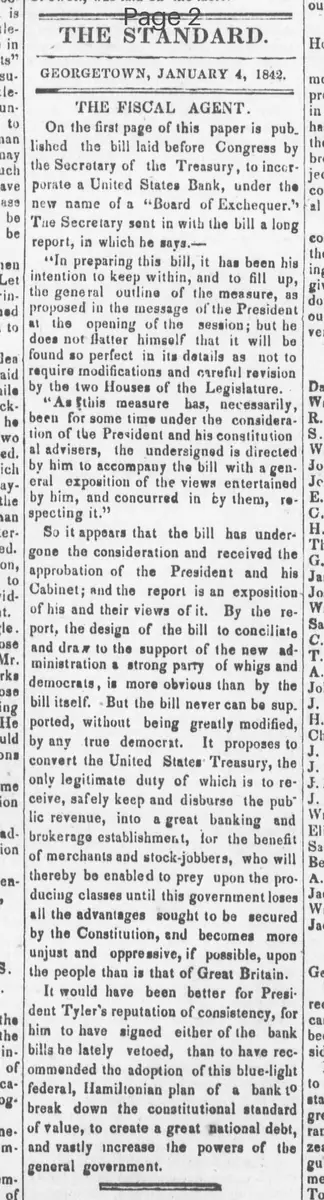
THE STANDARD.
GEORGETOWN, JANUARY 4, 1842.
THE FISCAL AGENT.
On the first page of this paper is published the bill laid before Congress by the Secretary of the Treasury, to incorporate a United States Bank, under the new name of a "Board of Exchequer."
The Secretary sent in with the bill a long report, in which he says—
"In preparing this bill, it has been his intention to keep within, and to fill up, the general outline of the measure, as proposed in the message of the President at the opening of the session; but he does not flatter himself that it will be found so perfect in its details as not to require modifications and careful revision by the two Houses of the Legislature."
"As this measure has, necessarily, been for some time under the consideration of the President and his constitutional advisers, the undersigned is directed by him to accompany the bill with a general exposition of the views entertained by him, and concurred in by them, respecting it."
So it appears that the bill has undergone the consideration and received the approbation of the President and his Cabinet; and the report is an exposition of his and their views of it. By the report, the design of the bill to conciliate and draw to the support of the new administration a strong party of whigs and democrats, is more obvious than by the bill itself. But the bill never can be supported, without being greatly modified, by any true democrat. It proposes to convert the United States Treasury, the only legitimate duty of which is to receive, safely keep and disburse the public revenue, into a great banking and brokerage establishment, for the benefit of merchants and stock-jobbers, who will thereby be enabled to prey upon the producing classes until this government loses all the advantages sought to be secured by the Constitution, and becomes more unjust and oppressive, if possible, upon the people than is that of Great Britain.
It would have been better for President Tyler's reputation of consistency, for him to have signed either of the bank bills he lately vetoed, than to have recommended the adoption of this blue-light federal, Hamiltonian plan of a bank to break down the constitutional standard of value, to create a great national debt, and vastly increase the powers of the general government.
GEORGETOWN, JANUARY 4, 1842.
THE FISCAL AGENT.
On the first page of this paper is published the bill laid before Congress by the Secretary of the Treasury, to incorporate a United States Bank, under the new name of a "Board of Exchequer."
The Secretary sent in with the bill a long report, in which he says—
"In preparing this bill, it has been his intention to keep within, and to fill up, the general outline of the measure, as proposed in the message of the President at the opening of the session; but he does not flatter himself that it will be found so perfect in its details as not to require modifications and careful revision by the two Houses of the Legislature."
"As this measure has, necessarily, been for some time under the consideration of the President and his constitutional advisers, the undersigned is directed by him to accompany the bill with a general exposition of the views entertained by him, and concurred in by them, respecting it."
So it appears that the bill has undergone the consideration and received the approbation of the President and his Cabinet; and the report is an exposition of his and their views of it. By the report, the design of the bill to conciliate and draw to the support of the new administration a strong party of whigs and democrats, is more obvious than by the bill itself. But the bill never can be supported, without being greatly modified, by any true democrat. It proposes to convert the United States Treasury, the only legitimate duty of which is to receive, safely keep and disburse the public revenue, into a great banking and brokerage establishment, for the benefit of merchants and stock-jobbers, who will thereby be enabled to prey upon the producing classes until this government loses all the advantages sought to be secured by the Constitution, and becomes more unjust and oppressive, if possible, upon the people than is that of Great Britain.
It would have been better for President Tyler's reputation of consistency, for him to have signed either of the bank bills he lately vetoed, than to have recommended the adoption of this blue-light federal, Hamiltonian plan of a bank to break down the constitutional standard of value, to create a great national debt, and vastly increase the powers of the general government.
What sub-type of article is it?
Economic Policy
Partisan Politics
Constitutional
What keywords are associated?
Fiscal Agent
Board Of Exchequer
United States Bank
President Tyler
Treasury
Banking
Democrats
Whigs
Hamiltonian Plan
Constitutional Powers
What entities or persons were involved?
President Tyler
Secretary Of The Treasury
Congress
Whigs
Democrats
United States Treasury
Board Of Exchequer
Editorial Details
Primary Topic
Opposition To The Board Of Exchequer As A Fiscal Agent
Stance / Tone
Strongly Critical Of The Administration's Banking Proposal
Key Figures
President Tyler
Secretary Of The Treasury
Congress
Whigs
Democrats
United States Treasury
Board Of Exchequer
Key Arguments
The Bill Has Been Approved By President Tyler And His Cabinet
It Aims To Conciliate Whigs And Democrats But Cannot Be Supported By True Democrats Without Modification
It Converts The Treasury Into A Banking Establishment Benefiting Merchants And Stock Jobbers At The Expense Of Producers
This Would Make The Government Unjust And Oppressive Like Great Britain's
Tyler Should Have Signed Previous Vetoed Bank Bills For Consistency
The Plan Is A Hamiltonian Scheme To Undermine Constitutional Value Standards, Create National Debt, And Expand Federal Powers