Thank you for visiting SNEWPapers!
Sign up free
Editorial
February 17, 1797
Gazette Of The United States, & Philadelphia Daily Advertiser
Philadelphia, Philadelphia County, Pennsylvania
What is this article about?
Editorial argues for the United States to build and maintain a navy to protect commerce from foreign powers, funded by land taxes, emphasizing interdependence of agriculture and trade, and assertive neutrality in European conflicts.
Clipping
OCR Quality
98%
Excellent
Full Text
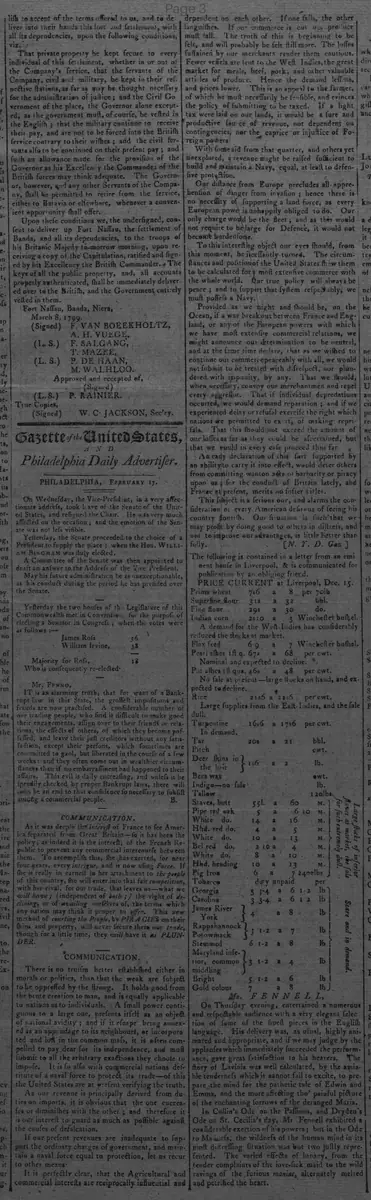
COMMUNICATION.
There is no truth better established either in morals or politics, than that the weak are subject to be oppressed by the strong. It holds good from the brute creation to man, and is equally applicable to nations as to individuals. A small power contiguous to a large one, presents itself as an object of national avidity; and if it escape being annexed as an appendage to its neighbours, or incorporated and lost in the common mass, it is often compelled to pay dear for its independence, and must submit to all the arbitrary exactions they choose to impose. It is so also with commercial nations destitute of a naval force to protect its trade—of this the United States are at present verifying the truth.
As our revenue is principally derived from duties on imports. it is obvious that the one increases or diminishes with the other; and therefore it is our interest to guard as much as possible against the causes of defalcation.
If our present revenues are inadequate to support the ordinary charges of government, and maintain a naval force equal to protection, let us recur to other means
It is perfectly clear, that the Agricultural and commercial interests are reciprocally influential and dependent on each other. If one fails, the other languishes. If our commerce is cut up, produce must fall. The truth of this is beginning to be felt, and will probably be felt more. The loss sustained by our merchants render them cautious. Fewer vessels are sent to the West Indies, the great market for meals, beef, pork, and other valuable articles of produce. Hence the demand lessens, and prices lower. This is an appeal to the farmer, of which he must necessarily be sensible, and evinces the policy of submitting to be taxed. If a light tax were laid on our lands, it would be a sure and productive source of revenue, not dependent on contingencies, nor the caprice or injustice of Foreign powers
With some aid from that quarter, and others yet unexplored, a revenue might be raised sufficient to build and maintain a Navy, equal, at least to defensive protection.
Our distance from Europe precludes all. apprehension of danger from invasion; hence there is no necessity of supporting a land force, as every European power is unhappily obliged to do. Our only charge would be the fleet; and as this would not require to be large for Defence, it would not become burdensome.
To this interesting object our eyes should, from this moment, be instantly turned. The circumstances and position of the United States show them to be calculated for most extensive commerce with the whole world. Our true policy will always be peace; and to support that system respectably, we must possess a Navy.
Provided as we might and should be, on the Ocean, if a war break out between France and England, or any of the European powers with which we have most extensive commercial relations, we might announce our determination to be neutral, and. at the same time declare, that as we wished to continue our commerce peaceably with all, we would not submit to be treated with disrespect, nor plundered with impunity, by any. That we should, when necessary, convoy our merchantmen and repel every aggressor. That if individual depredations occurred, we would demand reparation; and if we experienced delay or refusal exercise the right which nations are permitted to exert, of making reprisals. That this should not exceed the amount of our losses as far as they could be ascertained, but that we would in every case proceed thus far.
An early declaration of this sort supported by an ability to carry it into effect, would deter others from committing wanton acts of barbarity or piracy upon us; for the conduct of Britain lately, and France at present, merits no other titles.
This subject is a serious one, and alarms the consideration of every American desirous of seeing his country flourish. Our situation is such that we may profit by doing good to others in distress, and not to improve our advantages, is little better than folly.
[N. T. D. Gaz]
There is no truth better established either in morals or politics, than that the weak are subject to be oppressed by the strong. It holds good from the brute creation to man, and is equally applicable to nations as to individuals. A small power contiguous to a large one, presents itself as an object of national avidity; and if it escape being annexed as an appendage to its neighbours, or incorporated and lost in the common mass, it is often compelled to pay dear for its independence, and must submit to all the arbitrary exactions they choose to impose. It is so also with commercial nations destitute of a naval force to protect its trade—of this the United States are at present verifying the truth.
As our revenue is principally derived from duties on imports. it is obvious that the one increases or diminishes with the other; and therefore it is our interest to guard as much as possible against the causes of defalcation.
If our present revenues are inadequate to support the ordinary charges of government, and maintain a naval force equal to protection, let us recur to other means
It is perfectly clear, that the Agricultural and commercial interests are reciprocally influential and dependent on each other. If one fails, the other languishes. If our commerce is cut up, produce must fall. The truth of this is beginning to be felt, and will probably be felt more. The loss sustained by our merchants render them cautious. Fewer vessels are sent to the West Indies, the great market for meals, beef, pork, and other valuable articles of produce. Hence the demand lessens, and prices lower. This is an appeal to the farmer, of which he must necessarily be sensible, and evinces the policy of submitting to be taxed. If a light tax were laid on our lands, it would be a sure and productive source of revenue, not dependent on contingencies, nor the caprice or injustice of Foreign powers
With some aid from that quarter, and others yet unexplored, a revenue might be raised sufficient to build and maintain a Navy, equal, at least to defensive protection.
Our distance from Europe precludes all. apprehension of danger from invasion; hence there is no necessity of supporting a land force, as every European power is unhappily obliged to do. Our only charge would be the fleet; and as this would not require to be large for Defence, it would not become burdensome.
To this interesting object our eyes should, from this moment, be instantly turned. The circumstances and position of the United States show them to be calculated for most extensive commerce with the whole world. Our true policy will always be peace; and to support that system respectably, we must possess a Navy.
Provided as we might and should be, on the Ocean, if a war break out between France and England, or any of the European powers with which we have most extensive commercial relations, we might announce our determination to be neutral, and. at the same time declare, that as we wished to continue our commerce peaceably with all, we would not submit to be treated with disrespect, nor plundered with impunity, by any. That we should, when necessary, convoy our merchantmen and repel every aggressor. That if individual depredations occurred, we would demand reparation; and if we experienced delay or refusal exercise the right which nations are permitted to exert, of making reprisals. That this should not exceed the amount of our losses as far as they could be ascertained, but that we would in every case proceed thus far.
An early declaration of this sort supported by an ability to carry it into effect, would deter others from committing wanton acts of barbarity or piracy upon us; for the conduct of Britain lately, and France at present, merits no other titles.
This subject is a serious one, and alarms the consideration of every American desirous of seeing his country flourish. Our situation is such that we may profit by doing good to others in distress, and not to improve our advantages, is little better than folly.
[N. T. D. Gaz]
What sub-type of article is it?
Military Affairs
Economic Policy
Foreign Affairs
What keywords are associated?
Navy Construction
Commercial Protection
Neutrality Policy
Land Tax Revenue
Agricultural Commerce
Foreign Depredations
Defensive Fleet
What entities or persons were involved?
United States
France
England
Britain
Editorial Details
Primary Topic
Need For Us Navy To Protect Commerce And Assert Neutrality
Stance / Tone
Advocacy For Naval Buildup And Defensive Policy
Key Figures
United States
France
England
Britain
Key Arguments
Weak Nations Are Oppressed By Strong Ones, Applicable To Us Commerce Without Navy
Revenue From Imports Vulnerable To Foreign Interference
Agriculture And Commerce Interdependent; Trade Disruptions Lower Produce Prices
Propose Light Land Tax For Stable Revenue To Fund Navy
No Need For Large Land Force Due To Distance From Europe
Maintain Navy For Peaceable Commerce And Neutrality
Declare Neutrality But Protect Against Depredations With Convoys And Reprisals
Early Naval Strength Deters Piracy And Barbarity From Britain And France