Thank you for visiting SNEWPapers!
Sign up free
Foreign News
January 2, 1849
Indiana State Sentinel
Indianapolis, Marion County, Indiana
What is this article about?
Analysis of the French Constitution's universal suffrage and single legislative chamber, contrasting it favorably with restrictive US and English systems, and arguing its suitability for France's character and Europe's aristocratic struggles.
Clipping
OCR Quality
95%
Excellent
Full Text
The French Constitution
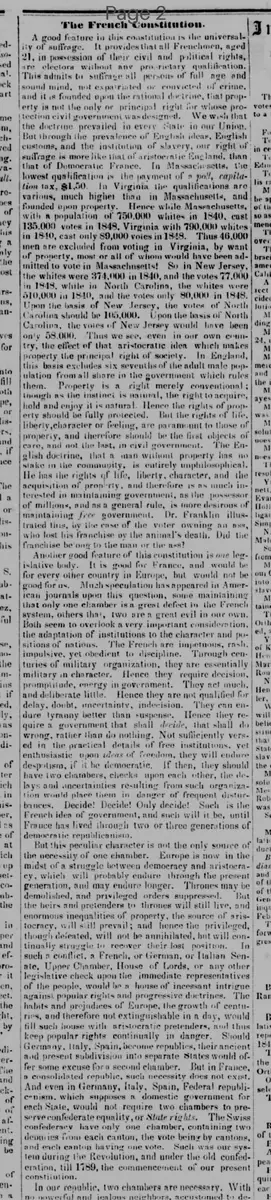
A good feature in this constitution is the universality of suffrage. It provides that all Frenchmen, aged 21, in possession of their civil and political rights, are electors without any proprietary qualification. This admits to suffrage all persons of full age and sound mind, not expatriated or convicted of crime; and it is founded upon the rational doctrine, that property is not the only or principal right for whose protection civil government was designed. We wish that the doctrine prevailed in every State in our Union. But through the prevalence of English ideas, English customs, and the institution of slavery, our right of suffrage is more like that of aristocratic England, than that of Democratic France. In Massachusetts, the lowest qualification is the payment of a poll, capitation tax, $1.50. In Virginia the qualifications are various, much higher than in Massachusetts, and founded upon property. Hence while Massachusetts, with a population of 750,000 whites in 1840, cast 135,000 votes in 1848, Virginia with 790,000 whites in 1840, cast only 89,000 votes in 1848. Thus 46,000 men are excluded from voting in Virginia, by want of property, most or all of whom would have been admitted to vote in Massachusetts! So in New Jersey, the whites were 374,000 in 1840, and the votes 77,000 in 1848, while in North Carolina, the whites were 510,000 in 1840, and the votes only 80,000 in 1848. Upon the basis of New Jersey, the votes of North Carolina should be 105,000. Upon the basis of North Carolina, the votes of New Jersey would have been only 58,000. Thus we see, even in our own country, the effect of that aristocratic idea which makes property the principal right of society. In England, this basis excludes six sevenths of the adult male population from all share in the government which rules them. Property is a right merely conventional: though as the instinct is natural, the right to acquire, hold and enjoy it is natural. Hence the rights of property should be fully protected. But the rights of life, liberty, character or feeling, are paramount to those of property, and therefore should be the first objects of care, and not the last, in civil government. The English doctrine, that a man without property has no stake in the community, is entirely unphilosophical. He has the rights of life, liberty, character, and the acquisition of property, and therefore is as much interested in maintaining government, as the possessor of millions, and as a general rule, is more desirous of maintaining free government. Dr. Franklin illustrated thus, by the case of the voter owning an ass, who lost his franchise on the animal's death. Did the franchise belong to the man or the ass?
Another good feature of this constitution is one legislative body. It is good for France, and would be for every other country in Europe, but would not be good for us. Much speculation has appeared in American journals upon this question, some maintaining that only one chamber is a great defect in the French system, others that two are a great evil in our own. Both seem to overlook a very important consideration, the adaptation of institutions to the character and positions of nations. The French are impetuous, rash, impulsive, yet obedient to discipline. Through centuries of military organization, they are essentially military in character. Hence they require decision, promptitude, energy in government. They act much, and deliberate little. Hence they are not qualified for delay, doubt, uncertainty, indecision. They can endure tyranny better than suspense. Hence they require a government that shall decide, that shall do wrong, rather than do nothing. Not sufficiently versed in the practical details of free institutions, yet enthusiastic upon ideas of freedom, they will endure despotism, if it be democratic. If then, they should have two chambers, checks upon each other, the delays and uncertainties resulting from such organization would place them in danger of frequent disturbances. Decide! Decide! Only decide! Such is the French idea of government, and such will it be, until France has lived through two or three generations of democratic republicanism.
But this peculiar character is not the only source of the necessity of one chamber. Europe is now in the midst of a struggle between democracy and aristocracy, which will probably endure through the present generation, and may endure longer. Thrones may be demolished, and privileged orders suppressed. But the heirs and pretenders to thrones will still live, and enormous inequalities of property, the source of aristocracy, will still prevail: and hence the privileged though defeated, will not be annihilated, but will continually struggle to recover their lost position. In such a conflict, a French, or German, or Italian Senate, Upper Chamber, House of Lords, or any other legislative check upon the immediate representatives of the people, would be a house of incessant intrigue against popular rights and progressive doctrines. The habits and prejudices of Europe, the growth of centuries, and therefore not extinguishable in a day, would fill such house with aristocratic pretenders, and thus keep popular rights continually in danger. Should Germany, Italy, Spain, become republics, their ancient and present subdivision into separate States would offer some excuse for a second chamber. But in France, a consolidated republic, such necessity does not exist. And even in Germany, Italy, Spain, Federal republicanism, which supposes a domestic government for each State, would not require two chambers to preserve confederate equality, or State rights. The Swiss confederacy have only one chamber, containing two deputies from each canton, the vote being by cantons, and each canton having one vote. Such was our system during the Revolution, and under the old confederation, till 1789, the commencement of our present constitution.
In our republic, two chambers are necessary. With no powerful and jealous neighbors, accustomed to deliberation, and being a confederacy of homogeneous States, we are in no danger from delay, can afford to wait and deliberate, and must maintain State rights. The inequality in our States is inconsistent with a vote by States, for it would render the small too powerful: and it is inconsistent with a vote by numbers, for it would destroy the power of the small States. We require a combination of the two, and have got it. Some Americans who see every thing through an English medium, regard our Senate as the aristocratic part of our system. It is no more aristocratic than the House. It is the representative of our bodies politic, our cantons, our States, the members of our confederacy : the House being the representative of the people. Existing in this compound capacity, we require this compound representation, as a security for both State and popular rights. The same rule will ultimately apply to Germany, Italy, Spain, but not until they are thoroughly purged of political aristocracies. As such mischiefs have never existed in our country, we require no immediate fences against them. But as they predominate in Europe, the people must guard against them till they are thoroughly extinguished. Therefore we advise every European republic to have one chamber at present.-Pa. Ledger.
A good feature in this constitution is the universality of suffrage. It provides that all Frenchmen, aged 21, in possession of their civil and political rights, are electors without any proprietary qualification. This admits to suffrage all persons of full age and sound mind, not expatriated or convicted of crime; and it is founded upon the rational doctrine, that property is not the only or principal right for whose protection civil government was designed. We wish that the doctrine prevailed in every State in our Union. But through the prevalence of English ideas, English customs, and the institution of slavery, our right of suffrage is more like that of aristocratic England, than that of Democratic France. In Massachusetts, the lowest qualification is the payment of a poll, capitation tax, $1.50. In Virginia the qualifications are various, much higher than in Massachusetts, and founded upon property. Hence while Massachusetts, with a population of 750,000 whites in 1840, cast 135,000 votes in 1848, Virginia with 790,000 whites in 1840, cast only 89,000 votes in 1848. Thus 46,000 men are excluded from voting in Virginia, by want of property, most or all of whom would have been admitted to vote in Massachusetts! So in New Jersey, the whites were 374,000 in 1840, and the votes 77,000 in 1848, while in North Carolina, the whites were 510,000 in 1840, and the votes only 80,000 in 1848. Upon the basis of New Jersey, the votes of North Carolina should be 105,000. Upon the basis of North Carolina, the votes of New Jersey would have been only 58,000. Thus we see, even in our own country, the effect of that aristocratic idea which makes property the principal right of society. In England, this basis excludes six sevenths of the adult male population from all share in the government which rules them. Property is a right merely conventional: though as the instinct is natural, the right to acquire, hold and enjoy it is natural. Hence the rights of property should be fully protected. But the rights of life, liberty, character or feeling, are paramount to those of property, and therefore should be the first objects of care, and not the last, in civil government. The English doctrine, that a man without property has no stake in the community, is entirely unphilosophical. He has the rights of life, liberty, character, and the acquisition of property, and therefore is as much interested in maintaining government, as the possessor of millions, and as a general rule, is more desirous of maintaining free government. Dr. Franklin illustrated thus, by the case of the voter owning an ass, who lost his franchise on the animal's death. Did the franchise belong to the man or the ass?
Another good feature of this constitution is one legislative body. It is good for France, and would be for every other country in Europe, but would not be good for us. Much speculation has appeared in American journals upon this question, some maintaining that only one chamber is a great defect in the French system, others that two are a great evil in our own. Both seem to overlook a very important consideration, the adaptation of institutions to the character and positions of nations. The French are impetuous, rash, impulsive, yet obedient to discipline. Through centuries of military organization, they are essentially military in character. Hence they require decision, promptitude, energy in government. They act much, and deliberate little. Hence they are not qualified for delay, doubt, uncertainty, indecision. They can endure tyranny better than suspense. Hence they require a government that shall decide, that shall do wrong, rather than do nothing. Not sufficiently versed in the practical details of free institutions, yet enthusiastic upon ideas of freedom, they will endure despotism, if it be democratic. If then, they should have two chambers, checks upon each other, the delays and uncertainties resulting from such organization would place them in danger of frequent disturbances. Decide! Decide! Only decide! Such is the French idea of government, and such will it be, until France has lived through two or three generations of democratic republicanism.
But this peculiar character is not the only source of the necessity of one chamber. Europe is now in the midst of a struggle between democracy and aristocracy, which will probably endure through the present generation, and may endure longer. Thrones may be demolished, and privileged orders suppressed. But the heirs and pretenders to thrones will still live, and enormous inequalities of property, the source of aristocracy, will still prevail: and hence the privileged though defeated, will not be annihilated, but will continually struggle to recover their lost position. In such a conflict, a French, or German, or Italian Senate, Upper Chamber, House of Lords, or any other legislative check upon the immediate representatives of the people, would be a house of incessant intrigue against popular rights and progressive doctrines. The habits and prejudices of Europe, the growth of centuries, and therefore not extinguishable in a day, would fill such house with aristocratic pretenders, and thus keep popular rights continually in danger. Should Germany, Italy, Spain, become republics, their ancient and present subdivision into separate States would offer some excuse for a second chamber. But in France, a consolidated republic, such necessity does not exist. And even in Germany, Italy, Spain, Federal republicanism, which supposes a domestic government for each State, would not require two chambers to preserve confederate equality, or State rights. The Swiss confederacy have only one chamber, containing two deputies from each canton, the vote being by cantons, and each canton having one vote. Such was our system during the Revolution, and under the old confederation, till 1789, the commencement of our present constitution.
In our republic, two chambers are necessary. With no powerful and jealous neighbors, accustomed to deliberation, and being a confederacy of homogeneous States, we are in no danger from delay, can afford to wait and deliberate, and must maintain State rights. The inequality in our States is inconsistent with a vote by States, for it would render the small too powerful: and it is inconsistent with a vote by numbers, for it would destroy the power of the small States. We require a combination of the two, and have got it. Some Americans who see every thing through an English medium, regard our Senate as the aristocratic part of our system. It is no more aristocratic than the House. It is the representative of our bodies politic, our cantons, our States, the members of our confederacy : the House being the representative of the people. Existing in this compound capacity, we require this compound representation, as a security for both State and popular rights. The same rule will ultimately apply to Germany, Italy, Spain, but not until they are thoroughly purged of political aristocracies. As such mischiefs have never existed in our country, we require no immediate fences against them. But as they predominate in Europe, the people must guard against them till they are thoroughly extinguished. Therefore we advise every European republic to have one chamber at present.-Pa. Ledger.
What sub-type of article is it?
Political
What keywords are associated?
French Constitution
Universal Suffrage
Single Chamber
European Republics
Democracy Vs Aristocracy
Where did it happen?
France
Foreign News Details
Primary Location
France
Event Details
The French Constitution features universal suffrage for all Frenchmen aged 21 with civil and political rights, without property qualifications, and a single legislative body suited to France's impetuous character and Europe's democratic-aristocratic struggle, contrasting with multi-chamber systems in the US and England.