Thank you for visiting SNEWPapers!
Sign up free
Literary
September 19, 1934
The Daily Worker
Chicago, Cook County, Illinois
What is this article about?
This ninth installment critiques the petty-bourgeois policy of Social-Democracy in Germany and Austria, which vacillates between labor and capital, leading to collaboration with big capital and agrarians, splitting the working class, and driving middle classes toward fascism. It contrasts this with Communist proletarian policy advocating united action against capitalism.
Clipping
OCR Quality
98%
Excellent
Full Text
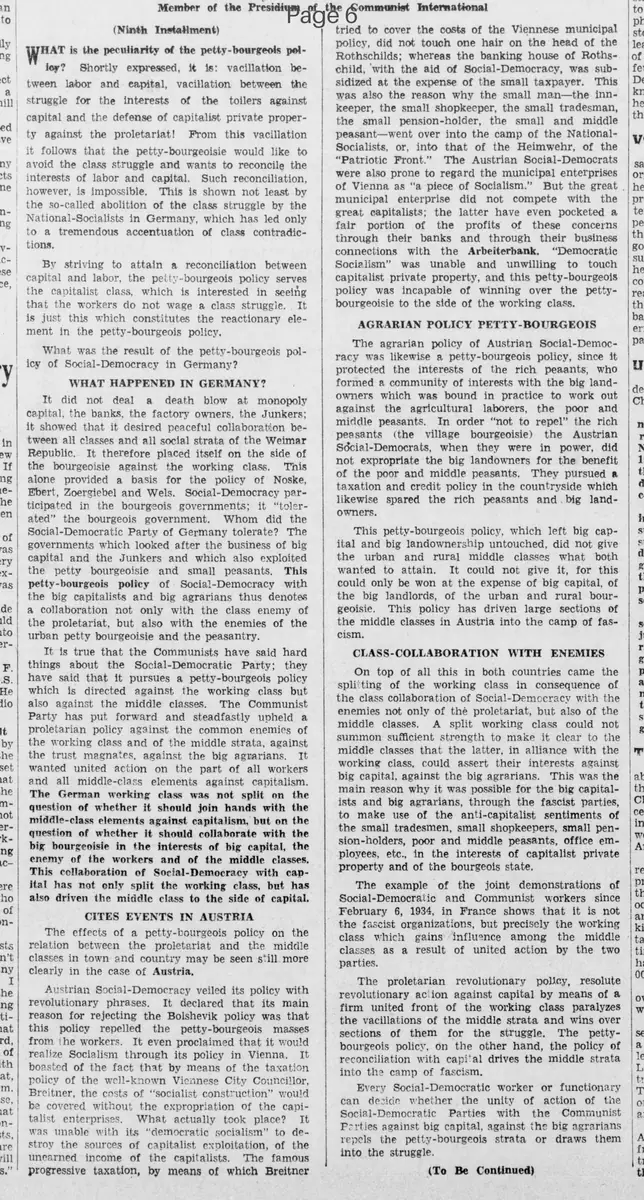
(Ninth Installment)
What is the peculiarity of the petty-bourgeois policy?
Shortly expressed, it is: vacillation between labor and capital, vacillation between the struggle for the interests of the toilers against capital and the defense of capitalist private property against the proletariat! From this vacillation it follows that the petty-bourgeoisie would like to avoid the class struggle and wants to reconcile the interests of labor and capital. Such reconciliation, however, is impossible. This is shown not least by the so-called abolition of the class struggle by the National-Socialists in Germany, which has led only to a tremendous accentuation of class contradictions.
By striving to attain a reconciliation between capital and labor, the petty-bourgeois policy serves the capitalist class, which is interested in seeing that the workers do not wage a class struggle. It is just this which constitutes the reactionary element in the petty-bourgeois policy.
What was the result of the petty-bourgeois policy of Social-Democracy in Germany?
WHAT HAPPENED IN GERMANY?
It did not deal a death blow at monopoly capital, the banks, the factory owners, the Junkers; it showed that it desired peaceful collaboration between all classes and all social strata of the Weimar Republic. It therefore placed itself on the side of the bourgeoisie against the working class. This alone provided a basis for the policy of Noske, Ebert, Zoergiebel and Wels. Social-Democracy participated in the bourgeois governments; it "tolerated" the bourgeois government. Whom did the Social-Democratic Party of Germany tolerate? The governments which looked after the business of big capital and the Junkers and which also exploited the petty bourgeoisie and small peasants. This petty-bourgeois policy of Social-Democracy with the big capitalists and big agrarians thus denotes a collaboration not only with the class enemy of the proletariat, but also with the enemies of the urban petty bourgeoisie and the peasantry.
It is true that the Communists have said hard things about the Social-Democratic Party; they have said that it pursues a petty-bourgeois policy which is directed against the working class but also against the middle classes. The Communist Party has put forward and steadfastly upheld a proletarian policy against the common enemies of the working class and of the middle strata, against the trust magnates, against the big agrarians. It wanted united action on the part of all workers and all middle-class elements against capitalism.
The German working class was not split on the question of whether it should join hands with the middle-class elements against capitalism, but on the question of whether it should collaborate with the big bourgeoisie in the interests of big capital, the enemy of the workers and of the middle classes.
This collaboration of Social-Democracy with capital has not only split the working class, but has also driven the middle class to the side of capital.
CITES EVENTS IN AUSTRIA
The effects of a petty-bourgeois policy on the relation between the proletariat and the middle classes in town and country may be seen still more clearly in the case of Austria.
Austrian Social-Democracy veiled its policy with revolutionary phrases. It declared that its main reason for rejecting the Bolshevik policy was that this policy repelled the petty-bourgeois masses from the workers. It even proclaimed that it would realize Socialism through its policy in Vienna. It boasted of the fact that by means of the taxation policy of the well-known Viennese City Councillor, Breitner, the costs of "socialist construction" would be covered without the expropriation of the capitalist enterprises. What actually took place? It was unable with its "democratic socialism" to destroy the sources of capitalist exploitation, of the unearned income of the capitalists. The famous progressive taxation, by means of which Breitner tried to cover the costs of the Viennese municipal policy, did not touch one hair on the head of the Rothschilds; whereas the banking house of Rothschild, with the aid of Social-Democracy, was subsidized at the expense of the small taxpayer. This was also the reason why the small man-the innkeeper, the small shopkeeper, the small tradesman, the small pension-holder, the small and middle peasant-went over into the camp of the National-Socialists, or, into that of the Heimwehr, of the "Patriotic Front." The Austrian Social-Democrats were also prone to regard the municipal enterprises of Vienna as "a piece of Socialism." But the great municipal enterprise did not compete with the great capitalists; the latter have even pocketed a fair portion of the profits of these concerns through their banks and through their business connections with the Arbeiterbank. "Democratic Socialism" was unable and unwilling to touch capitalist private property, and this petty-bourgeois policy was incapable of winning over the petty-bourgeoisie to the side of the working class.
AGRARIAN POLICY PETTY-BOURGEOIS
The agrarian policy of Austrian Social-Democracy was likewise a petty-bourgeois policy, since it protected the interests of the rich peasants, who formed a community of interests with the big landowners which was bound in practice to work out against the agricultural laborers, the poor and middle peasants. In order not to repel the rich peasants (the village bourgeoisie) the Austrian Social-Democrats, when they were in power, did not expropriate the big landowners for the benefit of the poor and middle peasants. They pursued a taxation and credit policy in the countryside which likewise spared the rich peasants and big landowners.
This petty-bourgeois policy, which left big capital and big landownership untouched, did not give the urban and rural middle classes what both wanted to attain. It could not give it, for this could only be won at the expense of big capital, of the big landlords, of the urban and rural bourgeoisie. This policy has driven large sections of the middle classes in Austria into the camp of fascism.
CLASS-COLLABORATION WITH ENEMIES
On top of all this in both countries came the splitting of the working class in consequence of the class collaboration of Social-Democracy with the enemies not only of the proletariat, but also of the middle classes. A split working class could not summon sufficient strength to make it clear to the middle classes that the latter, in alliance with the working class, could assert their interests against big capital, against the big agrarians. This was the main reason why it was possible for the big capitalists and big agrarians, through the fascist parties, to make use of the anti-capitalist sentiments of the small tradesmen, small shopkeepers, small pension-holders, poor and middle peasants, office employees, etc., in the interests of capitalist private property and of the bourgeois state.
The example of the joint demonstrations of Social-Democratic and Communist workers since February 6, 1934, in France shows that it is not the fascist organizations, but precisely the working class which gains influence among the middle classes as a result of united action by the two parties.
The proletarian revolutionary policy, resolute revolutionary action against capital by means of a firm united front of the working class paralyzes the vacillations of the middle strata and wins over sections of them for the struggle. The petty-bourgeois policy, on the other hand, the policy of reconciliation with capital drives the middle strata into the camp of fascism.
Every Social-Democratic worker or functionary can decide whether the unity of action of the Social-Democratic Parties with the Communist Parties against big capital, against the big agrarians repels the petty-bourgeois strata or draws them into the struggle.
(To Be Continued)
What is the peculiarity of the petty-bourgeois policy?
Shortly expressed, it is: vacillation between labor and capital, vacillation between the struggle for the interests of the toilers against capital and the defense of capitalist private property against the proletariat! From this vacillation it follows that the petty-bourgeoisie would like to avoid the class struggle and wants to reconcile the interests of labor and capital. Such reconciliation, however, is impossible. This is shown not least by the so-called abolition of the class struggle by the National-Socialists in Germany, which has led only to a tremendous accentuation of class contradictions.
By striving to attain a reconciliation between capital and labor, the petty-bourgeois policy serves the capitalist class, which is interested in seeing that the workers do not wage a class struggle. It is just this which constitutes the reactionary element in the petty-bourgeois policy.
What was the result of the petty-bourgeois policy of Social-Democracy in Germany?
WHAT HAPPENED IN GERMANY?
It did not deal a death blow at monopoly capital, the banks, the factory owners, the Junkers; it showed that it desired peaceful collaboration between all classes and all social strata of the Weimar Republic. It therefore placed itself on the side of the bourgeoisie against the working class. This alone provided a basis for the policy of Noske, Ebert, Zoergiebel and Wels. Social-Democracy participated in the bourgeois governments; it "tolerated" the bourgeois government. Whom did the Social-Democratic Party of Germany tolerate? The governments which looked after the business of big capital and the Junkers and which also exploited the petty bourgeoisie and small peasants. This petty-bourgeois policy of Social-Democracy with the big capitalists and big agrarians thus denotes a collaboration not only with the class enemy of the proletariat, but also with the enemies of the urban petty bourgeoisie and the peasantry.
It is true that the Communists have said hard things about the Social-Democratic Party; they have said that it pursues a petty-bourgeois policy which is directed against the working class but also against the middle classes. The Communist Party has put forward and steadfastly upheld a proletarian policy against the common enemies of the working class and of the middle strata, against the trust magnates, against the big agrarians. It wanted united action on the part of all workers and all middle-class elements against capitalism.
The German working class was not split on the question of whether it should join hands with the middle-class elements against capitalism, but on the question of whether it should collaborate with the big bourgeoisie in the interests of big capital, the enemy of the workers and of the middle classes.
This collaboration of Social-Democracy with capital has not only split the working class, but has also driven the middle class to the side of capital.
CITES EVENTS IN AUSTRIA
The effects of a petty-bourgeois policy on the relation between the proletariat and the middle classes in town and country may be seen still more clearly in the case of Austria.
Austrian Social-Democracy veiled its policy with revolutionary phrases. It declared that its main reason for rejecting the Bolshevik policy was that this policy repelled the petty-bourgeois masses from the workers. It even proclaimed that it would realize Socialism through its policy in Vienna. It boasted of the fact that by means of the taxation policy of the well-known Viennese City Councillor, Breitner, the costs of "socialist construction" would be covered without the expropriation of the capitalist enterprises. What actually took place? It was unable with its "democratic socialism" to destroy the sources of capitalist exploitation, of the unearned income of the capitalists. The famous progressive taxation, by means of which Breitner tried to cover the costs of the Viennese municipal policy, did not touch one hair on the head of the Rothschilds; whereas the banking house of Rothschild, with the aid of Social-Democracy, was subsidized at the expense of the small taxpayer. This was also the reason why the small man-the innkeeper, the small shopkeeper, the small tradesman, the small pension-holder, the small and middle peasant-went over into the camp of the National-Socialists, or, into that of the Heimwehr, of the "Patriotic Front." The Austrian Social-Democrats were also prone to regard the municipal enterprises of Vienna as "a piece of Socialism." But the great municipal enterprise did not compete with the great capitalists; the latter have even pocketed a fair portion of the profits of these concerns through their banks and through their business connections with the Arbeiterbank. "Democratic Socialism" was unable and unwilling to touch capitalist private property, and this petty-bourgeois policy was incapable of winning over the petty-bourgeoisie to the side of the working class.
AGRARIAN POLICY PETTY-BOURGEOIS
The agrarian policy of Austrian Social-Democracy was likewise a petty-bourgeois policy, since it protected the interests of the rich peasants, who formed a community of interests with the big landowners which was bound in practice to work out against the agricultural laborers, the poor and middle peasants. In order not to repel the rich peasants (the village bourgeoisie) the Austrian Social-Democrats, when they were in power, did not expropriate the big landowners for the benefit of the poor and middle peasants. They pursued a taxation and credit policy in the countryside which likewise spared the rich peasants and big landowners.
This petty-bourgeois policy, which left big capital and big landownership untouched, did not give the urban and rural middle classes what both wanted to attain. It could not give it, for this could only be won at the expense of big capital, of the big landlords, of the urban and rural bourgeoisie. This policy has driven large sections of the middle classes in Austria into the camp of fascism.
CLASS-COLLABORATION WITH ENEMIES
On top of all this in both countries came the splitting of the working class in consequence of the class collaboration of Social-Democracy with the enemies not only of the proletariat, but also of the middle classes. A split working class could not summon sufficient strength to make it clear to the middle classes that the latter, in alliance with the working class, could assert their interests against big capital, against the big agrarians. This was the main reason why it was possible for the big capitalists and big agrarians, through the fascist parties, to make use of the anti-capitalist sentiments of the small tradesmen, small shopkeepers, small pension-holders, poor and middle peasants, office employees, etc., in the interests of capitalist private property and of the bourgeois state.
The example of the joint demonstrations of Social-Democratic and Communist workers since February 6, 1934, in France shows that it is not the fascist organizations, but precisely the working class which gains influence among the middle classes as a result of united action by the two parties.
The proletarian revolutionary policy, resolute revolutionary action against capital by means of a firm united front of the working class paralyzes the vacillations of the middle strata and wins over sections of them for the struggle. The petty-bourgeois policy, on the other hand, the policy of reconciliation with capital drives the middle strata into the camp of fascism.
Every Social-Democratic worker or functionary can decide whether the unity of action of the Social-Democratic Parties with the Communist Parties against big capital, against the big agrarians repels the petty-bourgeois strata or draws them into the struggle.
(To Be Continued)
What sub-type of article is it?
Essay
What themes does it cover?
Political
Taxation Oppression
What keywords are associated?
Petty Bourgeois Policy
Social Democracy
Class Struggle
Germany
Austria
Fascism
Capitalism
United Front
Literary Details
Title
(Ninth Installment)
Subject
Critique Of Petty Bourgeois Policy In Social Democracy
Key Lines
Shortly Expressed, It Is: Vacillation Between Labor And Capital, Vacillation Between The Struggle For The Interests Of The Toilers Against Capital And The Defense Of Capitalist Private Property Against The Proletariat!
Such Reconciliation, However, Is Impossible. This Is Shown Not Least By The So Called Abolition Of The Class Struggle By The National Socialists In Germany, Which Has Led Only To A Tremendous Accentuation Of Class Contradictions.
The Petty Bourgeois Policy, On The Other Hand, The Policy Of Reconciliation With Capital Drives The Middle Strata Into The Camp Of Fascism.