Thank you for visiting SNEWPapers!
Sign up free
Gazette Of The United States And Daily Evening Advertiser
Philadelphia, Philadelphia County, Pennsylvania
What is this article about?
On December 4, 1794, Merlin of Douai addressed the French National Convention, exposing enemy intrigues spreading false peace rumors to undermine French resolve. He affirmed France's desire for peace on republican terms, critiquing allies like England and predicting shifts in coalition members' stances.
Clipping
OCR Quality
Full Text
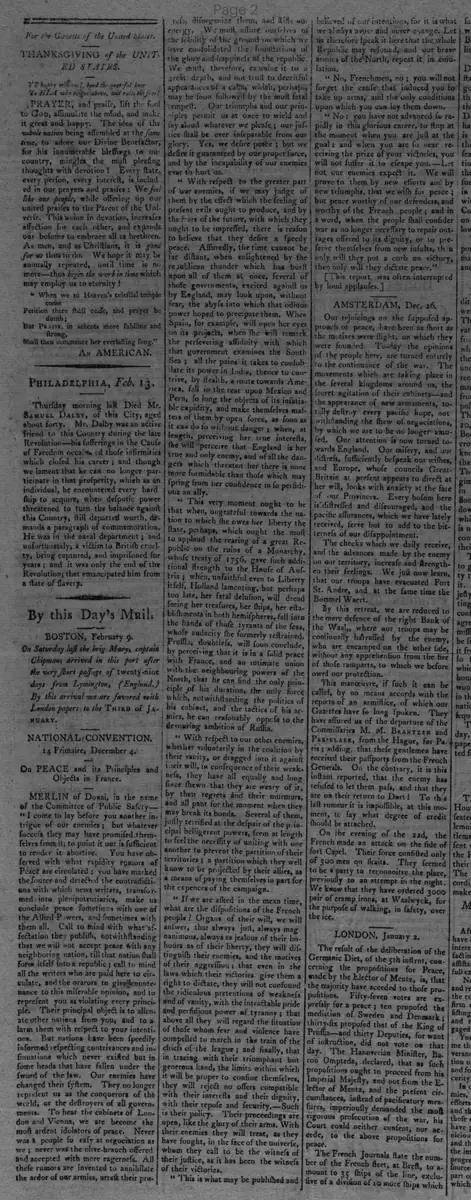
14 Frimaire, December 4.
On PEACE and its Principles and
Objects in France.
MERLIN of Douai, in the name
of the Committee of Public Safety—
"I come to lay before you another in-
trigue of our enemies; but whatever
success they may have promised them-
selves from it, to point it out is sufficient
to render it abortive. You have ob-
served with what rapidity rumors of
Peace are circulated; you have marked
the source and detected the contradicti-
ons with which news writers, transfor-
med into plenipotentiaries, make us
conclude peace sometimes with one of
the Allied Powers, and sometimes with
them all. Call to mind with what af-
fectation they publish, notwithstanding
that we will not accept peace with any
neighboring nation, till that nation has
formed itself into a republic; call to mind
all the writers who are paid here to cir-
culate, and the orators to give counte-
nance to this miserable opinion, and to
represent you as violating every princi-
ple. Their principal object is to alien-
ate other nations from you, and to a-
larm them with respect to your intenti-
ons. But nations have been speedily
informed respecting contrivances and in-
sinuations which never existed but in
some heads that have fallen under the
sword of the law. Our enemies have
changed their system. They no longer
represent us as the conquerors of the
world, or the destroyers of all govern-
ments. To hear the cabinets of Lon-
don and Vienna, we are become the
most ardent idolators of peace. Never
was a people so easy at negotiation as
we; never was the olive-branch offered
and accepted with more eagerness. All
these rumors are invented to annihilate
the ardor of our armies, arrest their pro-
gress, disorganize them, and stifle our
energy. We must assure ourselves of
the solidity of the ground on which we
have consolidated the foundations of
the glory and happiness of the republic.
We must, therefore, examine it to a
great depth, and not trust to deceitful
appearances of a calm, which, perhaps,
may be soon followed by the most fatal
tempest. Our triumphs and our prin-
ciples permit us at once to wield and
say aloud whatever we please; our ju-
stice shall be ever inseparable from our
glory. Yes, we desire peace; but we
desire it guaranteed by our proper force,
and by the incapability of our enemies
ever to hurt us.
"With respect to the greater part
of our enemies, if we may judge of
them by the effect which the feeling of
present evils ought to produce, and by
the fears of the future, with which they
ought to be impressed, there is reason
to believe that they desire a speedy
peace. Assuredly, the time cannot be
far distant, when enlightened by the
republican thunder which has burst
upon all of them at once, several of
those governments, excited against us
by England, may look upon, without
fear, the abyss into which that odious
power hoped to precipitate them. When
Spain, for example, shall open her eyes
on its projects, when she shall remark
the persevering assiduity with which
that government examines the South
Sea; all the pains it takes to consoli-
date its power in India, thence to con-
trive, by stealth, a route towards Ame-
rica, fall in the rear upon Mexico and
Peru, so long the objects of its insatia-
ble cupidity, and make themselves ma-
sters of them by open force, as soon
as it can do so without danger; when, at
length, perceiving her true interests,
she will perceive that England is her
true and only enemy, and of all the dan-
gers which threaten her there is none
more formidable than those which may
spring from her confidence in so peridi-
ous an ally.
"This very moment ought to be
that when, ungrateful towards the na-
tion to which she owes her liberty the
state, perhaps, which ought the most
to applaud the rearing of a great Re-
public on the ruins of a Monarchy.
whose treaty of 1756, gave such addi-
tional strength to the House of Au-
stria; when, unfaithful even to Liberty
itself, Holland lamenting, but perhaps
too late, her fatal delusion, will dread
seeing her treasures, her ships, her esta-
blishments in both hemispheres, fall into
the hands of those tyrants of the seas,
whose audacity she formerly restrained.
Prussia, doubtless, will soon conclude,
by perceiving that it is in a solid peace
with France, and an intimate union
with the neighbouring powers of the
North, that she can find the only prin-
ciple of her duration, the only force
which, notwithstanding the politics of
her cabinet, and the tactics of her ar-
mies, she can reasonably oppose to the
devouring ambition of Russia.
"With respect to our other enemies,
whether voluntarily in the coalition by
their vanity, or dragged into it against
their will, in consequence of their weak-
ness, they have all equally and long
since shewn that they are weary of it,
by their regrets and their murmurs,
and all pant for the moment when they
may break its bonds. Several of them,
justly terrified at the despair of the p in-
cipal belligerent powers, seem at length
to feel the necessity of uniting with one
another to prevent the partition of their
territories; a partition which they well
know to be projected by their allies, as
a means of paying themselves in part for
the expences of the campaign.
"If we are asked in the mean time.
what are the dispositions of the French
people? Organs of their will, we will
answer, that always just, always mag-
nanimous, always as jealous of their ho.
nors as of their liberty, they will di.
stinguish their enemies, and the motives
of their aggression; that even in the
laws which their victories give them a
right to dictate, they will not confound
the ridiculous pretentions of weakness
and of vanity, with the intractable pride
and perfidious power of tyranny; that
above all they will regard the situation
of those whom fear and violence have
compelled to march in the train of the
chiefs of the league; and finally, that
in tracing with their triumphant but
generous hand, the limits within which
it will be proper to confine themselves,
they will reject no offers compatible
with their interests and their dignity,
with their repose and security.—Such
is their policy. Their proceedings are
open, like the glory of their arms. With
their enemies they will treat, as they
have fought, in the face of the universe.
whom they call to be the witness of
their justice, as it has been the witness
of their victories.
"This is what may be published and
believed of our intentions, for it is what
we always avow: and never change. Let
us therefore speak it here that the whole
Republic may resound, and our brave
armies of the North, repeat it in emu-
lation.
"No, Frenchmen, no; you will not
forget the cause that induced you to
take up arms, and the only conditions
upon which you can lay them down.
"No: you have not advanced so ra-
pidly in this glorious career, to stop at
the moment when you are just at the
goal: and when you are so near re-
ceiving the prize of your victories, you
will not suffer it to escape you.—Let
not our enemies expect it. We will
prove to them by new efforts and by
new triumphs, that we wish for peace;
but peace worthy of our defenders, and
worthy of the French people; and in
a word, when the people shall consider
war as no longer necessary to repair out-
rages offered to its dignity, or to pre-
serve themselves from new insults, th n
only will they put a curb on victory,
then only will they dictate peace."
[This report was often interrupted
by loud applauses.]
What sub-type of article is it?
What keywords are associated?
What entities or persons were involved?
Where did it happen?
Foreign News Details
Primary Location
France
Event Date
14 Frimaire, December 4
Key Persons
Outcome
france desires peace guaranteed by its strength and enemy incapability to harm; rejects offers not compatible with interests, dignity, repose, and security.
Event Details
Merlin of Douai, for the Committee of Public Safety, exposes enemy intrigues spreading false peace rumors to undermine French armies and energy. He affirms France's principled desire for peace only on republican terms, critiques coalition members like England, Spain, Holland, Prussia, and predicts their potential shifts against England and desire to exit the coalition.