Thank you for visiting SNEWPapers!
Sign up free
Story
September 23, 1892
Fairhaven Herald
Fairhaven, Bellingham, Whatcom County, Washington
What is this article about?
An article discussing the geographical and economic factors that determine the locations and growth of great cities, such as seaports, river confluences, and transshipment points, with Washington, D.C., as a political exception lacking commercial production.
Clipping
OCR Quality
95%
Excellent
Full Text
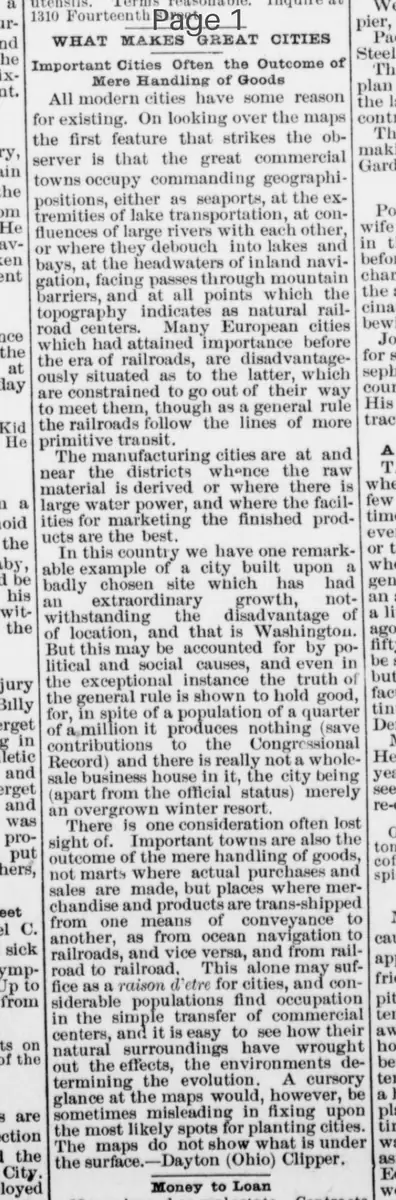
WHAT MAKES GREAT CITIES
Important Cities
Often the Outcome of
Mere Handling of Goods
All modern cities have some reason
for existing. On looking over the maps
the first feature that strikes the ob-
server is that the great commercial
towns occupy commanding geographi-
cal positions, either as seaports, at the ex-
tremities of lake transportation, at con-
fluences of large rivers with each other.
or where they debouch into lakes and
bays, at the headwaters of inland navi-
gation, facing passes through mountain
barriers, and at all points which the
topography indicates as natural rail-
road centers. Many European cities
which had attained importance before
the era of railroads, are disadvantage-
ously situated as to the latter, which
are constrained to go out of their way
to meet them, though as a general rule
the railroads follow the lines of more
primitive transit.
The manufacturing cities are at and
near the districts whence the raw
material is derived or where there is
large water power, and where the facil-
ities for marketing the finished prod-
ucts are the best.
In this country we have one remark-
able example of a city built upon a
badly chosen site which has had
an
extraordinary growth, notwithstand-
ing the disadvantage of location, and that is Washington.
But this may be accounted for by po-
litical and social causes, and even in
the exceptional instance the truth of
the general rule is shown to hold good,
for, in spite of a population of a quarter
of a million it produces nothing (save
contributions to the Congressional
Record) and there is really not a whole-
sale business house in it, the city being
( apart from the official status) merely
an overgrown winter resort.
There is one consideration often lost
sight of. Important towns are also the
outcome of the mere handling of goods,
not marts where actual purchases and
sales are made, but places where mer-
chandise and products are trans-shipped
from one means of conveyance to
another, as from ocean navigation to
railroads, and vice versa, and from rail-
road to railroad. This alone may suf-
fice as a raison d'etre for cities, and con-
siderable populations find occupation
in the simple transfer of commercial
centers, and it is easy to see how their
natural surroundings have wrought
out the effects, the environments de-
termining the evolution. A cursory
glance at the maps would, however, be
sometimes misleading in fixing upon
the most likely spots for planting cities.
The maps do not show what is under
the surface. -Dayton (Ohio) Clipper.
Important Cities
Often the Outcome of
Mere Handling of Goods
All modern cities have some reason
for existing. On looking over the maps
the first feature that strikes the ob-
server is that the great commercial
towns occupy commanding geographi-
cal positions, either as seaports, at the ex-
tremities of lake transportation, at con-
fluences of large rivers with each other.
or where they debouch into lakes and
bays, at the headwaters of inland navi-
gation, facing passes through mountain
barriers, and at all points which the
topography indicates as natural rail-
road centers. Many European cities
which had attained importance before
the era of railroads, are disadvantage-
ously situated as to the latter, which
are constrained to go out of their way
to meet them, though as a general rule
the railroads follow the lines of more
primitive transit.
The manufacturing cities are at and
near the districts whence the raw
material is derived or where there is
large water power, and where the facil-
ities for marketing the finished prod-
ucts are the best.
In this country we have one remark-
able example of a city built upon a
badly chosen site which has had
an
extraordinary growth, notwithstand-
ing the disadvantage of location, and that is Washington.
But this may be accounted for by po-
litical and social causes, and even in
the exceptional instance the truth of
the general rule is shown to hold good,
for, in spite of a population of a quarter
of a million it produces nothing (save
contributions to the Congressional
Record) and there is really not a whole-
sale business house in it, the city being
( apart from the official status) merely
an overgrown winter resort.
There is one consideration often lost
sight of. Important towns are also the
outcome of the mere handling of goods,
not marts where actual purchases and
sales are made, but places where mer-
chandise and products are trans-shipped
from one means of conveyance to
another, as from ocean navigation to
railroads, and vice versa, and from rail-
road to railroad. This alone may suf-
fice as a raison d'etre for cities, and con-
siderable populations find occupation
in the simple transfer of commercial
centers, and it is easy to see how their
natural surroundings have wrought
out the effects, the environments de-
termining the evolution. A cursory
glance at the maps would, however, be
sometimes misleading in fixing upon
the most likely spots for planting cities.
The maps do not show what is under
the surface. -Dayton (Ohio) Clipper.
What sub-type of article is it?
Explanatory Essay
Geographical Analysis
What keywords are associated?
Great Cities
Geographical Positions
Commercial Towns
Manufacturing Districts
Transshipment Points
Washington Exception
Where did it happen?
Various Commercial And Manufacturing Sites; Washington, D.C.; Dayton, Ohio
Story Details
Location
Various Commercial And Manufacturing Sites; Washington, D.C.; Dayton, Ohio
Story Details
The article explores how great cities arise from advantageous geographical positions for trade, transportation, and manufacturing, noting transshipment roles and exceptions like Washington due to political factors.