Thank you for visiting SNEWPapers!
Sign up free
American Citizen
Canton, Madison County, Mississippi
What is this article about?
A farmer details five years of chinch bug damage to corn crops and proposes a remedy: removing all shocks and stalks from fields after harvest, either by feeding to stock or burning, to prevent overwintering and eliminate the pests, based on observations from last year and this spring.
Clipping
OCR Quality
Full Text
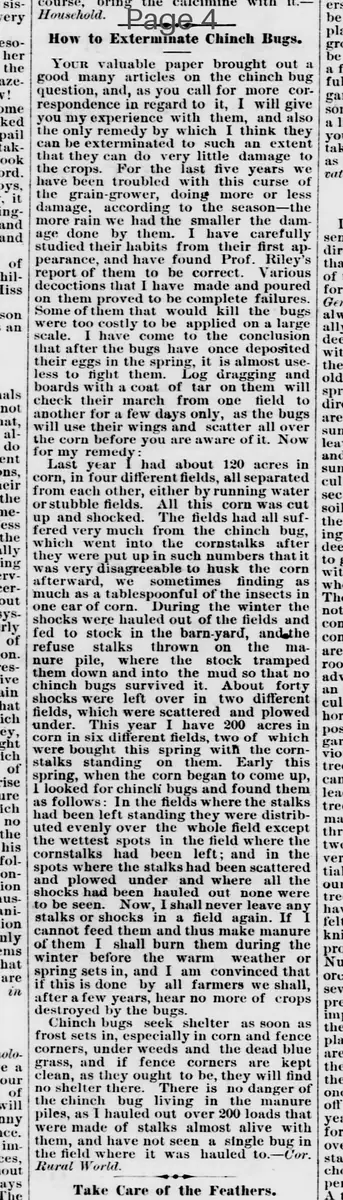
Your valuable paper brought out a good many articles on the chinch bug question, and, as you call for more correspondence in regard to it, I will give you my experience with them, and also the only remedy by which I think they can be exterminated to such an extent that they can do very little damage to the crops. For the last five years we have been troubled with this curse of the grain-grower, doing more or less damage, according to the season-the more rain we had the smaller the damage done by them. I have carefully studied their habits from their first appearance, and have found Prof. Riley's report of them to be correct. Various decoctions that I have made and poured on them proved to be complete failures. Some of them that would kill the bugs were too costly to be applied on a large scale. I have come to the conclusion that after the bugs have once deposited their eggs in the spring, it is almost useless to fight them. Log dragging and boards with a coat of tar on them will check their march from one field to another for a few days only, as the bugs will use their wings and scatter all over the corn before you are aware of it. Now for my remedy:
Last year I had about 120 acres in corn, in four different fields, all separated from each other, either by running water or stubble fields. All this corn was cut up and shocked. The fields had all suffered very much from the chinch bug, which went into the cornstalks after they were put up in such numbers that it was very disagreeable to husk the corn afterward, we sometimes finding as much as a tablespoonful of the insects in one ear of corn. During the winter the shocks were hauled out of the fields and fed to stock in the barn-yard, and the refuse stalks thrown on the manure pile, where the stock tramped them down and into the mud so that no chinch bugs survived it. About forty shocks were left over in two different fields, which were scattered and plowed under. This year I have 200 acres in corn in six different fields, two of which were bought this spring with the corn stalks standing on them. Early this spring, when the corn began to come up, I looked for chinch bugs and found them as follows: In the fields where the stalks had been left standing they were distributed evenly over the whole field except the wettest spots in the field where the cornstalks had been left; and in the spots where the stalks had been scattered and plowed under and where all the shocks had been hauled out none were to be seen. Now, I shall never leave any stalks or shocks in a field again. If I cannot feed them and thus make manure of them I shall burn them during the winter before the warm weather or spring sets in, and I am convinced that if this is done by all farmers we shall, after a few years, hear no more of crops destroyed by the bugs.
Chinch bugs seek shelter as soon as frost sets in, especially in corn and fence corners, under weeds and the dead blue grass, and if fence corners are kept clean, as they ought to be, they will find no shelter there. There is no danger of the chinch bug living in the manure piles, as I hauled out over 200 loads that were made of stalks almost alive with them, and have not seen a single bug in the field where it was hauled to.-Cor. Rural World.
What sub-type of article is it?
What keywords are associated?
Domestic News Details
Event Date
Last Five Years, With Details From Last Year And Early This Spring
Outcome
chinch bugs largely eliminated in fields where stalks were removed and destroyed; no bugs seen in treated areas this spring, confirming method's effectiveness in preventing crop damage.
Event Details
Farmer observes chinch bug habits and damage to corn over five years, tests failed remedies, and implements successful strategy of hauling shocks to barn for feeding or plowing under remnants, preventing bug survival over winter; advises burning if not feeding, and cleaning fence corners.