Thank you for visiting SNEWPapers!
Sign up free
Bloomington Herald
Bloomington, Muscatine, Story County, Muscatine County, Iowa
What is this article about?
Traveler's letter from Birmingham, Aug. 27, 1843, detailing rail journey from London, observations on English countryside and industry, social distress in Staffordshire, pedestrian trip to Stratford-on-Avon to visit Shakespeare's birthplace and tomb, Warwick Castle, and Kenilworth ruins, evoking historical and natural beauty.
Merged-components note: Continuation of the same literary piece, 'Letters from Europe', across pages with matching topic and style.
Clippings
1 of 2
OCR Quality
Full Text
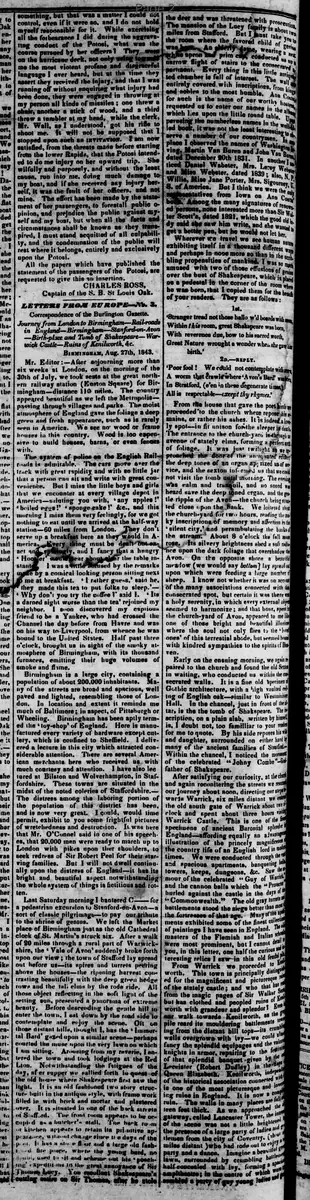
Correspondence of the Burlington Gazette.
Journey from London to Birmingham---Rail-roads in England Birmingham Stratford-on-Avon---Birth-place and Tomb of Shakespeare---Warwick Castle Ruins of Kenilworth, &c.
BIRMINGHAM, Aug. 27th, 1843.
Mr. Editor:--After sojourning more than six weeks at London, on the morning of the 30th of July, we took seats at the great northern railway station (Euston Square) for Birmingham---distance 110 miles. The country appeared beautiful as we left the Metropolis---passing through villages and parks. The moist atmosphere of England gave the foliage a deep green and fresh appearance, such as is rarely seen in America.
We see no wood or frame houses in this country. Wood is too expensive to build houses, barns, or even fences with.
The system of locomotion on the English Rail-roads is admirable. The cars move over the track with great rapidity and with so little jar that a person can sit and write with great convenience.
But I miss the little boys and girls that we encounter at every village depot in America---saluting you with, 'any apples!' 'boiled eggs!' 'sponge cake!' &c., and this morning I miss them very feelingly, for we got nothing to eat until we arrived at the half-way station---60 miles from London. They don't serve up a breakfast here as they would in America. Everything must be dealt-out exact and sparingly, and I fancy that a hungry Hoosier would tear about the table in---
I was a little amused by the remarks made by a comical looking person sitting next me at breakfast. 'I rather guess,' said he, 'they made this tea to put folks to sleep.'-- 'Why don't you try the coffee?' said I. 'It's a darned sight worse than the tea' rejoined my neighbor. I soon discovered my captious friend to be a Yankee, who had crossed the Channel the day before from Havre and was on his way to-Liverpool, from whence he was bound to the United States. Half past three o'clock, brought us in sight of the smoky atmosphere of Birmingham. with its thousand furnaces, emitting their huge volumes of smoke and flame.
Birmingham is a large city, containing a population of about 200,000 inhabitants. Many of the streets are broad and spacious, well paved and lighted, resembling those of London. In location and extent it reminds me much of Baltimore: in aspect, of Pittsburgh or Wheeling. Birmingham has been aptly termed the toy-shop' of England. Here is manufactured every variety of hardware except cutlery, which is confined to Sheffield. I delivered a lecture in this city which attracted considerable attention. There are several American merchants here who received us with much courtesy and attention. I have also lectured at Bilston and Wolverhampton, in Staffordshire. These towns are situated in the midst of the noted collieries of Staffordshire. The distress among the laboring portion of the population of this district has been. and is now very great. I could, would time permit, exhibit to you some frightful pictures of wretchedness and destruction. It. was here that Mr. O'Connel said in one of his speeches, that 20,000 men were ready to march up to London with pikes upon their shoulders, to seek redress of Sir Robert Peel or their starving families. But I will not dwell continually upon the distress of England---it has its bright and beautiful aspect notwithstanding the whole system of things is fictitious and rotten.
Last Saturday morning I bantered C for a pedestrian excursion to Stratford-on-Avon---a sort of classic pilgrimage---so pay our tribute to the shrine of genius. We left the Market place of Birmingham just as the old Cathedral clock of St. Martin's struck six. After a walk of 20 miles through a rural part of Warwick-shire, the 'Vale of Avon' suddenly broke forth upon our view ; the town of Stratford lay spread out before us---its spires and turrets peering above the houses---the ripening harvest contrasting beautifully with the deep green hedge rows and the tall elms by the road side. All those objects reflecting in the soft light of the setting sun, presented a panorama of extreme beauty. Before descending the gentle hill to enter the town, I sat down by the road side to contemplate and enjoy the scene. O! on those distant hills, thought I, has the immortal Bard' gazed upon a similar scene---perhaps courted the muse upon the very lawn on which I am sitting. ' Arousing from my reverie, I entered the town and took lodgings at the Red Lion. Notwithstanding the fatigue of the day, after supper we sallied forth in quest of the old house where Shakespeare first saw the light. ' It is an old fashioned two story structure---built in the antique style, with frame work filled in with brick and mortar and plastered over. It is situated in one of the back streets of Stratford. The front room appears to be occupied as a butcher's stall. The back room or kitchen appears to retain its primitive appearance, without change since the days of the poet. It has a stone floor and a large old fashioned fire place, where the young bard, no doubt, used to sit and scheme out his poaching expeditions to the great annoyance of Sir Thomas Lucy. You recollect---
the deer and was threatened with prosecution
Stranger tread not those hallow'd boards with
Within this room, great Shakespeare was born,
With reverence due, bow to his sacred worth,
Great Nature wrought a wonder when she gave
birth.'
2D. REPLY.
'Poor fool! We could not contemplate with
A worm that Crawls where Avon's Bard' wakes
In Stratford, (e'en in these degenerate times)
All is respectable---except thy rhymes.'
From the house that gave the poet birth we proceeded to the church where repose his mortal remains, or rather his ashes. It is indeed a lonely spot---in fit unison for the sleeper in death The entrance to the church-yard is through a avenue of stately elms, forming a perfect arch of foliage. It was just twilight as we approached the door of the antiquated edifice the deep tones of an organ apprised us of service, and the sexton informed us that we could not visit the tomb until morning. The evening was calm and tranquil, and no sound was heard save the deep toned organ, and the gentle ripple of the Avon---the church being situated close upon the bank. We loitered about the church-yard for two hours. reading the many inscriptions of memory and affection in the silent city,' and perambulating the banks of the stream. About 8 o'clock the full moon rose. Its silvery brightness shed a soft radiance upon the dark foliage that overshadow the Avon. On the opposite shore a beautiful meadow (we would say bottom) lay spread out upon which were feeding a large number of sheep. I know not whether it was on account of the many associations connected with the Consecrated spot, but certain it was there was a holy serenity, in which every external object seemed to harmonize; and that hour, spent in the church-yard of Avon, appeared to me like one of those bright and beautiful illusions where the soul not only flies to the loved ones' of this terrestrial abode. but seemed borne with kindred sympathies to the spirits of Heaven.
Early on the ensuing morning, we again repaired to the church and found the old Sexton in waiting, who conducted us within the consecrated walls. It is a fine old specimen of Gothic architecture, with a high vaulted ceiling of English oak---similar to Westminster Hall. In the chancel, just in front of the altar, is the tomb of Shakespeare. The inscription, on a plain slab, written by himself is, I doubt not, too familiar to your readers for me to quote. By his side reposes his wife and daughter, surrounded on either hand by many of the ancient families of Stratford.--- Within the chancel, I noticed the monument of the celebrated "John Combe"---God father of Shakespeare.
After satisfying our curiosity, at the chancel and again reconnoitering the streets we resumed our journey about noon, directing our steps towards Warwick, six miles distant we entered the old south gate of Warwick about two o'clock and spent about three hours visiting Warwick Castle. This is one of the finest specimens of ancient Baronial splendor England affording equally an advantageous illustration of the princely magnificence of the country life of an English lord in modern times. We were conducted through the splendid and spacious apartments, banqueting towers, keeps, dungeons, &c. Saw the armour of the celebrated "Guy of Warwick and the cannon balls which the "Protector hurled against the castle in the days of the "Commonwealth."
The old gray turrets the fortresses of that age. Many of the apartments exhibited some of the finest collections of paintings I have seen in England. The works of the Flemish and Italian schools were most prominent, but I cannot detail you, in this letter, all the curious and interesting relics I saw in this old feudal abode.
From Warwick we proceeded to Kenilworth. This town is principally distinguished for the magnificent and picturesque ruins of the stately castle; and who that has read from the magic pages of Sir Walter Scott but has clothed and peopled ruins of Kenilworth with grandeur and splendor E'en as we walk towards Kenilworth, as the pile reared its mouldering battlements to view over walls overgrown with ivy---we could almost fancy the splendid equipages and the knights in armor repairing to that splendid banquet ---given by the Leicester Robert Queen Elizabeth. Kenilworth, independent of the historical associations connected with it, is one of the most picturesque and interesting ruins in England. It is now a complete ruin The walls in many places are not less than fourteen feet thick. As we approached the grand gateway called Lancaster Tower the interest of the scene was not a little heightened by the presence of a large party of ladies and gentlemen from the city of Coventry. (about five miles distant who had rode out to view the ruins. The party was on the lawn. surrounded by crumbling battlements and a dunce. Imagine a beautiful green half-concealed with ivy. forming a spacious amphitheatre; in the centre of which were the party of say young ladies and
Imagine this, and you have a meagre looking down upon the joyous dancers a long table was spread out, covered with viands while from the neighboring 'loop-hole' and ivy-clad battlements might be seen the flowing dresses of fifty couple, dancing to the old flowers. On the other side of the band stationed srationed. It appeared on the afternoon of the 15th August. ruins of Kenilworth it know that this ancient castle was the romance of Kenilworth was founded br Elizabeth's visit in 1575. This grand festival concealed with the events Queen to hear, in 1843, the shrill notes of the bugle re-echoing through the halls for the gay ladies of Coventry to dance by, was no less impressive. ren by the Earl of Leicester continued for days in banqueting and revelry--and now,
lingering about the ruins of Kenilworth, my pa-
ten. I intended to have told you about Cov.
entry, "Birmingham on Saturday night," and
the renowned Father Matthew, whom I had
the pleasure of meeting in company, before I
get London; also, my journey to Manches-
ter, where, I met our very agreeable country-
man and old friend Mr. Catlin, also Miss Cat-
in.. I will stop now, invoking all the chari-
be crude and rambling remarks of
yours of those who have the patience to follow
CHE-MO-KO-MAN.
What sub-type of article is it?
What themes does it cover?
What keywords are associated?
What entities or persons were involved?
Literary Details
Title
Letters From Europe No. &.
Author
Che Mo Ko Man.
Subject
Journey From London To Birmingham, Stratford On Avon, Warwick Castle, Kenilworth
Form / Style
Travel Letter In Descriptive Prose
Key Lines