Thank you for visiting SNEWPapers!
Sign up free
The Union Daily Times
Union, Union County, South Carolina
What is this article about?
In Corbach, Germany, gold diggers are reopening pits along the Eder River idle since 1585, causing excitement in Waldeck over assayers' reports on gold-rich red clay. Dr. Beyschlag found 16th-century methods lost 70% of gold; modern solvents yield up to 1.25 ounces per ton.
Clipping
OCR Quality
Full Text
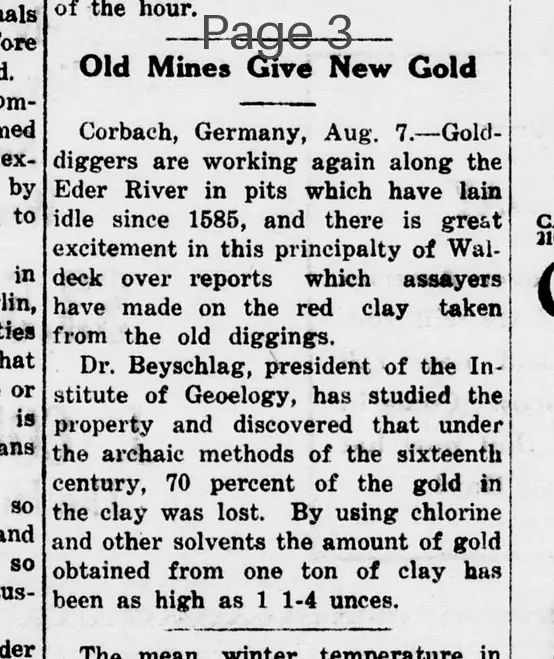
Dr. Beyschlag, president of the Institute of Geology, has studied the property and discovered that under the archaic methods of the sixteenth century, 70 percent of the gold in the clay was lost. By using chlorine and other solvents the amount of gold obtained from one ton of clay has been as high as 1 1-4 ounces.
What sub-type of article is it?
What keywords are associated?
What entities or persons were involved?
Where did it happen?
Foreign News Details
Primary Location
Corbach, Germany
Event Date
Aug. 7
Key Persons
Outcome
modern methods using chlorine and solvents yield up to 1 1-4 ounces of gold per ton of clay, compared to 70 percent loss under 16th-century methods.
Event Details
Gold-diggers are working again along the Eder River in pits idle since 1585, with great excitement in the principality of Waldeck over assayers' reports on red clay from old diggings. Dr. Beyschlag, president of the Institute of Geology, studied the property and discovered that archaic 16th-century methods lost 70 percent of the gold.