Thank you for visiting SNEWPapers!
Sign up free
Literary
June 25, 1806
Norfolk Gazette And Publick Ledger
Norfolk, Virginia
What is this article about?
Reflections from a Norwich writer on the recent solar eclipse, extraordinary astronomical events of 1805-1806, atmospheric changes, and philosophical arguments for the world's non-eternity based on eclipse calculations. Ties into religious views on mortality, quoting Addison on afterlife comfort and his dying words to Lord Warwick.
Clipping
OCR Quality
95%
Excellent
Full Text
PHILADELPHIA, June 19.
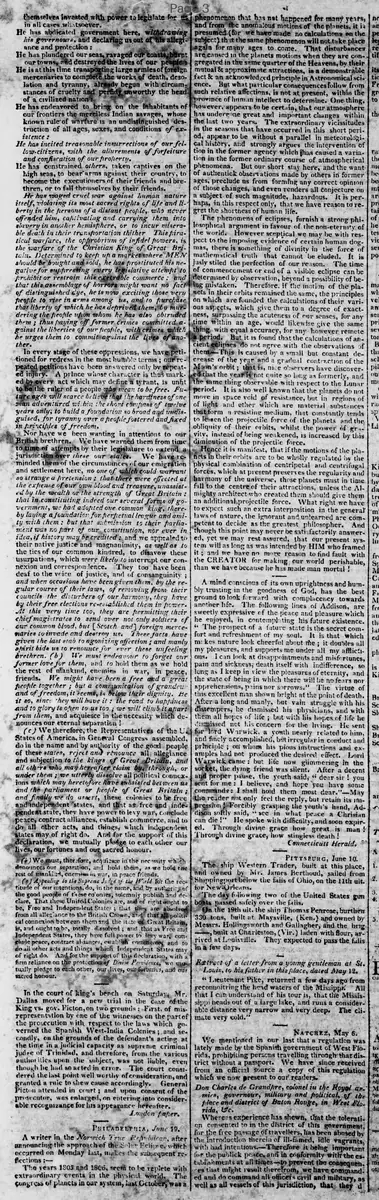
A writer in the Norwich True Republican, after announcing the approach of the Solar Eclipse, which occurred on Monday last, makes the subsequent reflections :--
The years 1805 and 1806, seem to be replete with extraordinary events in the physical world. The congress of planets in our system, last October, was a phenomenon that has not happened for many years and from the anomalous motions of the planets, it is presumed (for we have made no calculations on the subject) that the same phenomenon will not take place again for many ages to come. That disturbances are caused in the planets motions when they are congregated in the same quarter of the Heavens, by their mutual & approximate attractions, is a demonstrable fact & an acknowledged principle in Astronomical science. But what particular consequences follow from such relative affections, is not at present, within the province of human intellect to determine. One thing, however, appears to be certain, that our atmosphere has undergone great and important changes within the last two years. The extraordinary vicissitudes in the seasons that have occurred in this short period, appear to be without a parallel in meteorological history, and strongly argues the intervention of some cause or other in the former agency which has caused a variation in the former ordinary course of atmospherical phenomena. But our short stay here, and the want of authentick observations made by others in former ages, preclude us from forming any correct opinion of those changes, and even renders all conjecture on a subject of such magnitude, hazardous. It is perhaps, in this respect only, that we have reason to regret the shortness of human life.
The phenomena of eclipses, furnish a strong philosophical argument in favour of the non-eternity of the world. However sceptical we may be with respect to the imposing evidence of certain human dogmas, there is something of divinity in the force of mathematical truth that cannot be eluded. It is justly stiled the perfection of our reason. The time of commencement or end of a visible eclipse can be determined by observation, beyond a possibility of being mistaken. Therefore, if the motion of the planets in their orbits remained the same, the principles on which are founded the calculations of their various aspects, which give them to a degree of exactness, surpassing the acuteness of our senses, for any time within an age, would likewise give the same thing with equal accuracy, for any however remote a period. But it is found that the calculations of ancient eclipses do not agree with the observations of them. This is caused by a small but constant decrease of the year and a gradual contraction of the Moon's orbit ; that is, nice observers have discovered that the year is not quite so long as formerly, and the same thing observable with respect to the Lunar period. It is also well known that the planets do not move in space void of resistance, but in regions of light and ether which are material substances that form a resisting medium, that constantly tends to lessen the projectile force of the planets and the obliquity of their orbits, whilst the power of gravity, instead of being weakened, is increased by this diminution of the projectile force. Hence it is manifest, that if the motions of the planets in their orbits are to be wholly regulated by the physical combination of centripetal and centrifugal forces, which at present preserves the regularity and harmony of the universe, those planets must in time fall to the centre of their attractions, unless the Almighty architect who created them should give them an additional projectile force. What right we have to expect such an extra interposition in the general laws of nature, the ignorant and unlearned are competent to decide as the greatest philosopher. And though this point may never be satisfactorily answered, yet we may rest assured, that our present system will last as long as was intended by HIM who framed it ; and we have no more reason to find fault with the CREATOR for making, our world perishable, than we have because he has made man mortal !
A mind conscious of its own uprightness and humbly trusting in the goodness of God, has the best ground to look forward with complacency towards another life. The following lines of Addison, are sweetly expressive of the peace and pleasure which he enjoyed, in contemplating his future existence.
" The prospect of a future state is the secret comfort and refreshment of my soul. It is that which makes nature look cheerful about me ; it doubles all my pleasures, and supports me under all my afflictions. I can look at disappointments and misfortunes, pain and sickness; death itself with indifference, so long as I keep in view the pleasures of eternity, and the state of being in which there will be no fears nor apprehensions, pains nor sorrows." The virtue of this excellent man shown bright at the point of death. After a long and manly, but vain struggle with his distempers, he dismissed his physicians, and with them all hopes of life : but with his hopes of life he dismissed not his concern for the living. He sent for lord Warwick, a youth nearly related to him, and finely accomplished, but irregular in conduct and principle ; on whom his pious instructions and examples had not produced the desired effect. Lord Warwick came : but life now glimmering in the socket, the dying friend was silent. After a decent and proper pause, the youth said, " dear sir ! you sent for me: I believe, and hope you have some commands: I shall hold them most dear."--May the reader not only feel the reply, but retain its impression Forcibly grasping the youth's hand, Addison softly said, " see in what peace a Christian can die !" He spoke with difficulty, and soon expired. Through divine grace how great is man ! Through divine grace, how stingless death!
A writer in the Norwich True Republican, after announcing the approach of the Solar Eclipse, which occurred on Monday last, makes the subsequent reflections :--
The years 1805 and 1806, seem to be replete with extraordinary events in the physical world. The congress of planets in our system, last October, was a phenomenon that has not happened for many years and from the anomalous motions of the planets, it is presumed (for we have made no calculations on the subject) that the same phenomenon will not take place again for many ages to come. That disturbances are caused in the planets motions when they are congregated in the same quarter of the Heavens, by their mutual & approximate attractions, is a demonstrable fact & an acknowledged principle in Astronomical science. But what particular consequences follow from such relative affections, is not at present, within the province of human intellect to determine. One thing, however, appears to be certain, that our atmosphere has undergone great and important changes within the last two years. The extraordinary vicissitudes in the seasons that have occurred in this short period, appear to be without a parallel in meteorological history, and strongly argues the intervention of some cause or other in the former agency which has caused a variation in the former ordinary course of atmospherical phenomena. But our short stay here, and the want of authentick observations made by others in former ages, preclude us from forming any correct opinion of those changes, and even renders all conjecture on a subject of such magnitude, hazardous. It is perhaps, in this respect only, that we have reason to regret the shortness of human life.
The phenomena of eclipses, furnish a strong philosophical argument in favour of the non-eternity of the world. However sceptical we may be with respect to the imposing evidence of certain human dogmas, there is something of divinity in the force of mathematical truth that cannot be eluded. It is justly stiled the perfection of our reason. The time of commencement or end of a visible eclipse can be determined by observation, beyond a possibility of being mistaken. Therefore, if the motion of the planets in their orbits remained the same, the principles on which are founded the calculations of their various aspects, which give them to a degree of exactness, surpassing the acuteness of our senses, for any time within an age, would likewise give the same thing with equal accuracy, for any however remote a period. But it is found that the calculations of ancient eclipses do not agree with the observations of them. This is caused by a small but constant decrease of the year and a gradual contraction of the Moon's orbit ; that is, nice observers have discovered that the year is not quite so long as formerly, and the same thing observable with respect to the Lunar period. It is also well known that the planets do not move in space void of resistance, but in regions of light and ether which are material substances that form a resisting medium, that constantly tends to lessen the projectile force of the planets and the obliquity of their orbits, whilst the power of gravity, instead of being weakened, is increased by this diminution of the projectile force. Hence it is manifest, that if the motions of the planets in their orbits are to be wholly regulated by the physical combination of centripetal and centrifugal forces, which at present preserves the regularity and harmony of the universe, those planets must in time fall to the centre of their attractions, unless the Almighty architect who created them should give them an additional projectile force. What right we have to expect such an extra interposition in the general laws of nature, the ignorant and unlearned are competent to decide as the greatest philosopher. And though this point may never be satisfactorily answered, yet we may rest assured, that our present system will last as long as was intended by HIM who framed it ; and we have no more reason to find fault with the CREATOR for making, our world perishable, than we have because he has made man mortal !
A mind conscious of its own uprightness and humbly trusting in the goodness of God, has the best ground to look forward with complacency towards another life. The following lines of Addison, are sweetly expressive of the peace and pleasure which he enjoyed, in contemplating his future existence.
" The prospect of a future state is the secret comfort and refreshment of my soul. It is that which makes nature look cheerful about me ; it doubles all my pleasures, and supports me under all my afflictions. I can look at disappointments and misfortunes, pain and sickness; death itself with indifference, so long as I keep in view the pleasures of eternity, and the state of being in which there will be no fears nor apprehensions, pains nor sorrows." The virtue of this excellent man shown bright at the point of death. After a long and manly, but vain struggle with his distempers, he dismissed his physicians, and with them all hopes of life : but with his hopes of life he dismissed not his concern for the living. He sent for lord Warwick, a youth nearly related to him, and finely accomplished, but irregular in conduct and principle ; on whom his pious instructions and examples had not produced the desired effect. Lord Warwick came : but life now glimmering in the socket, the dying friend was silent. After a decent and proper pause, the youth said, " dear sir ! you sent for me: I believe, and hope you have some commands: I shall hold them most dear."--May the reader not only feel the reply, but retain its impression Forcibly grasping the youth's hand, Addison softly said, " see in what peace a Christian can die !" He spoke with difficulty, and soon expired. Through divine grace how great is man ! Through divine grace, how stingless death!
What sub-type of article is it?
Essay
What themes does it cover?
Nature
Religious
Death Mortality
What keywords are associated?
Solar Eclipse
Astronomical Phenomena
Atmospheric Changes
World Non Eternity
Christian Death
Addison Quote
What entities or persons were involved?
A Writer In The Norwich True Republican
Literary Details
Author
A Writer In The Norwich True Republican
Subject
Reflections On The Solar Eclipse And Extraordinary Astronomical Events
Form / Style
Philosophical Essay Blending Astronomy And Theology
Key Lines
The Prospect Of A Future State Is The Secret Comfort And Refreshment Of My Soul. It Is That Which Makes Nature Look Cheerful About Me ; It Doubles All My Pleasures, And Supports Me Under All My Afflictions. I Can Look At Disappointments And Misfortunes, Pain And Sickness; Death Itself With Indifference, So Long As I Keep In View The Pleasures Of Eternity, And The State Of Being In Which There Will Be No Fears Nor Apprehensions, Pains Nor Sorrows.
See In What Peace A Christian Can Die !