Thank you for visiting SNEWPapers!
Sign up free
Gazette Of The United States, & Philadelphia Daily Advertiser
Philadelphia, Philadelphia County, Pennsylvania
What is this article about?
Review of the Irish Parliament session that closed on April 15 in Dublin, covering government and opposition positions on war prosecution, internal security, economic measures like grain export stoppage and loans, prosperity of the poor, handling of disturbances, and judicial salary increases.
Clipping
OCR Quality
Full Text
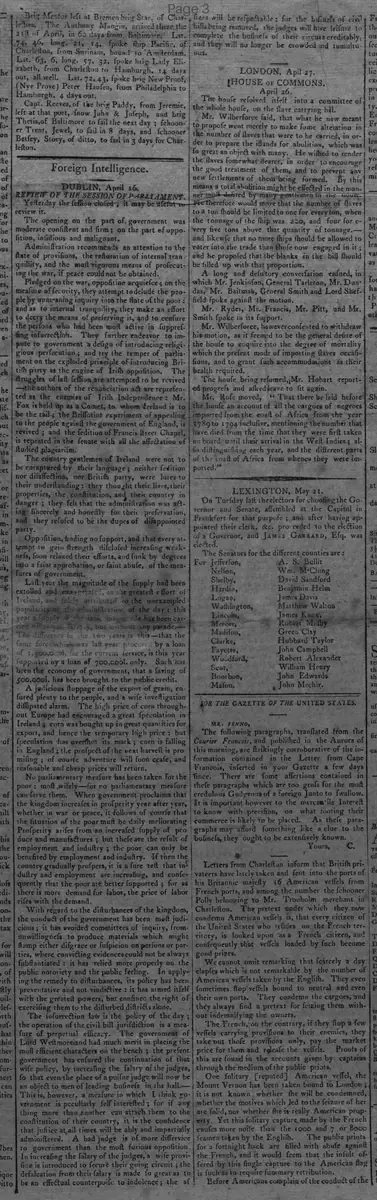
DUBLIN, April 16.
REVIEW OF THE SESSION OF PARLIAMENT.
Yesterday the session closed; it may be useful to review it.
The opening on the part of government was moderate, confident and firm; on the part of opposition, insidious and malignant.
Administration recommends an attention to the state of provisions, the restoration of internal tranquility, and the most vigorous means of prosecuting the war, if peace could not be obtained.
Pledged on the war, opposition acquiesce; on the measures of security, they attempt to delude the people by unmeaning inquiry into the state of the poor: and as to internal tranquility, they make an effort to decry the means of preserving it, and to censure the persons who had been most active in suppressing insurrection. They further endeavor to impute to government a design of introducing religious persecution; and try the temper of parliament on the exploded principle of introducing British party as the engine of Irish opposition. The struggles of last session are attempted to be revived—the authors of the renunciation act are represented as the enemies of Irish Independence: Mr. Fox is held up as a Comet, to whom Ireland is to be the tail; the Brissotin experiment of appealing to the people against the government of England, is revived; and the edition of Francis Street Chapel, is repeated in the senate with all the affectation of studied plagiarism.
The country gentlemen of Ireland were not to be enraptured by their language; neither sedition nor disaffection, nor British party, were lures to their understanding: they thought their lives, their properties, the constitution, and their country in danger; they felt that the administration was acting sincerely and honestly for their preservation, and they refused to be the dupes of disappointed party.
Opposition, finding no support, and that every attempt to gain strength disclosed increasing weakness, soon relaxed their efforts, and sunk by degrees into a faint approbation, or faint abuse, of the measures of government.
Last year the magnitude of the supply had been extolled and exaggerated, as the greatest effort of Ireland, and solely attributed to the unexampled popularity of the administration of the day: this year a supply—a sum may be—has been carried unanimously, but without any parade.
The difference in the two years is this—that the same force which was last year procured by a loan of 1,200,000l. for the current service, is this year supported by a loan of 700,000l. only. Such has been the economy of government, that a saving of 500,000l. has been brought to the public credit.
A judicious stoppage of the export of grain, ensured plenty to the people, and a wise investigation dissipated alarm. The high price of corn throughout Europe had encouraged a great speculation in Ireland; corn was bought up in great quantities for export, and hence the temporary high price: but speculation has overshot its mark; corn is falling in England; the prospect of the next harvest is promising; of course adventure will soon cease, and reasonable and cheap prices will return.
No parliamentary measure has been taken for the poor: most wisely—for no parliamentary measure can serve them. When government proclaims that the kingdom increases in prosperity year after year, whether in war or peace, it follows of course that the situation of the poor must be daily meliorating.
Prosperity arises from an increased supply of produce and manufactures; but these are the result of employment and industry; the poor can only be benefited by employment and industry. If then the country gradually prospers, it is a sure test that industry and employment are increasing, and consequently that the poor are better supported; for as there is more demand for labor, the price of labor rises with the demand.
With regard to the disturbances of the kingdom, the conduct of the government has been most judicious; it has avoided committees of inquiry, from unwillingness to produce materials which might stamp either disgrace or suspicion on persons or parties, where convicting evidences could not be always substantiated: it has relied more properly on the public notoriety and the public feeling. In applying the remedy to disturbances, its policy has been preventative and not vindictive: it has armed itself with the greatest powers, but confines the right of exercising them to the disturbed districts alone.
The insurrection laws is the policy of the day; the operation of the civil bill jurisdiction is a measure of perpetual efficacy. The government of Lord Westmoreland had much merit in placing the most efficient characters on the bench; the present government has ensured the continuation of that wise policy, by increasing the salary of the judges, so that even the place of a puisne judge will now be an object to men of leading business in the hall.
This is, however, a measure in which I think government is peculiarly self interested; for if any thing more than another can attach them to the constitution of their country, it is the confidence that justice at all times will be ably and impartially administered. A bad judge is of more disservice to government than the most furious opposition.
In increasing the salary of the judges, a wise provision is introduced to secure their going circuit; the defalcation from their salary is made so great as to be an effectual counterpoise to indolence; the assizes will be respectable: for the business of civil bills being removed, the judges will have leisure to complete the business of their circuits creditably, and they will no longer be crowded and tumultuous.
What sub-type of article is it?
What keywords are associated?
What entities or persons were involved?
Where did it happen?
Foreign News Details
Primary Location
Dublin
Event Date
Session Closed Yesterday, April 16
Key Persons
Outcome
supply carried unanimously with loan of 700,000l. saving 500,000l.; stoppage of grain export ensured plenty; increased judge salaries; insurrection laws and civil bill jurisdiction implemented; prosperity increasing for poor through employment.
Event Details
The Irish Parliament session closed yesterday with government advocating attention to provisions, internal tranquility, and vigorous war prosecution. Opposition acquiesced on war but criticized security measures and accused government of religious persecution. Country gentlemen supported administration. Economy improved with reduced loan needs and grain export controls leading to falling prices. No measures for poor as prosperity from industry benefits them. Government handled disturbances preventatively via laws and efficient judiciary, including salary increases for judges.