Thank you for visiting SNEWPapers!
Sign up free
Marion Progress
Marion, Mcdowell County, North Carolina
What is this article about?
In 1933, the National Education Association highlighted the severe impact of the economic depression on U.S. schools: thousands closed, terms shortened, funding slashed, leading to part-time classes, inadequate facilities, and textbook shortages. Federal loans and a Department of Education are proposed to help.
Clipping
OCR Quality
Full Text
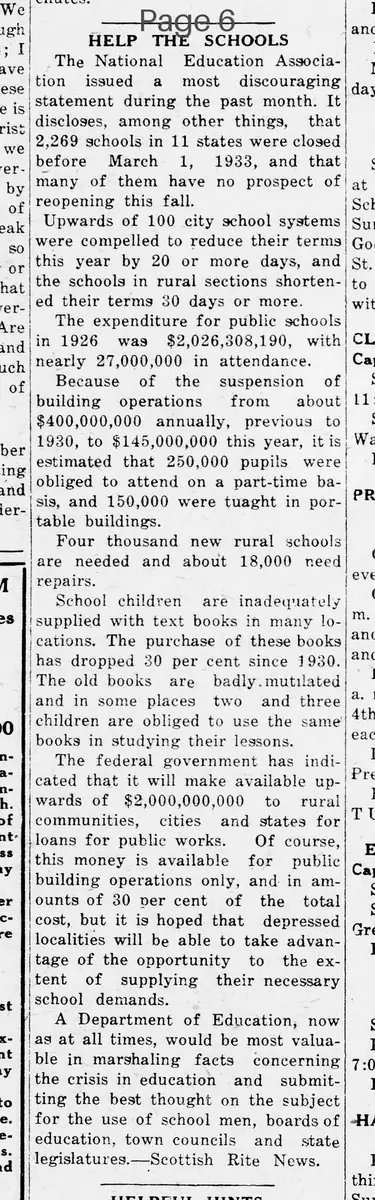
The National Education Association issued a most discouraging statement during the past month. It discloses, among other things, that 2,269 schools in 11 states were closed before March 1, 1933, and that many of them have no prospect of reopening this fall.
Upwards of 100 city school systems were compelled to reduce their terms this year by 20 or more days, and the schools in rural sections shortened their terms 30 days or more.
The expenditure for public schools in 1926 was $2,026,308,190, with nearly 27,000,000 in attendance.
Because of the suspension of building operations from about $400,000,000 annually, previous to 1930, to $145,000,000 this year, it is estimated that 250,000 pupils were obliged to attend on a part-time basis, and 150,000 were taught in portable buildings.
Four thousand new rural schools are needed and about 18,000 need repairs.
School children are inadequately supplied with text books in many locations. The purchase of these books has dropped 30 per cent since 1930. The old books are badly mutilated and in some places two and three children are obliged to use the same books in studying their lessons.
The federal government has indicated that it will make available upwards of $2,000,000,000 to rural communities, cities and states for loans for public works. Of course, this money is available for public building operations only, and in amounts of 30 per cent of the total cost, but it is hoped that depressed localities will be able to take advantage of the opportunity to the extent of supplying their necessary school demands.
A Department of Education, now as at all times, would be most valuable in marshaling facts concerning the crisis in education and submitting the best thought on the subject for the use of school men, boards of education, town councils and state legislatures.-Scottish Rite News.
What sub-type of article is it?
What themes does it cover?
What keywords are associated?
What entities or persons were involved?
Where did it happen?
Story Details
Key Persons
Location
11 States, Rural Sections, Cities In The United States
Event Date
1933
Story Details
The National Education Association reports that 2,269 schools in 11 states closed before March 1, 1933, with many unlikely to reopen. City school terms reduced by 20+ days, rural by 30+ days. Public school spending dropped from $2,026,308,190 in 1926 to lower levels, leading to part-time attendance for 250,000 pupils and portable buildings for 150,000. 4,000 new rural schools needed, 18,000 require repairs. Textbook purchases down 30% since 1930, causing shared and damaged books. Federal government offers $2,000,000,000 in loans for public works, hoped to aid schools. Advocates for a Department of Education to address the crisis.