Thank you for visiting SNEWPapers!
Sign up free
Story
April 2, 1854
The Daily Union
Washington, District Of Columbia
What is this article about?
Editorial critiquing Northern politicians for hypocrisy in upholding compromises on slavery, especially fugitive slave provisions in the Constitution, 1820 Missouri Compromise, and 1850 Compromise, amid debates over the Nebraska bill.
Clipping
OCR Quality
98%
Excellent
Full Text
The Faith of Compacts.
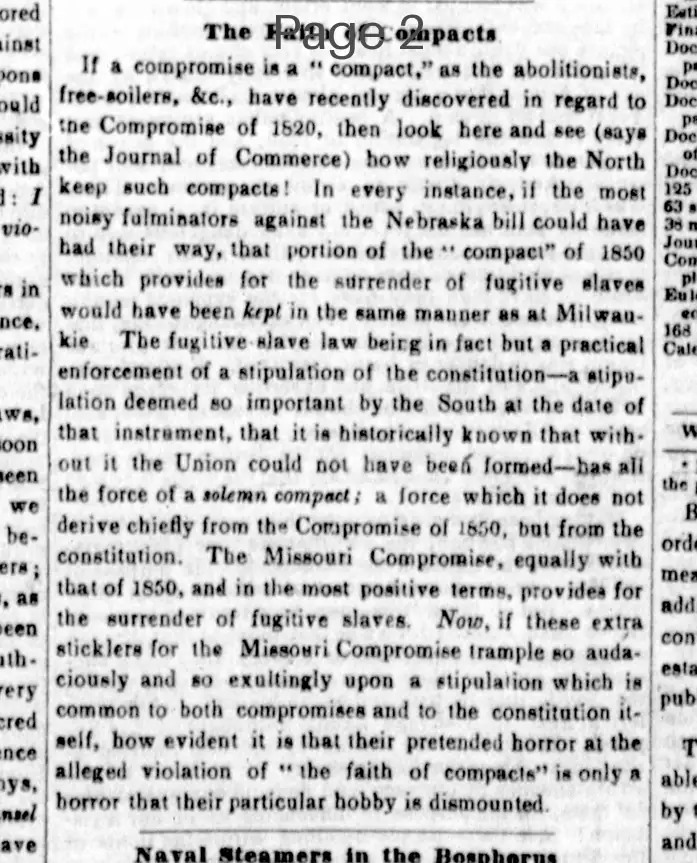
If a compromise is a 'compact,' as the abolitionists, free-soilers, &c., have recently discovered in regard to the Compromise of 1820, then look here and see (says the Journal of Commerce) how religiously the North keep such compacts! In every instance, if the most noisy fulminators against the Nebraska bill could have had their way, that portion of the 'compact' of 1850 which provides for the surrender of fugitive slaves would have been kept in the same manner as at Milwaukee. The fugitive-slave law being in fact but a practical enforcement of a stipulation of the constitution—a stipulation deemed so important by the South at the date of that instrument, that it is historically known that without it the Union could not have been formed—has all the force of a solemn compact; a force which it does not derive chiefly from the Compromise of 1850, but from the constitution. The Missouri Compromise, equally with that of 1850, and in the most positive terms, provides for the surrender of fugitive slaves. Now, if these extra sticklers for the Missouri Compromise trample so audaciously and so exultingly upon a stipulation which is common to both compromises and to the constitution itself, how evident it is that their pretended horror at the alleged violation of 'the faith of compacts' is only a horror that their particular hobby is dismounted.
If a compromise is a 'compact,' as the abolitionists, free-soilers, &c., have recently discovered in regard to the Compromise of 1820, then look here and see (says the Journal of Commerce) how religiously the North keep such compacts! In every instance, if the most noisy fulminators against the Nebraska bill could have had their way, that portion of the 'compact' of 1850 which provides for the surrender of fugitive slaves would have been kept in the same manner as at Milwaukee. The fugitive-slave law being in fact but a practical enforcement of a stipulation of the constitution—a stipulation deemed so important by the South at the date of that instrument, that it is historically known that without it the Union could not have been formed—has all the force of a solemn compact; a force which it does not derive chiefly from the Compromise of 1850, but from the constitution. The Missouri Compromise, equally with that of 1850, and in the most positive terms, provides for the surrender of fugitive slaves. Now, if these extra sticklers for the Missouri Compromise trample so audaciously and so exultingly upon a stipulation which is common to both compromises and to the constitution itself, how evident it is that their pretended horror at the alleged violation of 'the faith of compacts' is only a horror that their particular hobby is dismounted.
What sub-type of article is it?
Historical Event
What themes does it cover?
Deception
Justice
Moral Virtue
What keywords are associated?
Fugitive Slave Law
Missouri Compromise
Compromise Of 1850
Nebraska Bill
Political Compacts
Where did it happen?
Milwaukee
Story Details
Location
Milwaukee
Event Date
1820 1850
Story Details
The article argues that Northern abolitionists and free-soilers violate the faith of political compacts like the Missouri Compromise of 1820 and the Compromise of 1850 by resisting the fugitive slave law, which is constitutionally mandated, revealing their selective adherence to agreements.