Thank you for visiting SNEWPapers!
Sign up free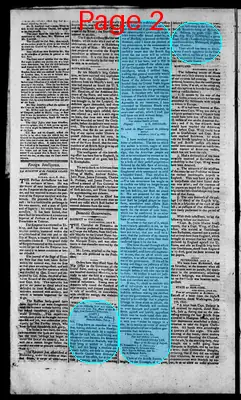
Herald Of The United States
Warren, Bristol County, Rhode Island
What is this article about?
In Norfolk, Virginia, on July 4, 1807, British Commodore J.E. Douglas threatened to blockade the port over a local resolution barring communication with the British Consul, linking it to Chesapeake frigate deserters. Mayor Richard Evers Lee responded defiantly, stating it was individuals' act and they would defend against aggression. Squadron details and three deserters noted.
Clipping
OCR Quality
Full Text
NORFOLK, JULY 4.
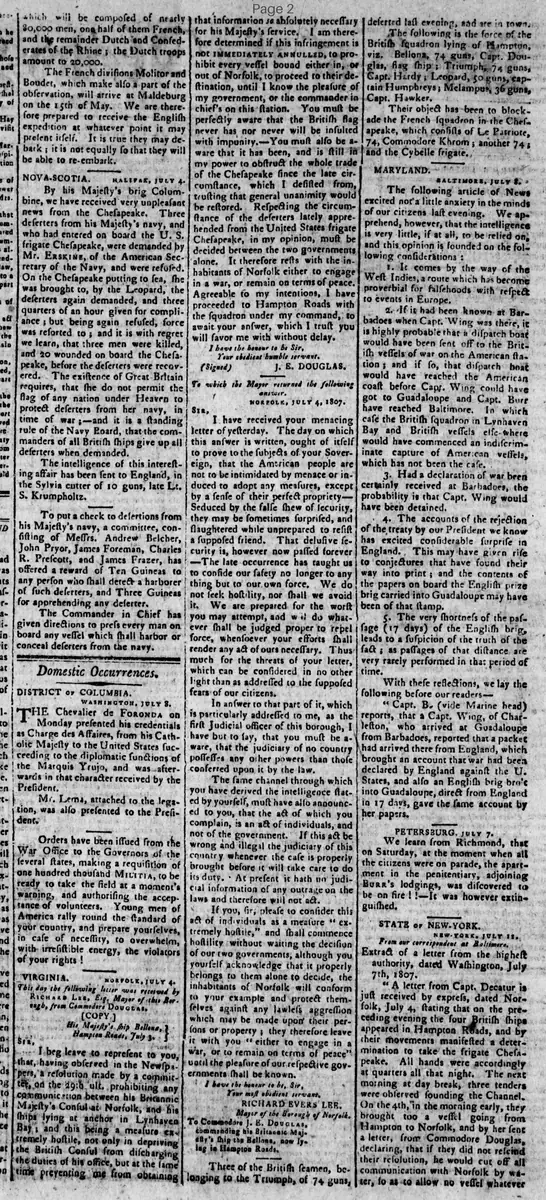
This day the following letter was received by Richard Evers Lee, Esq, Mayor of this Borough, from Commodore Douglas.
[COPY.]
SIR,
His Majesty's ship Bellona, Hampton Roads, July 3, 1807.
I beg leave to represent to you, that, having observed in the Newspapers, a resolution made by a committee on the 29th ult., prohibiting any communication between his Britannic Majesty's Consul at Norfolk, and his ships lying at anchor in Lynhaven Bay: and this being a measure extremely hostile, not only in depriving the British Consul from discharging the duties of his office, but at the same time preventing one from obtaining that information so absolutely necessary for his Majesty's service. I am therefore determined if this infringement is not IMMEDIATELY ANNULLED, to prohibit every vessel bound either in, or out of Norfolk, to proceed to their destination, until I know the pleasure of my government, or this commander in chief's on this station. You must be perfectly aware that the British flag never has nor never will be insulted with impunity. You must also be aware that it has been, and is still in my power to obstruct the whole trade of the Chesapeake since the late circumstance, which I desisted from, trusting that general unanimity would be restored. Respecting the circumstance of the deserters lately apprehended from the United States frigate Chesapeake, in my opinion, must be decided between the two governments alone. It therefore rests with the inhabitants of Norfolk either to engage in a war, or remain on terms of peace.
Agreeable to my intentions, I have proceeded to Hampton Roads with the squadron under my command, to await your answer, which I trust you will favor me with without delay.
I have the honour to be Sir,
Your obedient humble servant,
(Signed) J. E. DOUGLAS.
To which the Mayor returned the following answer.
NORFOLK, JULY 4, 1807.
SIR,
I have received your menacing letter of yesterday. The day on which this answer is written, ought of itself to prove to the subjects of your Sovereign, that the American people are not to be intimidated by menace or induced to adopt any measures, except by a sense of their perfect propriety.
Seduced by the false shew of security, they may be sometimes surprised, and slaughtered while unprepared to resist a supposed friend. That delusive security is, however now passed forever. The late occurrence has taught us to confide our safety no longer to anything but to our own force. We do not seek hostility, nor shall we avoid it. We are prepared for the worst you may attempt, and will do whatever shall be judged proper to repel force, whensoever your efforts shall render any act of ours necessary. Thus much for the threats of your letter, which can be considered in no other light than as addressed to the supposed fears of our citizens.
In answer to that part of it, which is particularly addressed to me, as the first Judicial officer of this borough, I have but to say, that you must be aware, that the judiciary of no country possesses any other powers than those conferred upon it by the law.
The same channel through which you have derived the intelligence stated by yourself, must have also announced to you, that the act of which you complain, is an act of individuals, and not of the government. If this act be wrong and illegal the judiciary of this country whenever the case is properly brought before it will take care to do its duty. At present it hath no judicial information of any outrage on the laws and therefore will not act.
If you, sir, please to consider this act of individuals as a measure "extremely hostile," and shall commence hostility without waiting the decision of our two governments, although you yourself acknowledge that it properly belongs to them alone to decide, the inhabitants of Norfolk will conform to your example and protect themselves against any lawless aggression which may be made upon their persons or property; they therefore leave it with you "either to engage in a war, or to remain on terms of peace" until the pleasure of our respective governments shall be known.
I have the honour to be, Sir,
Your most obedient servant,
RICHARD EVERS LEE.
Mayor of the Borough of Norfolk.
To Commodore J. E. Douglas, commanding his Britannic Majesty's Ship the Bellona, now lying in Hampton Roads.
Three of the British seamen, belonging to the Triumph, of 74 guns, deserted last evening, and are in town.
The following is the force of the British squadron lying off Hampton, viz. Bellona, 74 guns, Capt. Douglas, flag ship; Triumph, 74 guns, Capt. Hardy; Leopard, 50 guns, Captain Humphreys; Melampus, 36 guns, Capt. Hawker.
Their object has been to blockade the French squadron in the Chesapeake, which consists of Le Patriote, 74, Commodore Chrom; another 74; and the Cybelle frigate.
What sub-type of article is it?
What keywords are associated?
What entities or persons were involved?
Where did it happen?
Domestic News Details
Primary Location
Norfolk, Virginia
Event Date
July 4, 1807
Key Persons
Outcome
no hostilities ensued; british squadron positioned in hampton roads awaiting response; three british seamen deserted.
Event Details
Commodore J. E. Douglas wrote to Mayor Richard Evers Lee protesting a resolution by a committee on June 29 prohibiting communication between the British Consul and ships in Lynhaven Bay, threatening to blockade Norfolk if not annulled. The mayor replied that the resolution was by individuals, not government, and the judiciary would address if illegal; affirmed readiness to repel aggression.