Thank you for visiting SNEWPapers!
Sign up free
Literary
October 31, 1836
Alexandria Gazette
Alexandria, Alexandria County, District Of Columbia
What is this article about?
N.P. Willis's satirical essay explores English prejudices against continental foreigners, especially French, using the fictional story of Baron Adolphe, a charming Parisian roué, who travels to London to marry a wealthy heiress but faces rejection and ridicule due to cultural clashes.
Clipping
OCR Quality
98%
Excellent
Full Text
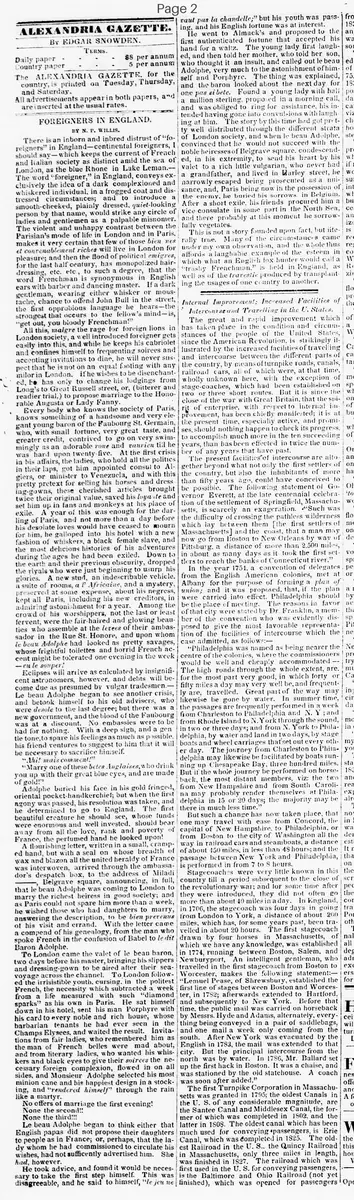
FOREIGNERS IN ENGLAND.
BY N. P. WILLIS.
There is an inborn and inbred distrust of "foreigners" in England—continental foreigners, I should say—which keeps the current of French and Italian society as distinct amid the sea of London, as the blue Rhone in Lake Leman.
The word "foreigner," in England, conveys exclusively the idea of a dark complexioned and whiskered individual, in a frogged coat and distressed circumstances; and to introduce a smooth-cheeked, plainly dressed, quiet-looking person by that name, would strike any circle of ladies and gentlemen as a palpable misnomer.
The violent and unhappy contrast between the Parisian’s mode of life in London and in Paris, makes it very certain that few of those bien nes et convenablement riches will live in London for pleasure; and then the flood of political emigres, for the last half century, has monopolized hair-dressing, etc. etc., to such a degree, that the word Frenchman is synonymous in English ears with barber and dancing master. If a dark gentleman, wearing either whisker or moustache, chance to offend John Bull in the street, the first opprobrious language he hears—the strongest that occurs to the fellow’s mind—is, "get out, you bloody Frenchman!"
All this, malgre the rage for foreign lions in London society, a well introduced foreigner gets easily into this, and while he keeps his cabriolet and confines himself to frequenting soirees and accepting invitations to dine, he will never suspect that he is not on an equal footing with any milord in London. If he wishes to be disenchanted, he has only to change his lodgings from Long’s to Great Russell street, or, (bitterer and readier trial,) to propose marriage to the Honorable Augusta or Lady Fanny.
Every body who knows the society of Paris, knows something of a handsome and very elegant young baron of the Faubourg St. Germain, who, with small fortune, very great taste, and greater credit, contrived to go on very swimmingly as an adorable roue and raurien till he was hard upon twenty-five. At the first crisis in his affairs, the ladies, who hold all the politics in their laps, got him appointed consul to Algiers, or minister to Venezuela, and with this pretty pretext for selling his horses and dressing-gowns, these cherished articles brought twice their original value, saved his loyalty and set him up in fans and monkeys at his place of exile. A year of this was enough for the darling of Paris, and not more than a day before his desolate loves would have ceased to mourn for him, he galloped into his hotel with a new fashion of whiskers, a black female slave, and the most delicious histories of his adventures during the ages he had been exiled. Down to the earth and their previous obscurity, dropped the rivals who were just beginning to usurp his glories. A new stud, an indescribable vehicle, a suite of rooms, a l’Africaine, and a mystery, preserved at some expense, about his negress, kept all Paris, including his new creditors, in admiring astonishment for a year. Among the crowd of his worshippers, not the last or least fervent, were the fair-haired and glowing beauties who assemble at the levees of their ambassador in the Rue St. Honore, and upon whom le beau Adolphe had looked as pretty savages, whose frightful toilettes and horrid French accent might be tolerated one evening in the week—rule souper.
Eclipses will arrive as calculated by insignificant astronomers, however, and debts will become due as presumed by vulgar tradesmen. Le beau Adolphe began to see another crisis, and betook himself to his old advisers, who were desole to the last degree; but there was a new government, and the blood of the Faubourg was at a discount. No embassies were to be had for nothing. With a deep sigh, and a gentle tone to spare his feelings as much as possible, his friend ventures to suggest to him that it will be necessary to sacrifice himself.
"Ahi! mais comment!"
"Marry one of these betes Inglaises, who drink you up with their great blue eyes, and are made of gold!"
Adolphe buried his face in his gold fringed, oriental pocket-handkerchief; but when the first agony was passed, his resolution was taken, and he determined to go to England. The first beautiful creature he should see, whose funds were enormous and well invested, should bear away from all the love, rank and poverty of France, the perfumed hand he looked upon!
A flourishing letter, written in a small, cramped hand, but with a seal on whose breadth of wax and blazon all the united heraldry of France was interwoven, arrived through the ambassador’s despatch box, to the address of Miladi Belgrave square, announcing, in full, that le beau Adolphe was coming to London to marry the richest heiress in good society; and as Paris could not spare him more than a week, he wished those who had daughters to marry, answering the description, to be bien prevenus of his visit and errand. With the letter came a compend of his genealogy, from the man who spoke French in the confusion of Babel to le dit Baron Adolphe.
To London came the valet of le beau baron, two days before his master, bringing his slippers and dressing-gown to be aired after their sea-voyage across the channel. To London followed the irresistible youth, cursing, in the politest French, the necessity which subtracted a week from a life measured with such "diamond sparks" as his own in Paris. He sat himself down in his hotel, sent his man Porphyre with his card to every noble and rich house, whose barbarian tenants he had ever seen in the Champs Elysees, and waited the result. Invitations from fair ladies, who remembered him as the man of French belles were mad about, and from literary ladies, who wanted his whiskers and black eyes to give their soirees the necessary foreign complexion, flowed in on all sides, and Monsieur Adolphe selected his most minion cane and his happiest design in a stocking, and "rendered himself" through the rain like a martyr.
No offers of marriage the first evening! None the second!! None the third!!
Le beau Adolphe began to think either that English papas did not propose their daughters to people as in France; or, perhaps, that the lady whom he had commissioned to circulate his wishes, had not sufficiently advertised him. She had, however.
He took advice, and found it would be necessary to take the first step himself. This was disagreeable, and he said to himself, "le jeu ne vaut pas la chandelle;" but his youth was passing, and his English fortune was at interest.
He went to Almack’s and proposed to the first authenticated fortune that accepted his hand for a waltz. The young lady first laughed, and then told her mother, who told her son, who thought it an insult, and called out le beau Adolphe, very much to the astonishment of himself and Porphyre. The thing was explained, and the baron looked about the next day for one passible. Found a young lady with half a million sterling, proposed in a morning call, and was obliged to ring for assistance, his intended having gone into convulsions with laughing at him. The story by this time had got pretty well distributed through the different strata of London society, and when le beau Adolphe, convinced that he would not succeed with the noble heiresses of Belgrave square, condescended, in his extremity, to send his heart by his valet to a rich little vulgarian, who never had a grandfather, and lived in Harley street, he narrowly escaped being prosecuted as a nuisance, and, Paris being now in the possession of the enemy, he buried his sorrows in Belgium.
After a short exile, his friends procured him a vice-consulate in some part in the North Sea, and there probably at this moment he sorrowfully vegetates.
This is not a story founded upon fact, but literally true. Many of the circumstances came under my own observation, and the whole thus affords a laughable example of the esteem in which what an English fox hunter would call a "trashy Frenchman," is held in England, as well as of the satire produced by transplanting the usages of one country to another.
BY N. P. WILLIS.
There is an inborn and inbred distrust of "foreigners" in England—continental foreigners, I should say—which keeps the current of French and Italian society as distinct amid the sea of London, as the blue Rhone in Lake Leman.
The word "foreigner," in England, conveys exclusively the idea of a dark complexioned and whiskered individual, in a frogged coat and distressed circumstances; and to introduce a smooth-cheeked, plainly dressed, quiet-looking person by that name, would strike any circle of ladies and gentlemen as a palpable misnomer.
The violent and unhappy contrast between the Parisian’s mode of life in London and in Paris, makes it very certain that few of those bien nes et convenablement riches will live in London for pleasure; and then the flood of political emigres, for the last half century, has monopolized hair-dressing, etc. etc., to such a degree, that the word Frenchman is synonymous in English ears with barber and dancing master. If a dark gentleman, wearing either whisker or moustache, chance to offend John Bull in the street, the first opprobrious language he hears—the strongest that occurs to the fellow’s mind—is, "get out, you bloody Frenchman!"
All this, malgre the rage for foreign lions in London society, a well introduced foreigner gets easily into this, and while he keeps his cabriolet and confines himself to frequenting soirees and accepting invitations to dine, he will never suspect that he is not on an equal footing with any milord in London. If he wishes to be disenchanted, he has only to change his lodgings from Long’s to Great Russell street, or, (bitterer and readier trial,) to propose marriage to the Honorable Augusta or Lady Fanny.
Every body who knows the society of Paris, knows something of a handsome and very elegant young baron of the Faubourg St. Germain, who, with small fortune, very great taste, and greater credit, contrived to go on very swimmingly as an adorable roue and raurien till he was hard upon twenty-five. At the first crisis in his affairs, the ladies, who hold all the politics in their laps, got him appointed consul to Algiers, or minister to Venezuela, and with this pretty pretext for selling his horses and dressing-gowns, these cherished articles brought twice their original value, saved his loyalty and set him up in fans and monkeys at his place of exile. A year of this was enough for the darling of Paris, and not more than a day before his desolate loves would have ceased to mourn for him, he galloped into his hotel with a new fashion of whiskers, a black female slave, and the most delicious histories of his adventures during the ages he had been exiled. Down to the earth and their previous obscurity, dropped the rivals who were just beginning to usurp his glories. A new stud, an indescribable vehicle, a suite of rooms, a l’Africaine, and a mystery, preserved at some expense, about his negress, kept all Paris, including his new creditors, in admiring astonishment for a year. Among the crowd of his worshippers, not the last or least fervent, were the fair-haired and glowing beauties who assemble at the levees of their ambassador in the Rue St. Honore, and upon whom le beau Adolphe had looked as pretty savages, whose frightful toilettes and horrid French accent might be tolerated one evening in the week—rule souper.
Eclipses will arrive as calculated by insignificant astronomers, however, and debts will become due as presumed by vulgar tradesmen. Le beau Adolphe began to see another crisis, and betook himself to his old advisers, who were desole to the last degree; but there was a new government, and the blood of the Faubourg was at a discount. No embassies were to be had for nothing. With a deep sigh, and a gentle tone to spare his feelings as much as possible, his friend ventures to suggest to him that it will be necessary to sacrifice himself.
"Ahi! mais comment!"
"Marry one of these betes Inglaises, who drink you up with their great blue eyes, and are made of gold!"
Adolphe buried his face in his gold fringed, oriental pocket-handkerchief; but when the first agony was passed, his resolution was taken, and he determined to go to England. The first beautiful creature he should see, whose funds were enormous and well invested, should bear away from all the love, rank and poverty of France, the perfumed hand he looked upon!
A flourishing letter, written in a small, cramped hand, but with a seal on whose breadth of wax and blazon all the united heraldry of France was interwoven, arrived through the ambassador’s despatch box, to the address of Miladi Belgrave square, announcing, in full, that le beau Adolphe was coming to London to marry the richest heiress in good society; and as Paris could not spare him more than a week, he wished those who had daughters to marry, answering the description, to be bien prevenus of his visit and errand. With the letter came a compend of his genealogy, from the man who spoke French in the confusion of Babel to le dit Baron Adolphe.
To London came the valet of le beau baron, two days before his master, bringing his slippers and dressing-gown to be aired after their sea-voyage across the channel. To London followed the irresistible youth, cursing, in the politest French, the necessity which subtracted a week from a life measured with such "diamond sparks" as his own in Paris. He sat himself down in his hotel, sent his man Porphyre with his card to every noble and rich house, whose barbarian tenants he had ever seen in the Champs Elysees, and waited the result. Invitations from fair ladies, who remembered him as the man of French belles were mad about, and from literary ladies, who wanted his whiskers and black eyes to give their soirees the necessary foreign complexion, flowed in on all sides, and Monsieur Adolphe selected his most minion cane and his happiest design in a stocking, and "rendered himself" through the rain like a martyr.
No offers of marriage the first evening! None the second!! None the third!!
Le beau Adolphe began to think either that English papas did not propose their daughters to people as in France; or, perhaps, that the lady whom he had commissioned to circulate his wishes, had not sufficiently advertised him. She had, however.
He took advice, and found it would be necessary to take the first step himself. This was disagreeable, and he said to himself, "le jeu ne vaut pas la chandelle;" but his youth was passing, and his English fortune was at interest.
He went to Almack’s and proposed to the first authenticated fortune that accepted his hand for a waltz. The young lady first laughed, and then told her mother, who told her son, who thought it an insult, and called out le beau Adolphe, very much to the astonishment of himself and Porphyre. The thing was explained, and the baron looked about the next day for one passible. Found a young lady with half a million sterling, proposed in a morning call, and was obliged to ring for assistance, his intended having gone into convulsions with laughing at him. The story by this time had got pretty well distributed through the different strata of London society, and when le beau Adolphe, convinced that he would not succeed with the noble heiresses of Belgrave square, condescended, in his extremity, to send his heart by his valet to a rich little vulgarian, who never had a grandfather, and lived in Harley street, he narrowly escaped being prosecuted as a nuisance, and, Paris being now in the possession of the enemy, he buried his sorrows in Belgium.
After a short exile, his friends procured him a vice-consulate in some part in the North Sea, and there probably at this moment he sorrowfully vegetates.
This is not a story founded upon fact, but literally true. Many of the circumstances came under my own observation, and the whole thus affords a laughable example of the esteem in which what an English fox hunter would call a "trashy Frenchman," is held in England, as well as of the satire produced by transplanting the usages of one country to another.
What sub-type of article is it?
Essay
Satire
Prose Fiction
What themes does it cover?
Social Manners
Patriotism
Love Romance
What keywords are associated?
Foreigners
England
France
Satire
Marriage
Heiress
Prejudice
Society
Cultural Clash
What entities or persons were involved?
By N. P. Willis.
Literary Details
Title
Foreigners In England.
Author
By N. P. Willis.
Subject
English Attitudes Towards Continental Foreigners
Form / Style
Satirical Essay With Fictional Anecdote
Key Lines
There Is An Inborn And Inbred Distrust Of "Foreigners" In England—Continental Foreigners, I Should Say—Which Keeps The Current Of French And Italian Society As Distinct Amid The Sea Of London, As The Blue Rhone In Lake Leman.
"Marry One Of These Betes Inglaises, Who Drink You Up With Their Great Blue Eyes, And Are Made Of Gold!"
No Offers Of Marriage The First Evening! None The Second!! None The Third!!
This Is Not A Story Founded Upon Fact, But Literally True.
The Whole Thus Affords A Laughable Example Of The Esteem In Which What An English Fox Hunter Would Call A "Trashy Frenchman," Is Held In England