Thank you for visiting SNEWPapers!
Sign up free
Story
September 23, 1956
Atlanta Daily World
Atlanta, Fulton County, Georgia
What is this article about?
1953 survey shows Americans allocate 4-5% of family income to health care amid unpredictable costs. Voluntary health insurance has expanded from 57% to 67% population coverage, aiding financial management of medical expenses. (198 chars)
Clipping
OCR Quality
95%
Excellent
Full Text
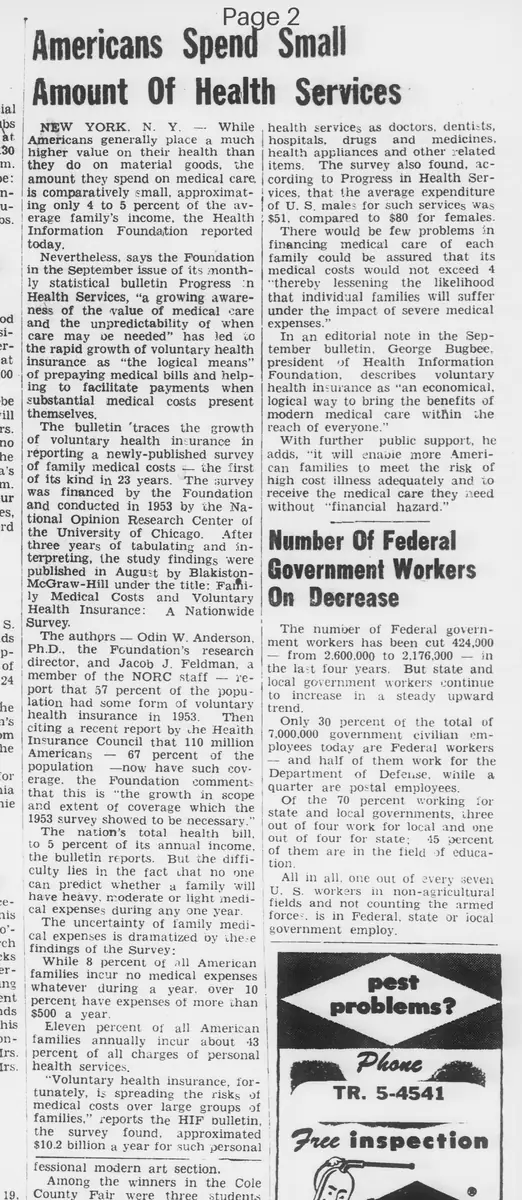
Americans Spend Small Amount Of Health Services
NEW YORK. N. Y. - While Americans generally place a much higher value on their health than they do on material goods, the amount they spend on medical care is comparatively small, approximating only 4 to 5 percent of the average family's income. the Health Information Foundation reported today.
Nevertheless. says the Foundation in the September issue of its monthly statistical bulletin Progress in Health Services, "a growing awareness of the value of medical care and the unpredictability of when care may be needed" has led to the rapid growth of voluntary health insurance as "the logical means" of prepaying medical bills and helping to facilitate payments when substantial medical costs present themselves.
The bulletin traces the growth of voluntary health insurance in reporting a newly-published survey of family medical costs - the first of its kind in 23 years. The survey was financed by the Foundation and conducted in 1953 by the National Opinion Research Center of the University of Chicago.
After three years of tabulating and interpreting, the study findings were published in August by Blakiston-McGraw-Hill under the title: Family Medical Costs and Voluntary Health Insurance: A Nationwide Survey.
The authors - Odin W. Anderson, Ph.D., the Foundation's research director, and Jacob J. Feldman. a member of the NORC staff - report that 57 percent of the population had some form of voluntary health insurance in 1953.
Then citing a recent report by the Health Insurance Council that 110 million Americans 67 percent of the population -now have such coverage, the Foundation comments that this is "the growth in scope and extent of coverage which the 1953 survey showed to be necessary."
The nation's total health bill. the bulletin reports. is 4 to 5 percent of its annual income. But the difficulty lies in the fact that no one can predict whether a family will have heavy. moderate or light medical expenses during any one year.
The uncertainty of family medical expenses is dramatized by the findings of the Survey:
While 8 percent of all American families incur no medical expenses whatever during a year, over 10 percent have expenses of more than $500 a year.
Eleven percent of all American families annually incur about 13 percent of all charges of personal health services.
"Voluntary health insurance, fortunately, is spreading the risks of medical costs over large groups of families," reports the HIF bulletin, the survey found, approximated $10.2 billion a year for such personal health services as doctors, dentists, hospitals, drugs and medicines, health appliances and other related items. The survey also found, according to Progress in Health Services. that the average expenditure of U. S. males for such services was $51, compared to $80 for females.
There would be few problems in financing medical care if each family could be assured that its medical costs would not exceed 4 percent "thereby lessening the likelihood that individual families will suffer under the impact of severe medical expenses.
In an editorial note in the September bulletin, George Bugbee, president of Health Information Foundation, describes voluntary health insurance as "an economical. logical way to bring the benefits of modern medical care within the reach of everyone."
With further public support, he adds, "it will enable more American families to meet the risk of high cost illness adequately and to receive the medical care they need without "financial hazard.""
NEW YORK. N. Y. - While Americans generally place a much higher value on their health than they do on material goods, the amount they spend on medical care is comparatively small, approximating only 4 to 5 percent of the average family's income. the Health Information Foundation reported today.
Nevertheless. says the Foundation in the September issue of its monthly statistical bulletin Progress in Health Services, "a growing awareness of the value of medical care and the unpredictability of when care may be needed" has led to the rapid growth of voluntary health insurance as "the logical means" of prepaying medical bills and helping to facilitate payments when substantial medical costs present themselves.
The bulletin traces the growth of voluntary health insurance in reporting a newly-published survey of family medical costs - the first of its kind in 23 years. The survey was financed by the Foundation and conducted in 1953 by the National Opinion Research Center of the University of Chicago.
After three years of tabulating and interpreting, the study findings were published in August by Blakiston-McGraw-Hill under the title: Family Medical Costs and Voluntary Health Insurance: A Nationwide Survey.
The authors - Odin W. Anderson, Ph.D., the Foundation's research director, and Jacob J. Feldman. a member of the NORC staff - report that 57 percent of the population had some form of voluntary health insurance in 1953.
Then citing a recent report by the Health Insurance Council that 110 million Americans 67 percent of the population -now have such coverage, the Foundation comments that this is "the growth in scope and extent of coverage which the 1953 survey showed to be necessary."
The nation's total health bill. the bulletin reports. is 4 to 5 percent of its annual income. But the difficulty lies in the fact that no one can predict whether a family will have heavy. moderate or light medical expenses during any one year.
The uncertainty of family medical expenses is dramatized by the findings of the Survey:
While 8 percent of all American families incur no medical expenses whatever during a year, over 10 percent have expenses of more than $500 a year.
Eleven percent of all American families annually incur about 13 percent of all charges of personal health services.
"Voluntary health insurance, fortunately, is spreading the risks of medical costs over large groups of families," reports the HIF bulletin, the survey found, approximated $10.2 billion a year for such personal health services as doctors, dentists, hospitals, drugs and medicines, health appliances and other related items. The survey also found, according to Progress in Health Services. that the average expenditure of U. S. males for such services was $51, compared to $80 for females.
There would be few problems in financing medical care if each family could be assured that its medical costs would not exceed 4 percent "thereby lessening the likelihood that individual families will suffer under the impact of severe medical expenses.
In an editorial note in the September bulletin, George Bugbee, president of Health Information Foundation, describes voluntary health insurance as "an economical. logical way to bring the benefits of modern medical care within the reach of everyone."
With further public support, he adds, "it will enable more American families to meet the risk of high cost illness adequately and to receive the medical care they need without "financial hazard.""
What sub-type of article is it?
Curiosity
Historical Event
What themes does it cover?
Misfortune
Triumph
What keywords are associated?
Health Spending
Voluntary Insurance
Medical Costs
1953 Survey
Family Expenses
What entities or persons were involved?
Odin W. Anderson
Jacob J. Feldman
George Bugbee
Where did it happen?
New York. N. Y.
Story Details
Key Persons
Odin W. Anderson
Jacob J. Feldman
George Bugbee
Location
New York. N. Y.
Event Date
1953
Story Details
A 1953 survey reveals Americans spend 4-5% of income on health care, with unpredictable costs affecting families. Voluntary health insurance coverage grew from 57% in 1953 to 67% recently, spreading risks and facilitating access to care.