Thank you for visiting SNEWPapers!
Sign up free
National Gazette
Philadelphia, Philadelphia County, Pennsylvania
What is this article about?
On June 16, 1792, from Camp Maubeuge, the Marquis de Lafayette addresses the French National Assembly, denouncing the Jacobin faction's disruptive influence, warning of internal divisions and external threats from foreign courts, and urging strict adherence to the constitution to save France amid revolutionary dangers.
Clipping
OCR Quality
Full Text
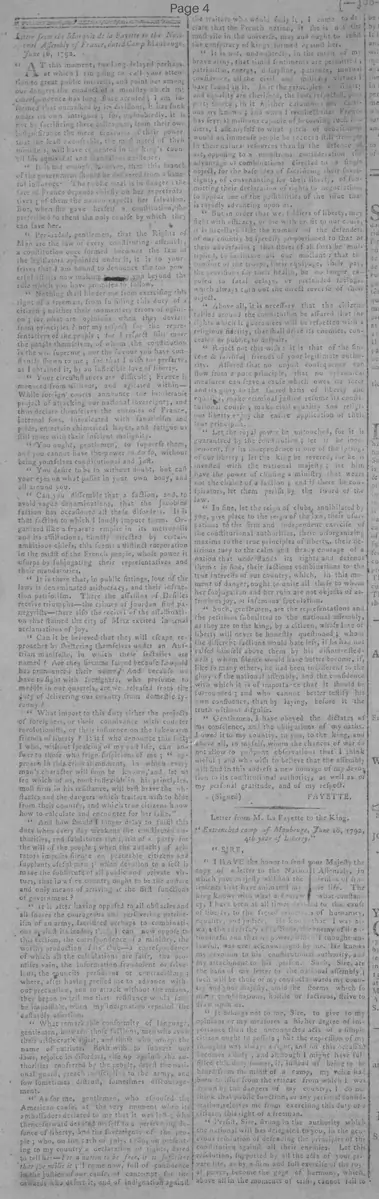
At this moment, too long delayed perhaps, at which I am going to call your attention to great public interests, and point out among our dangers the conduct of a ministry whose correspondence has long since accused; I am informed that unmasked by its divisions, it has sunk under its own intrigues; for, undoubtedly, it is not by sacrificing three colleagues, from their own insignificance the mere creatures of their power, that the least excusable, the most noted of the ministers, will have cemented in the king's council his equivocal and scandalous existence.
It is not enough, however, that this branch of the government should be delivered from a baneful influence. The public weal is in danger: the fate of France depends chiefly on her representatives; of them the nation expects her salvation.
But, when she gave herself a constitution, she prescribed to them the only course by which they can save her.
Persuaded, gentlemen, that the Rights of Man are the law of every constituting assembly, a constitution once formed becomes the law of the legislators appointed under it, it is to your decrees that I am bound to denounce the too powerful efforts now making secretly so beyond the line which you have promised to follow.
Nothing shall hinder me from exercising this right of a freeman, from fulfilling this duty of a citizen; neither their momentary errors of opinion; for what are opinions when they deviate from principles? nor my respect for the representatives of the people; for I respect still more the people themselves, of whom the constitution is the will supreme; nor the favour you have constantly shown to me; for that I wish to preserve, as I obtained it, by an inflexible love of liberty.
Your circumstances are difficult; France is menaced from without, and agitated within—
While foreign courts announce the intolerable project of attacking our national sovereignty, and thus declare themselves the enemies of France, internal foes, intoxicated with fanaticism and pride, entertain chimerical hopes, and fatigue us still more with their insolent malignity.
You ought, gentlemen, to suppress them, and you cannot have the power to do so, without being yourselves constitutional and just.
You desire to be so without doubt, but can your eyes on what passes in your own bosom, and all around you.
Can you dissemble that a faction, and, to avoid vague denominations, that the Jacobine faction has occasioned all these disorders. It is that faction to which I loudly impute them. Organized like a separate empire in its metropolis and its affiliations, blindly directed by certain ambitious chiefs, this forms a distinct corporation in the midst of the French people, whose power it usurps by subjugating their representatives and their mandarins.
It is there that, in public sittings, love of the laws is denominated aristocracy, and their infraction patriotism. There the assassins of Desilles receive triumphs—the crimes of Fournier find panegyrists—there also the recital of the assassination that stained the city of Metz excited criminal acclamations of joy.
Can it be believed that they will escape reproaches by sheltering themselves under an Austrian manifesto, in which these sectaries are named? Are they become sacred because Leopold has pronounced their name? And because we have to fight with foreigners, who presume to meddle in our quarrels, are we released from the duty of delivering our country from domestic tyranny?
What import to this duty either the projects of foreigners, or their connivance with counter-revolutionists, or their influence on the lukewarm friends of liberty? It is I who denounce this sect; I who, without speaking of my past life, can answer to those who feign suspicions of me; approach in this critical moment, in which every man's character will soon be known, and let us see which of us, most inflexible in his principles, most firm in his resistance, will be the brave the obstacles and the dangers which traitors wish to hide from their country, and which true citizens know how to calculate and encounter for her sake.
And how should I longer delay to fulfil this duty when every day weakens the constituted authorities, and substitutes the spirit of a party for the will of the people; when the audacity of agitators imposes silence on peaceable citizens and supplants useful men; when devotion to a sect is made the substitute of all public and private virtues, that in a free country ought to be the sure and only means of arriving at the first functions of government?
It is after having opposed to all obstacles and all snares the courageous and persevering patriotism of an army, sacrificed perhaps to combinations against its leader, that I can now oppose to this faction, the correspondence of a ministry, the worthy production of its club—a correspondence of which all the calculations are false, the promises vain, the information fraudulent or trivial, the councils perfidious or contradictory:
where, after having pressed me to advance without precaution, and to attack without the means, they began to tell me that resistance would soon be impossible, when my indignation repelled the dastardly assertion.
What remarkable conformity of language, gentlemen, between those factions, men who avow their aristocratic spirit, and those who usurp the name of patriots. Both wish to subvert our laws, rejoice in disorders, rise up against the authorities conferred by the people, detest the national guard, preach indiscipline to the army, and sow sometimes distrust, sometimes discouragement.
As for me, gentlemen, who espoused the American cause, at the very moment when its ambassadors declared to me that it was lost; who thenceforward devoted myself to a persevering defence of liberty, and the sovereignty of the people; who, on the 14th of July, 1789, presenting to my country a declaration of rights, dared to tell her—For a nation to be free, it is sufficient that she wills it; I come now, full of confidence in the justice of our cause, of contempt for the cowards who desert it, and of indignation against the traitors who would betray it; I come to declare that the French nation, if she is not the most vile in the universe, may and ought to resist the conspiracy of kings formed against her.
It is not, undoubtedly, in the midst of my brave army, that timid sentiments are permitted; patriotism, energy, discipline, patience, mutual confidence, all the civil and military virtues I have found in it. In it the principles of liberty and equality are cherished, the laws respected, property sacred; in it neither calumnies nor factions are known; and when I recollect that France has several millions capable of becoming such soldiers, I ask myself to what pitch of debasement would an immense people be reduced still stronger in their natural resources than in the defence of it, opposing to a monstrous confederation the advantage of combinations directed to a single object, for the base idea of sacrificing their sovereignty, of covenanting for their liberty, of submitting their declaration of rights to negotiation, to appear one of the possibilities of the issue that is rapidly advancing upon us.
But in order that we, soldiers of liberty, may fight with efficacy, or die with pride for our country, it is necessary that the number of the defenders of our country be speedily proportioned to that of their adversaries; that stores of all sorts be multiplied, to facilitate all our motions: that the comfort of the troops, their equipage, their pay, the provisions for their health, be no longer exposed to fatal delays, or pretended savings, which always turn out the direct reverse of their object.
Above all, it is necessary that the citizens rallied around the constitution be assured that the rights which it guarantees will be respected with a religious fidelity, that shall drive its enemies, concealed or public, to despair.
Reject not this wish: it is that of the sincere & faithful friends of your legitimate authority. Assured that no unjust consequence can flow from a pure principle, that no tyrannical measures can serve a cause which owes its force and its glory to the sacred basis of liberty and equal rights, make criminal justice resume its constitutional course; make civil equality and religious liberty enjoy the entire application of their true principles.
Let the royal power be untouched, for it is guaranteed by the constitution; let it be independent, for its independence is one of the springs of our liberty; let the king be revered, for he is invested with the national majesty; let him have the power of choosing a ministry that wears not the chains of a faction; and if there be conspirators, let them perish by the sword of the law.
In fine, let the reign of clubs, annihilated by you, give place to the reign of the law, their usurpations to the firm and independent exercise of the constitutional authorities, their disorganizing maxims to the true principles of liberty, their delirious fury to the calm and steady courage of a nation that understands its rights and defends them: in fine, their factious combinations to the true interests of our country, which, in this moment of danger, ought to unite all those to whom her subjugation and her ruin are not objects of atrocious joy, or infamous speculation.
Such, gentlemen, are the representations and the petitions submitted to the national assembly, as they are to the king, by a citizen, whose love of liberty will never be honestly questioned; whom the different factions would hate less, if he had not raised himself above them by his disinterestedness; whom silence would have better become, if, like so many others, he had been indifferent to the glory of the national assembly, and the confidence with which it is of importance that it should be surrounded; and who cannot better testify his own confidence, than by laying, before it the truth without disguise.
Gentlemen, I have obeyed the dictates of my conscience, and the obligations of my oaths. I owed it to my country, to you, to the king, and above all, to myself, whom the chances of war do not allow to postpone observations that I think useful; and who wish to believe that the assembly will find in this address a new homage of my devotion to its constitutional authority, as well as of my personal gratitude, and of my respect.
(Signed) FAYETTE.
What sub-type of article is it?
What keywords are associated?
What entities or persons were involved?
Where did it happen?
Foreign News Details
Primary Location
France
Event Date
June 16, 1792
Key Persons
Outcome
lafayette denounces jacobin faction and ministerial intrigues, calls for suppression of internal threats, adherence to constitution, and preparation against foreign conspiracy of kings.
Event Details
In a letter to the National Assembly, Lafayette warns of internal divisions caused by the Jacobin faction, criticizes ministerial correspondence and policies, highlights external threats from foreign courts, praises the army's patriotism, and urges restoration of constitutional order, justice, and military readiness to defend France's sovereignty.