Thank you for visiting SNEWPapers!
Sign up free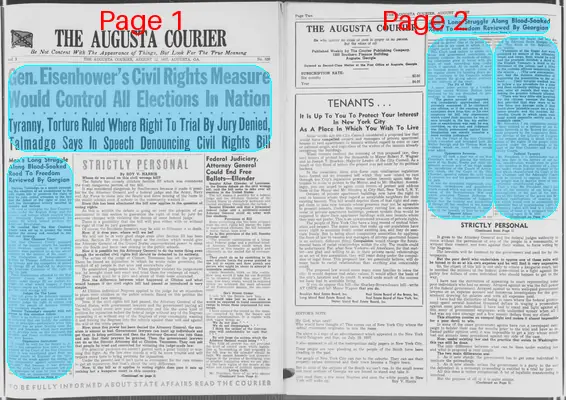
The Augusta Courier
Augusta, Richmond County, Georgia
What is this article about?
Senator Herman Talmadge delivers a Senate speech opposing the civil rights bill (H.R. 6127), arguing it threatens jury trials and could lead to tyranny like the Star Chamber and Admiralty Courts under George III, reviewing historical abuses that contributed to the American Revolution.
Merged-components note: Merged continuation of Herman Talmadge's speech on civil rights bill and trial by jury across pages 1 and 2.
Clippings
1 of 2
OCR Quality
Full Text
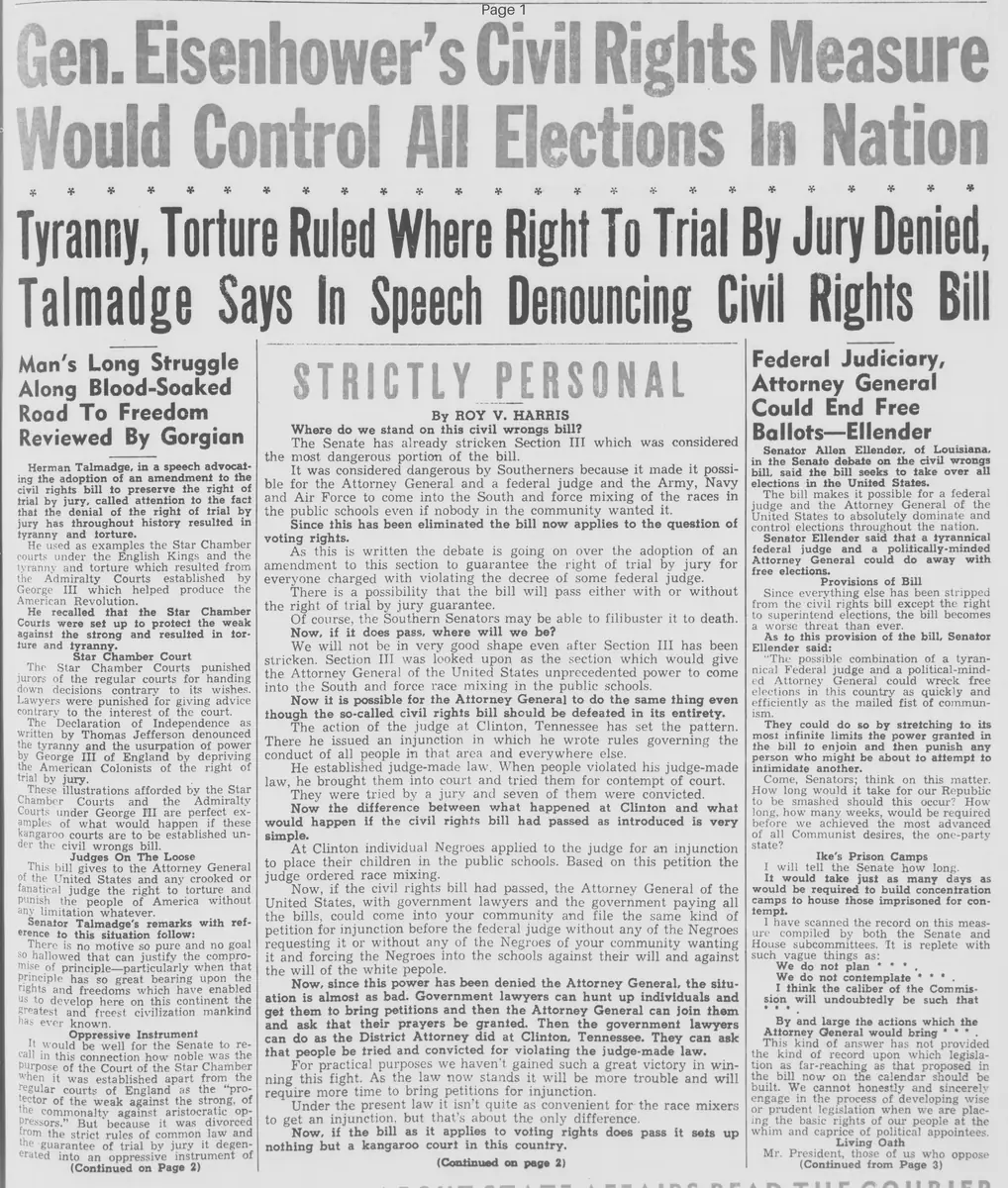
Tyranny, Torture Ruled Where Right To Trial By Jury Denied,
Talmadge Says Speech Denouncing Civil Rights Bill
Man's Long Struggle Along Blood-Soaked Road To Freedom Reviewed By Georgian
Herman Talmadge, in a speech advocating the adoption of an amendment to the civil rights bill to preserve the right of trial by jury, called attention to the fact that the denial of the right of trial by jury has throughout history resulted in tyranny and torture.
He used as examples the Star Chamber courts under the English Kings and the tyranny and torture which resulted from the Admiralty Courts established by George III which helped produce the American Revolution.
He recalled that the Star Chamber Courts were set up to protect the weak against the strong and resulted in torture and tyranny.
Star Chamber Court
The Star Chamber Courts punished jurors of the regular courts for handing down decisions contrary to its wishes.
Lawyers were punished for giving advice contrary to the interest of the court.
The Declaration of Independence as written by Thomas Jefferson denounced the tyranny and the usurpation of power by George III of England by depriving the American Colonists of the right of trial by jury.
These illustrations afforded by the Star Chamber Courts and the Admiralty Courts under George III are perfect examples of what would happen if these kangaroo courts are to be established under the civil rights bill.
Judges On The Loose
This bill gives to the Attorney General of the United States and any crooked or fanatical judge the right to torture and punish the people of America without any limitation whatever.
Senator Talmadge's remarks with reference to this situation follow:
There is no motive so pure and no goal so hallowed that can justify the compromise of principle -particularly when that principle has so great bearing upon the rights and freedoms which have enabled us to develop here on this continent the greatest and freest civilization mankind has ever known.
Oppressive Instrument
It would be well for the Senate to recall in this connection how noble was the purpose of the Court of the Star Chamber when it was established apart from the regular courts of England as the "protector of the weak against the strong, of the commonalty against aristocratic oppressors."
But because it was divorced from the strict rules of common law and the guarantee of trial by jury it degenerated into an oppressive instrument of
(Continued on Page 2)
Man's Long Struggle Along Blood-Soaked Road To Freedom Reviewed By Georgian Continued from Page 1
monarchic tyranny from which nothing escaped its power. One of its prime purposes was to try cases in which it was thought juries would not convict.
This Court used torture to obtain evidence and pronounced convictions on hearsay evidence. Its methods of enforcing submission grew in terror with the reign of each succeeding king under which it operated. At its zenith it used its limitless powers to punish jurors of the regular courts for handing down decisions contrary to the Council's wishes and lawyers for giving advice contrary to the interests of the court.
The Pit of Hell
A secret letter written by a London Barrister named William Hudson later disclosed by his son described its proceedings in these words:
'The person accused or suspected was immediately apprehended, and privately examined. If he confessed any offense, or if the cunning of his examiners drew from him, or his own simplicity let fall, any expressions which suited their purpose, he was at once brought to the bar, his confession or examination was read, he was convicted, ex oro suo, and judgment was finally pronounced against him.'
Imagination can scarely conceive a more terrible judicature.
It was the Court of the Star Chamber which convicted and beheaded both Sir Walter Raleigh and Sir Thomas More on evidence which no court today would even admit.
Oppressive Revenue
George III took a page out of the Star Chamber's book in placing the enforcement of the Sugar, Stamp and other oppressive revenue acts of his reign under the jurisdiction of the Courts of Admiralty which, like the Court of the Star Chamber, operated outside the strict rules of common law and the guarantee of trial by jury.
It was the tyrannical suppression, confiscation, intimidation and punishment which ensued which was one of the prime causes of the Revolutionary War and which prompted Thomas Jefferson to charge in the Declaration of Independence that the tyranny and usurpations of George III has resulted in the American colonists being 'deprived in many cases of the benefits of trial by jury.'
Flagrant Abuse
The flagrant abuse of the rights of the colonists under the Sugar Act was described by Edmund Sears Morgan in his book, 'The Birth of the Republic,' in these words:
'Violations of the Sugar Act were punished by seizure of the offending vessel and cargo. Both would be sold and the proceeds divided: a third to the English Treasury, a third to the Governor of the colony, and a third to the customs officers responsible for the seizure... (The new commissioners) had the dubious distinction of exploiting the possibilities to the utmost . . . Their favorite method was to follow a lax procedure for a time and then, suddenly shifting to a strict one, seize all vessels that were following the practice hitherto allowed.
'There was very little risk involved for the officers, because the Sugar Act provided that they were to be free from any damage suits if they could show 'probable cause' for a mistaken seizure, and the juryless Admiralty Courts in which cases were tried would generally certify such a probable cause.'
Mr. President, I ask unanimous consent to have printed as a portion of my remarks herewith in the Record the memoranda prepared by the Legislative Reference Service of the Library of Congress at my request dealing in detail with the abuses of the rights of the people which occurred under the proceedings of the Court of the Star Chamber and the Admiralty Courts.
Judicial Tyranny
Mr. President, it is unthinkable that at this late date in the history of our nation, consideration would even be given to the creation in this country of a situation under which judicial tyranny of the kind which characterized the Court of the Star Chamber and the Admiralty Courts could be revived to oppress the American people and to deprive them of their inalienable constitutional rights.
That is why, Mr. President, that I feel with all the sincerity of my being that contemplation of the part of the members of this Senate of the grave and far-reaching ramifications of enacting any law which would seek to accomplish the impossible feat of guaranteeing rights by destroying rights will lead to a sober re-appraisal of what it is proposed that we do in acting upon H. R. 6127.
(Continued on Page 3)
What sub-type of article is it?
What themes does it cover?
What keywords are associated?
What entities or persons were involved?
Where did it happen?
Story Details
Key Persons
Location
United States Senate
Story Details
Senator Talmadge opposes the civil rights bill by highlighting historical tyrannies from denying jury trials, including the Star Chamber's abuses under English kings and Admiralty Courts under George III that fueled the American Revolution, warning of similar judicial overreach.