Thank you for visiting SNEWPapers!
Sign up free
Literary
April 17, 1805
Norfolk Gazette And Publick Ledger
Norfolk, Virginia
What is this article about?
The Lay-Curate's Discourse IX expounds on the biblical maxim 'Study to be quiet—and to mind your own business,' advocating prudence, industry, and avoidance of meddling. It critiques idle gossip and promotes self-focus, illustrated by Athenagoras's apologue of Sosthenes's unrequited love, resolved through philosophical and Christian wisdom.
Clipping
OCR Quality
98%
Excellent
Full Text
For the Publick Ledger.
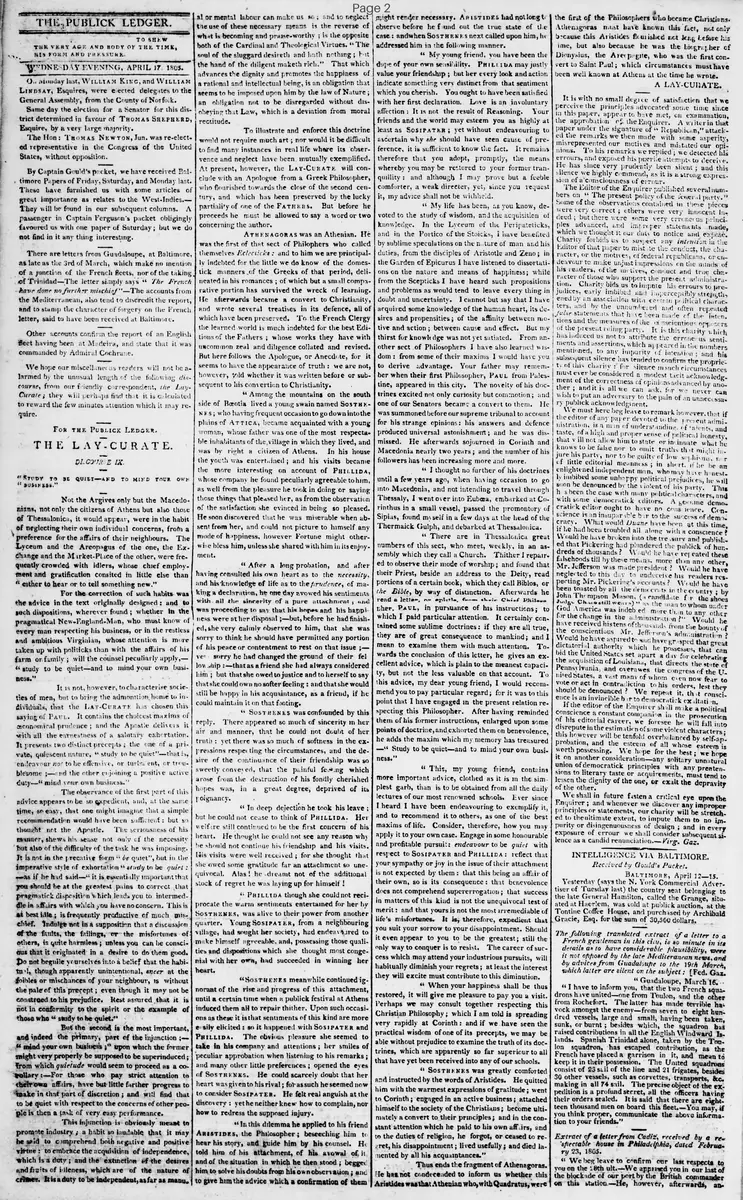
THE LAY-CURATE.
DISCOURSE IX.
"STUDY TO BE QUIET—AND TO MIND YOUR OWN BUSINESS."
Not the Argives only but the Macedonians, not only the citizens of Athens but also those of Thessalonica, it would appear, were in the habit of neglecting their own individual concerns, from a preference for the affairs of their neighbours. The Lyceum and the Areopagus of the one, the Exchange and the Market-Place of the other, were frequently crowded with idlers, whose chief employment and gratification consisted in little else than "either to hear or to tell something new."
For the correction of such habits was the advice in the text originally designed: and to such dispositions, wherever found; whether in the pragmatical New-England-Man, who must know of every man respecting his business, or in the restless and ambitious Virginian, whose attention is more taken up with politicks than with the affairs of his farm or family; will the counsel peculiarly apply,— "study to be quiet—and to mind your own business."
It is not, however, to characterise societies of men, but to bring the admonition, home to individuals, that the Lay-Curate has chosen this saying of Paul. It contains the choicest maxims of economical prudence; and the Apostle delivers it with all the earnestness of a salutary exhortation.
It presents two distinct precepts; the one of a private, quiescent nature, "study to be quiet"—that is, endeavour not to be offensive, or turbulent, or troublesome; and the other enjoining a positive active duty—“mind your own business."
The observance of the first part of this advice appears to be so expedient, and, at the same time, so easy, that one might imagine that a simple recommendation would have been sufficient: but so thought not the Apostle. The seriousness of his manner, shews his sense not only of the necessity but also of the difficulty of the task he was imposing.
It is not in the precative form "be quiet", but in the imperative style of exhortation "study to be quiet": as if he had said—“it is essentially important that you should be at the greatest pains to correct that pragmatick disposition which leads you to intermeddle in affairs with which you have no concern. This is at best idle; is frequently productive of much mischief. Indulge not in a supposition that a discussion of the faults, the failings, or the misfortunes of others, is quite harmless; unless you can be conscious that it originated in a desire to do them good.
Do not beguile yourselves into a belief that the habit, though apparently unintentional, to sneer at the foibles or mischances of your neighbour, is without the pale of this precept; even though it may not be construed to his prejudice. Rest assured that it is not in conformity to the spirit or the example of those who "study to be quiet."
But the second is the most important, and indeed the primary, part of the injunction ;— "mind your own business;" upon which the former might very properly be supposed to be superinduced; from which quietude would seem to proceed as a corollary:—For those who pay strict attention to their own affairs, have but little farther progress to make in that part of discretion; and will find that to be quiet with respect to the concerns of other people is then a task of very easy performance.
This injunction is obviously meant to promote industry; a habit so laudable that it may be said to comprehend both negative and positive virtue: to embrace the acquisition of independence, which is a duty; and the extinction of the desires and fruits of idleness, which are of the nature of crimes. It is a duty to be independent, as far as manual or mental labour can make us so: and to neglect the use of these necessary means is the reverse of what is becoming and praise-worthy; is the opposite both of the Cardinal and Theological Virtues. "The soul of the sluggard desireth and hath nothing; but the hand of the diligent maketh rich." That which advances the dignity and promotes the happiness of a rational and intellectual being, is an obligation that seems to be imposed upon him by the law of Nature; an obligation not to be disregarded without disobeying that Law, which is a deviation from moral rectitude.
To illustrate and enforce this doctrine would not require much art; nor would it be difficult to find many instances in real life where its observance and neglect have been, mutually exemplified.
At present, however, the Lay-CURATE will conclude with an Apologue from a Greek Philosopher, who flourished towards the close of the second century, and which has been preserved by the lucky partiality of one of the FATHERS. But before he proceeds he must be allowed to say a word or two concerning the author.
ATHENAGORAS was an Athenian. He was the first of that sect of Philosophers who called themselves Eclecticks: and to him we are principally indebted for the little we do know of the domestic manners of the Greeks of that period, delineated in his romances; of which but a small comparative portion has survived the wreck of learning.
He afterwards became a convert to Christianity, and wrote several treatises in its defence, all of which have been preserved. To the French Clergy the learned world is much indebted for the best Editions of the Fathers: whose works they have with uncommon zeal and diligence collated and revised.
But here follows the Apologue, or Anecdote, for it seems to have the appearance of truth: we are not, however, told whether it was written before or subsequent to his conversion to Christianity.
"Among the mountains on the south side of Bœotia lived a young swain named SOSTHENES; who having frequent occasion to go down into the plains of Attica, became acquainted with a young woman, whose father was one of the most respectable inhabitants of the village in which they lived, and was by right a citizen of Athens. In his house the youth was entertained; and his visits became the more interesting on account of PHILLLIDA, whose company he found peculiarly agreeable to him, as well from the pleasure he took in doing or saying those things that pleased her, as from the observation of the satisfaction she evinced in being so pleased.
He soon discovered that he was miserable when absent from her, and could not picture to himself any mode of happiness, however Fortune might otherwise bless him, unless she shared with him in its enjoyment.
"After a long probation, and after having consulted his own heart as to the necessity, and his knowledge of life as to the prudence, of making a declaration, he one day avowed his sentiments with all the sincerity of a pure attachment; and was proceeding to say that his hopes and his happiness were at her disposal;—but, before he had finished, she very calmly observed to him, that she was sorry to think he should have permitted any portion of his peace or contentment to rest on that issue;—very sorry he had changed the ground of their friendship:—that as a friend she had always considered him; but that she owed to justice and to herself to say that she could own no softer feeling: and that she would still be happy in his acquaintance, as a friend, if he could maintain it on that footing.
"SOSTHENES was confounded by this reply. There appeared so much of sincerity in her air and manner, that he could not doubt of her truth: yet there was so much of softness in the expressions respecting the circumstances, and the desire of the continuance of their friendship was so sweetly conveyed, that the painful feeling which arose from the destruction of his fondly cherished hopes was, in a great degree, deprived of its poignancy.
"In deep dejection he took his leave: but he could not cease to think of Philida. Her welfare still continued to be the first concern of his heart. He thought he could not see any reason why he should not continue his friendship and his visits.
His visits were well received; for she thought that she owed some gratitude for an attachment so unequivocal. Alas! he dreamt not of the additional stock of regret he was laying up for himself!
"PHILIDA though she could not reciprocate the warm sentiments entertained for her by Sosthenes, was alive to their power from another quarter. Young SOSIPATER, from a neighbouring village, had sought her society, had endeavoured to make himself agreeable, and, possessing those qualities and dispositions which she thought most congenial with her own, had succeeded in winning her heart.
"SOSTHENES meanwhile continued ignorant of the rise and progress of this attachment until a certain time when a publick festival at Athens induced them all to repair thither. Upon such occasions as these it is that sentiments of this kind are more easily elicited: so it happened with Sosipater and Phillida. The obvious pleasure she seemed to take in his company and attentions; her smiles of peculiar approbation when listening to his remarks; and many other little preferences; opened the eyes of Sosthenes. He could scarcely doubt that her heart was given to his rival; for as such he seemed now to consider Sosipater. He felt real anguish at the discovery: yet he neither knew how to complain, nor how to redress the supposed injury.
"In this dilemma he applied to his friend ARISTIDES, the Philosopher; beseeching him to hear his story, and guide him by his counsel. He told him of his attachment, of his avowal of it and of the situation in which he then stood; begged him to solve his doubts from his own observation; and to give him the advice which a confirmation of them might render necessary. Aristides had not long to observe before he found out the true state of the case: and when Sosthenes next called upon him, he addressed him in the following manner.
"My young friend, you have been the dupe of your own sensibility. Phillida may justly value your friendship; but her every look and action indicate something very distinct from that sentiment which you cherish. You ought to have been satisfied with her first declaration. Love is an involuntary affection: It is not the result of Reasoning. Your friends and the world may esteem you as highly at least as Sosipater; yet without endeavouring to ascertain why she should have seen cause of preference, it is sufficient to know the fact. It remains therefore that you adopt, promptly, the means whereby you may be restored to your former tranquillity: and although I may prove but a feeble comforter, a weak directer, yet, since you request it, my advice shall not be withheld.
"My life has been, as you know, devoted to the study of wisdom, and the acquisition of knowledge. In the Lyceum of the Peripatetics and in the Portico of the Stoicks, I have benefited by sublime speculations on the nature of man and his duties, from the disciples of Aristotle and Zeno: in the Garden of Epicurus I have listened to dissertations on the nature and means of happiness; while from the Scepticks I have heard such propositions and problems as would tend to leave every thing in doubt and uncertainty. I cannot but say that I have acquired some knowledge of the human heart, its desires and propensities; of the affinity between motive and action; between cause and effect. But my thirst for knowledge was not yet satiated. From another sect of Philosophers I have also learned wisdom: from some of their maxims I would have you to derive advantage. Your father may remember when their first Philosopher, PAUL from Palestine, appeared in this city. The novelty of his doctrines excited not only curiosity but commotion; and one of our Senators became a convert to them. He was summoned before our supreme tribunal to account for his strange opinions: his answers and defence produced universal astonishment; and he was dismissed. He afterwards sojourned in Corinth and Macedonia nearly two years; and the number of his followers has been increasing more and more.
"I thought no further of his doctrines until a few years ago, when having occasion to go into Macedonia, and not intending to travel through Thessaly, I went over into Eubœa, embarked at Corinthus in a small vessel, passed the promontory of Sipias, found myself in a few days at the head of the Thermaick Gulph, and debarked at Thessalonica.
"There are in Thessalonica great numbers of this sect, who meet, weekly, in an assembly which they call a Church. Thither I repaired to observe their mode of worship; and found that their Priest, beside an address to the Deity, read portions of a certain book, which they call Biblos, or the Bible, by way of distinction. Afterwards he read a letter, or epistle, from their Chief Philosopher. Paul, in pursuance of his instructions; to which I paid particular attention. It certainly contained some sublime doctrines: if they are all true, they are of great consequence to mankind; and I mean to examine them with much attention. Towards the conclusion of this letter, he gives an excellent advice, which is plain to the meanest capacity, but not the less valuable on that account. To this advice, my dear young friend, I would recommend you to pay particular regard; for it was to this point that I have engaged in the present relation respecting this Philosopher. After having reminded them of his former instructions, enlarged upon some points of doctrine, and exhorted them on benevolence, he adds the maxim which my memory has treasured— "Study to be quiet—and to mind your own business."
"This, my young friend, contains more important advice, clothed as it is in the simplest garb, than is to be obtained from all the daily lectures of our most renowned schools. Ever since I heard I have been endeavouring to exemplify it, and to recommend it to others, as one of the best maxims of life. Consider, therefore, how you may apply it to your own case. Engage in some honourable and profitable pursuit: endeavour to be quiet with respect to Sosipater and Phillida: reflect that your sympathy or joy in the issue of their attachment is not expected by them: that this being an affair of their own, so is its consequence: that benevolence does not comprehend supererogation; that success in matters of this kind is not the unequivocal test of merit: and that yours is not the most remediless of life's misfortunes. It is, therefore, expedient that you suit your sorrow to your disappointment. Should it even appear to you to be the greatest; still the only way to conquer is to resist. The career of success which may attend your industrious pursuits, will habitually diminish your regrets; at least the interest they will excite must contribute to this diminution.
"When your happiness shall be thus restored, it will give me pleasure to pay you a visit. Perhaps we may consult together respecting this Christian Philosophy; which I am told is spreading very rapidly at Corinth: and if we have seen the practical wisdom of one of its precepts, we may be able without prejudice to examine the truth of its doctrines, which are apparently so far superiour to all that have yet been received into any of our schools."
Sosthenes was greatly comforted and instructed by the words of Aristides. He quitted him with the warmest expressions of gratitude; went to Corinth; engaged in an active business; attached himself to the society of the Christians; became ultimately a convert to their principles; and in the constant attention which he paid to his own affairs, and to the duties of religion, he forgot, or ceased to regret, his disappointment; lived usefully; and died lamented by all his acquaintances.
Thus ends the fragment of Athenagoras.
He has not condescended to inform us whether this Aristides was that Athenian who, with Quadratus, were the first of the Philosophers who became Christians.
Athenagoras must have known this fact, not only because this Aristides flourished not long before his time, but also because he was the biographer of Dionysius, the Areopagite, who was the first convert to Saint Paul; which circumstances must have been well known at Athens at the time he wrote.
A LAY-CURATE.
THE LAY-CURATE.
DISCOURSE IX.
"STUDY TO BE QUIET—AND TO MIND YOUR OWN BUSINESS."
Not the Argives only but the Macedonians, not only the citizens of Athens but also those of Thessalonica, it would appear, were in the habit of neglecting their own individual concerns, from a preference for the affairs of their neighbours. The Lyceum and the Areopagus of the one, the Exchange and the Market-Place of the other, were frequently crowded with idlers, whose chief employment and gratification consisted in little else than "either to hear or to tell something new."
For the correction of such habits was the advice in the text originally designed: and to such dispositions, wherever found; whether in the pragmatical New-England-Man, who must know of every man respecting his business, or in the restless and ambitious Virginian, whose attention is more taken up with politicks than with the affairs of his farm or family; will the counsel peculiarly apply,— "study to be quiet—and to mind your own business."
It is not, however, to characterise societies of men, but to bring the admonition, home to individuals, that the Lay-Curate has chosen this saying of Paul. It contains the choicest maxims of economical prudence; and the Apostle delivers it with all the earnestness of a salutary exhortation.
It presents two distinct precepts; the one of a private, quiescent nature, "study to be quiet"—that is, endeavour not to be offensive, or turbulent, or troublesome; and the other enjoining a positive active duty—“mind your own business."
The observance of the first part of this advice appears to be so expedient, and, at the same time, so easy, that one might imagine that a simple recommendation would have been sufficient: but so thought not the Apostle. The seriousness of his manner, shews his sense not only of the necessity but also of the difficulty of the task he was imposing.
It is not in the precative form "be quiet", but in the imperative style of exhortation "study to be quiet": as if he had said—“it is essentially important that you should be at the greatest pains to correct that pragmatick disposition which leads you to intermeddle in affairs with which you have no concern. This is at best idle; is frequently productive of much mischief. Indulge not in a supposition that a discussion of the faults, the failings, or the misfortunes of others, is quite harmless; unless you can be conscious that it originated in a desire to do them good.
Do not beguile yourselves into a belief that the habit, though apparently unintentional, to sneer at the foibles or mischances of your neighbour, is without the pale of this precept; even though it may not be construed to his prejudice. Rest assured that it is not in conformity to the spirit or the example of those who "study to be quiet."
But the second is the most important, and indeed the primary, part of the injunction ;— "mind your own business;" upon which the former might very properly be supposed to be superinduced; from which quietude would seem to proceed as a corollary:—For those who pay strict attention to their own affairs, have but little farther progress to make in that part of discretion; and will find that to be quiet with respect to the concerns of other people is then a task of very easy performance.
This injunction is obviously meant to promote industry; a habit so laudable that it may be said to comprehend both negative and positive virtue: to embrace the acquisition of independence, which is a duty; and the extinction of the desires and fruits of idleness, which are of the nature of crimes. It is a duty to be independent, as far as manual or mental labour can make us so: and to neglect the use of these necessary means is the reverse of what is becoming and praise-worthy; is the opposite both of the Cardinal and Theological Virtues. "The soul of the sluggard desireth and hath nothing; but the hand of the diligent maketh rich." That which advances the dignity and promotes the happiness of a rational and intellectual being, is an obligation that seems to be imposed upon him by the law of Nature; an obligation not to be disregarded without disobeying that Law, which is a deviation from moral rectitude.
To illustrate and enforce this doctrine would not require much art; nor would it be difficult to find many instances in real life where its observance and neglect have been, mutually exemplified.
At present, however, the Lay-CURATE will conclude with an Apologue from a Greek Philosopher, who flourished towards the close of the second century, and which has been preserved by the lucky partiality of one of the FATHERS. But before he proceeds he must be allowed to say a word or two concerning the author.
ATHENAGORAS was an Athenian. He was the first of that sect of Philosophers who called themselves Eclecticks: and to him we are principally indebted for the little we do know of the domestic manners of the Greeks of that period, delineated in his romances; of which but a small comparative portion has survived the wreck of learning.
He afterwards became a convert to Christianity, and wrote several treatises in its defence, all of which have been preserved. To the French Clergy the learned world is much indebted for the best Editions of the Fathers: whose works they have with uncommon zeal and diligence collated and revised.
But here follows the Apologue, or Anecdote, for it seems to have the appearance of truth: we are not, however, told whether it was written before or subsequent to his conversion to Christianity.
"Among the mountains on the south side of Bœotia lived a young swain named SOSTHENES; who having frequent occasion to go down into the plains of Attica, became acquainted with a young woman, whose father was one of the most respectable inhabitants of the village in which they lived, and was by right a citizen of Athens. In his house the youth was entertained; and his visits became the more interesting on account of PHILLLIDA, whose company he found peculiarly agreeable to him, as well from the pleasure he took in doing or saying those things that pleased her, as from the observation of the satisfaction she evinced in being so pleased.
He soon discovered that he was miserable when absent from her, and could not picture to himself any mode of happiness, however Fortune might otherwise bless him, unless she shared with him in its enjoyment.
"After a long probation, and after having consulted his own heart as to the necessity, and his knowledge of life as to the prudence, of making a declaration, he one day avowed his sentiments with all the sincerity of a pure attachment; and was proceeding to say that his hopes and his happiness were at her disposal;—but, before he had finished, she very calmly observed to him, that she was sorry to think he should have permitted any portion of his peace or contentment to rest on that issue;—very sorry he had changed the ground of their friendship:—that as a friend she had always considered him; but that she owed to justice and to herself to say that she could own no softer feeling: and that she would still be happy in his acquaintance, as a friend, if he could maintain it on that footing.
"SOSTHENES was confounded by this reply. There appeared so much of sincerity in her air and manner, that he could not doubt of her truth: yet there was so much of softness in the expressions respecting the circumstances, and the desire of the continuance of their friendship was so sweetly conveyed, that the painful feeling which arose from the destruction of his fondly cherished hopes was, in a great degree, deprived of its poignancy.
"In deep dejection he took his leave: but he could not cease to think of Philida. Her welfare still continued to be the first concern of his heart. He thought he could not see any reason why he should not continue his friendship and his visits.
His visits were well received; for she thought that she owed some gratitude for an attachment so unequivocal. Alas! he dreamt not of the additional stock of regret he was laying up for himself!
"PHILIDA though she could not reciprocate the warm sentiments entertained for her by Sosthenes, was alive to their power from another quarter. Young SOSIPATER, from a neighbouring village, had sought her society, had endeavoured to make himself agreeable, and, possessing those qualities and dispositions which she thought most congenial with her own, had succeeded in winning her heart.
"SOSTHENES meanwhile continued ignorant of the rise and progress of this attachment until a certain time when a publick festival at Athens induced them all to repair thither. Upon such occasions as these it is that sentiments of this kind are more easily elicited: so it happened with Sosipater and Phillida. The obvious pleasure she seemed to take in his company and attentions; her smiles of peculiar approbation when listening to his remarks; and many other little preferences; opened the eyes of Sosthenes. He could scarcely doubt that her heart was given to his rival; for as such he seemed now to consider Sosipater. He felt real anguish at the discovery: yet he neither knew how to complain, nor how to redress the supposed injury.
"In this dilemma he applied to his friend ARISTIDES, the Philosopher; beseeching him to hear his story, and guide him by his counsel. He told him of his attachment, of his avowal of it and of the situation in which he then stood; begged him to solve his doubts from his own observation; and to give him the advice which a confirmation of them might render necessary. Aristides had not long to observe before he found out the true state of the case: and when Sosthenes next called upon him, he addressed him in the following manner.
"My young friend, you have been the dupe of your own sensibility. Phillida may justly value your friendship; but her every look and action indicate something very distinct from that sentiment which you cherish. You ought to have been satisfied with her first declaration. Love is an involuntary affection: It is not the result of Reasoning. Your friends and the world may esteem you as highly at least as Sosipater; yet without endeavouring to ascertain why she should have seen cause of preference, it is sufficient to know the fact. It remains therefore that you adopt, promptly, the means whereby you may be restored to your former tranquillity: and although I may prove but a feeble comforter, a weak directer, yet, since you request it, my advice shall not be withheld.
"My life has been, as you know, devoted to the study of wisdom, and the acquisition of knowledge. In the Lyceum of the Peripatetics and in the Portico of the Stoicks, I have benefited by sublime speculations on the nature of man and his duties, from the disciples of Aristotle and Zeno: in the Garden of Epicurus I have listened to dissertations on the nature and means of happiness; while from the Scepticks I have heard such propositions and problems as would tend to leave every thing in doubt and uncertainty. I cannot but say that I have acquired some knowledge of the human heart, its desires and propensities; of the affinity between motive and action; between cause and effect. But my thirst for knowledge was not yet satiated. From another sect of Philosophers I have also learned wisdom: from some of their maxims I would have you to derive advantage. Your father may remember when their first Philosopher, PAUL from Palestine, appeared in this city. The novelty of his doctrines excited not only curiosity but commotion; and one of our Senators became a convert to them. He was summoned before our supreme tribunal to account for his strange opinions: his answers and defence produced universal astonishment; and he was dismissed. He afterwards sojourned in Corinth and Macedonia nearly two years; and the number of his followers has been increasing more and more.
"I thought no further of his doctrines until a few years ago, when having occasion to go into Macedonia, and not intending to travel through Thessaly, I went over into Eubœa, embarked at Corinthus in a small vessel, passed the promontory of Sipias, found myself in a few days at the head of the Thermaick Gulph, and debarked at Thessalonica.
"There are in Thessalonica great numbers of this sect, who meet, weekly, in an assembly which they call a Church. Thither I repaired to observe their mode of worship; and found that their Priest, beside an address to the Deity, read portions of a certain book, which they call Biblos, or the Bible, by way of distinction. Afterwards he read a letter, or epistle, from their Chief Philosopher. Paul, in pursuance of his instructions; to which I paid particular attention. It certainly contained some sublime doctrines: if they are all true, they are of great consequence to mankind; and I mean to examine them with much attention. Towards the conclusion of this letter, he gives an excellent advice, which is plain to the meanest capacity, but not the less valuable on that account. To this advice, my dear young friend, I would recommend you to pay particular regard; for it was to this point that I have engaged in the present relation respecting this Philosopher. After having reminded them of his former instructions, enlarged upon some points of doctrine, and exhorted them on benevolence, he adds the maxim which my memory has treasured— "Study to be quiet—and to mind your own business."
"This, my young friend, contains more important advice, clothed as it is in the simplest garb, than is to be obtained from all the daily lectures of our most renowned schools. Ever since I heard I have been endeavouring to exemplify it, and to recommend it to others, as one of the best maxims of life. Consider, therefore, how you may apply it to your own case. Engage in some honourable and profitable pursuit: endeavour to be quiet with respect to Sosipater and Phillida: reflect that your sympathy or joy in the issue of their attachment is not expected by them: that this being an affair of their own, so is its consequence: that benevolence does not comprehend supererogation; that success in matters of this kind is not the unequivocal test of merit: and that yours is not the most remediless of life's misfortunes. It is, therefore, expedient that you suit your sorrow to your disappointment. Should it even appear to you to be the greatest; still the only way to conquer is to resist. The career of success which may attend your industrious pursuits, will habitually diminish your regrets; at least the interest they will excite must contribute to this diminution.
"When your happiness shall be thus restored, it will give me pleasure to pay you a visit. Perhaps we may consult together respecting this Christian Philosophy; which I am told is spreading very rapidly at Corinth: and if we have seen the practical wisdom of one of its precepts, we may be able without prejudice to examine the truth of its doctrines, which are apparently so far superiour to all that have yet been received into any of our schools."
Sosthenes was greatly comforted and instructed by the words of Aristides. He quitted him with the warmest expressions of gratitude; went to Corinth; engaged in an active business; attached himself to the society of the Christians; became ultimately a convert to their principles; and in the constant attention which he paid to his own affairs, and to the duties of religion, he forgot, or ceased to regret, his disappointment; lived usefully; and died lamented by all his acquaintances.
Thus ends the fragment of Athenagoras.
He has not condescended to inform us whether this Aristides was that Athenian who, with Quadratus, were the first of the Philosophers who became Christians.
Athenagoras must have known this fact, not only because this Aristides flourished not long before his time, but also because he was the biographer of Dionysius, the Areopagite, who was the first convert to Saint Paul; which circumstances must have been well known at Athens at the time he wrote.
A LAY-CURATE.
What sub-type of article is it?
Essay
Fable
What themes does it cover?
Moral Virtue
Religious
Temperance
What keywords are associated?
Moral Discourse
Biblical Maxim
Apologue
Athenagoras
Sosthenes
Unrequited Love
Christian Philosophy
Industry
Prudence
What entities or persons were involved?
A Lay Curate
Literary Details
Title
The Lay Curate. Discourse Ix.
Author
A Lay Curate
Subject
"Study To Be Quiet—And To Mind Your Own Business."
Form / Style
Moral Discourse With Embedded Apologue
Key Lines
"Study To Be Quiet—And To Mind Your Own Business."
"The Soul Of The Sluggard Desireth And Hath Nothing; But The Hand Of The Diligent Maketh Rich."
"Study To Be Quiet—And To Mind Your Own Business."