Thank you for visiting SNEWPapers!
Sign up free
The Idaho Springs Siftings News
Idaho Springs, Clear Creek County, Colorado
What is this article about?
A 1909 man's dream transports him to 1999 for a futuristic train ride to the North Pole, followed by discussion of real polar explorers like Baldwin, Wellman, and Peary, their plans, and scientific notes on the shifting pole.
Merged-components note: Images are illustrations integrated into the north pole exploration feature story; merge based on sequential reading order and contextual relevance.
Clipping
OCR Quality
Full Text
Gee, but I was glad to get into the polar bear section and away from that automatic instrument for rendering sane persons mentally incompetent. I had been reading a copy of the North Pole Friday night Post when, with a noise like all the air coming out of a balloon all at once, the C. & N. P. train started.
It was all strange to me, of the year 1909. I must have slept an awful long time to wake up here in the year of—yes, the date line on the publication I was scanning said February 1, 1999. It was printed in white ink and the words were all spelled phonetically.
"Medicine Hat," yelled a voice in my ear a minute or two after the train had started. I looked quickly around, ready to punch the rude brakeman who had given vent to those rasping notes. As I did so I bumped my nose against the—well, it looked like a phonograph sticking out from the wall of the car.
Then it dawned upon me. It wasn't the brakeman at all. In fact, looking around I could see no employees. As we reached the chunk of darkness, which I took to be the alleged Medicine Hat, the coach door opened without any human assistance, a man at my side punched a button and promptly disappeared through a chute which appeared at his feet.
"Two minutes for liquid air refreshments," came the same rasping, phonographic voice through the instrument at my right. I hunted for the button my disappearing friend had used to disappear by and in an instant I was looking down Medicine Hat's main street. I didn't try to puzzle out that phenomenon. I didn't care if I ever saw the pole, if it had to be seen via the cold, clammy subway route.
Nearly every place of business on the main street was labeled "private weather bureau." I glanced upward to see if it looked like rain. Far to the south I spied what looked strangely like the pictures I scanned in 1909 when I used to read about Count Zeppelin and his airship. As the big bird-like machine came closer, I managed to read the sign on the side. It read:
ROUTE NO. 34.
Fort Wayne, Duluth and Polar Aerial Transportation Company.
That was pretty near the last straw. I wanted to look at something ancient. I couldn't stand this much longer. It was getting on my nerves—these ahead-of-the-minute contrivances.
The airship drew nearer. I could see a roof garden party of young people sitting among the palms on the dome of the big machine. Around them were electric heaters, which radiated heat clear to the earth. Carelessly one young man emptied the contents of his glass over his shoulder in my direction.
I tried to dodge the cloudburst of amber beverage, but, alas, too late. It caught me squarely in the face and—
I WOKE UP!
considering the progress which the year 1908 saw in the way of airship navigation and polar efforts, that dream is within the realm of possibilities of the twentieth century. Less than 50 years ago the man who talked of flying would be deported. To-day the telephone carries one's words as clearly as if spoken to parties in the same room.
If an American should fall asleep in the year 1909 and awake 90 years hence, the things which would greet his eyes would make him the envy of Rip Van Winkle.
Discovery of the north pole will doubtless be made within the lifetime of many citizens of to-day. Anyhow that is what the scientists declare. They say the mere discovery of the pole is simple. It is the conquering of the details which must be surmounted that require the thought and efforts.
Most novel of all plans to plant the American flag or for that matter any other country's flag on top of the pole, is that which some time ago was proposed by Evelyn Briggs Baldwin, who is now working out details of his scheme.
This intrepid explorer aims to float to the pole and take plenty of time getting there. He laid out the plan in detail before the Harvard union at Cambridge, Mass., some time ago and while some blase persons were skeptical, others said they liked the plan.
Here's the way Mr. Baldwin would do it:
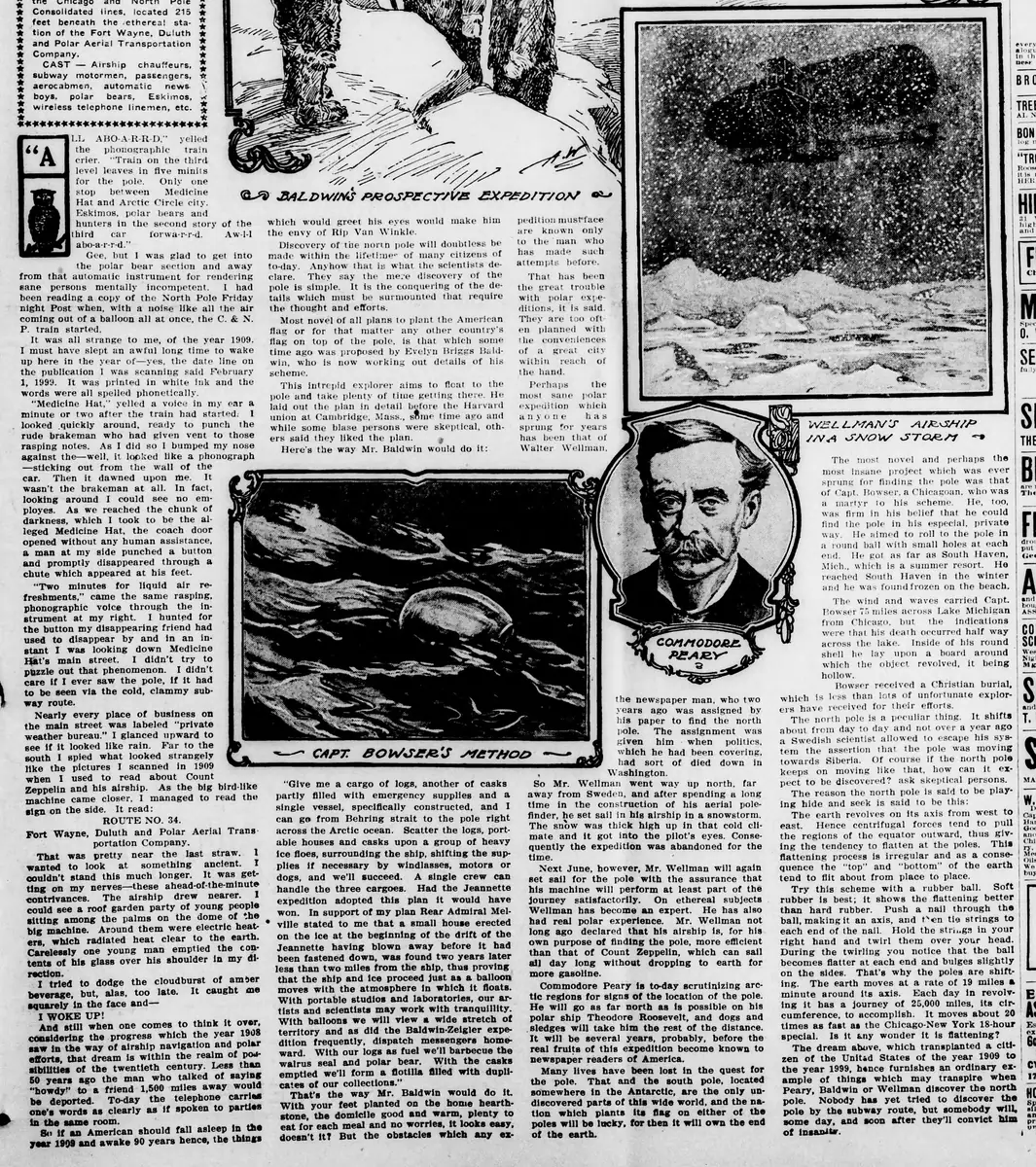
"Give me a cargo of logs, another of casks partly filled with emergency supplies and a single vessel, specifically constructed, and I can go from Behring strait to the pole right across the Arctic ocean. Scatter the logs, portable houses and casks upon a group of heavy ice floes, surrounding the ship, shifting the supplies if necessary by windlasses, motors or dogs, and we'll succeed. A single crew can handle the three cargoes. Had the Jeannette expedition adopted this plan it would have won. In support of my plan Rear Admiral Melville stated to me that a small house erected on the ice at the beginning of the drift of the Jeannette having blown away before it had been fastened down, was found two years later less than two miles from the ship, thus proving that the ship and ice proceed just as a balloon moves with the atmosphere in which it floats.
With portable studios and laboratories, our artists and scientists may work with tranquillity. With balloons we will view a wide stretch of territory and as did the Baldwin-Zeigler expedition frequently, dispatch messengers homeward. With our logs as fuel we'll barbecue the walrus seal and polar bear. With the casks emptied we'll form a flotilla filled with duplicates of our collections.
That's the way Mr. Baldwin would do it.
With your feet planted on the home hearthstone, the domicile good and warm, plenty to eat for each meal and no worries, it looks easy, doesn't it? But the obstacles which any expedition must face are known only to the man who has made such attempts before. That has been the great trouble with polar expeditions, it is said. They are too often planned with the conveniences of a great city within reach of the hand.
Perhaps the most sane polar expedition which anyone has sprung for years has been that of Walter Wellman, the newspaper man, who two years ago was assigned by his paper to find the north pole.
The assignment was given him when politics, which he had been covering, had sort of died down in Washington.
So Mr. Wellman went way up north, far away from Sweden, and after spending a long time in the construction of his aerial pole-finder, he set sail in his airship in a snowstorm.
The snow was thick high up in that cold climate and it got into the pilot's eyes. Consequently the expedition was abandoned for the time.
Next June, however, Mr. Wellman will again set sail for the pole with the assurance that his machine will perform at least part of the journey satisfactorily. On ethereal subjects Wellman has become an expert. He has also had real polar experience. Mr. Wellman not long ago declared that his airship is, for his own purpose of finding the pole, more efficient than that of Count Zeppelin, which can sail all day long without dropping to earth for more gasoline.
Commodore Peary is to-day scrutinizing arctic regions for signs of the location of the pole. He will go as far north as is possible on his polar ship Theodore Roosevelt, and dogs and sledges will take him the rest of the distance.
It will be several years, probably, before the real fruits of this expedition become known to newspaper readers of America.
Many lives have been lost in the quest for the pole. That and the south pole, located somewhere in the Antarctic, are the only undiscovered parts of this wide world, and the nation which plants its flag on either of the poles will be lucky, for then it will own the end of the earth.
The north pole is a peculiar thing. It shifts about from day to day and not over a year ago a Swedish scientist allowed to escape his system the assertion that the pole was moving towards Siberia. Of course if the north pole keeps on moving like that, how can it expect to be discovered? ask skeptical persons.
The reason the north pole is said to be playing hide and seek is said to be this:
The earth revolves on its axis from west to east. Hence centrifugal forces tend to pull the regions of the equator outward, thus giving the tendency to flatten at the poles. This flattening process is irregular and as a consequence the "top" and "bottom" of the earth tend to flit about from place to place.
Try this scheme with a rubber ball. Soft rubber is best; it shows the flattening better than hard rubber. Push a nail through the ball, making it an axis, and then tie strings to each end of the nail. Hold the strings in your right hand and twirl them over your head.
During the twirling you notice that the ball becomes flatter at each end and bulges slightly on the sides. That's why the poles are shifting.
The earth moves at a rate of 19 miles a minute around its axis. Each day in revolving it has a journey of 25,000 miles, its circumference, to accomplish. It moves about 20 times as fast as the Chicago-New York 18-hour special. Is it any wonder it is flattening?
The dream above, which transplanted a citizen of the United States of the year 1909 to the year 1999, hence furnishes an ordinary example of things which may transpire when Peary, Baldwin or Wellman discover the north pole. Nobody has yet tried to discover the pole by the subway route, but somebody will, some day, and soon after they'll convict him of insanity.
What sub-type of article is it?
What themes does it cover?
What keywords are associated?
What entities or persons were involved?
Where did it happen?
Story Details
Key Persons
Location
North Pole, Arctic Ocean, Medicine Hat
Event Date
1909
Story Details
A man dreams of waking in 1999 to futuristic travel to the North Pole via automated train and airship, then wakes up. The article discusses real 1908-1909 polar exploration plans by Baldwin (ice floe drifting), Wellman (airship), and Peary (ship and sledges), plus scientific explanation of the shifting pole.