Thank you for visiting SNEWPapers!
Sign up free
Letter to Editor
November 12, 1859
The Weekly Anglo African
New York, New York County, New York
What is this article about?
Frederick Douglass writes from Canada West denying accusations by prisoner Edwin Cook that he promised to join the Harper's Ferry insurrection led by John Brown. He defends his absence as prudent, reaffirms his abolitionist commitment, and criticizes slaveholders and the U.S. government.
Clipping
OCR Quality
98%
Excellent
Full Text
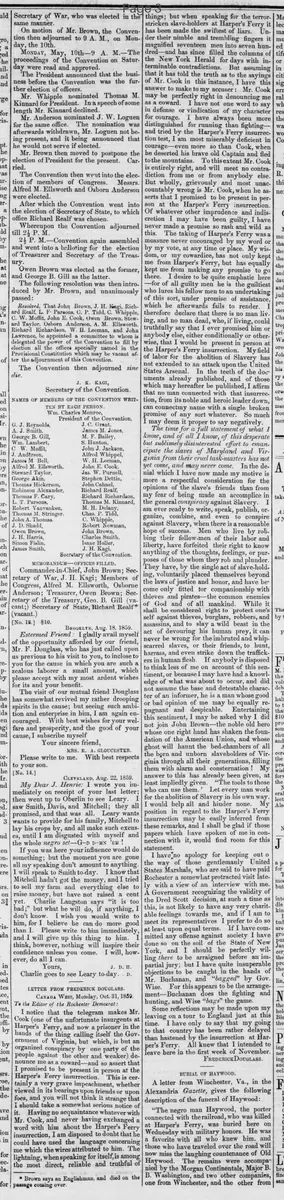
LETTER FROM FREDERICK DOUGLASS.
Canada West, Monday, Oct. 31, 1859.
To the Editor of the Rochester Democrat:
I notice that the telegram makes Mr. Cook (one of the unfortunate insurgents at Harper's Ferry, and now a prisoner in the hands of the thing calling itself the Government of Virginia, but which is but an organized conspiracy by one party of the people against the other and weaker), denounce me as a coward—and so assert that I promised to be present in person at the Harper's Ferry insurrection. This is certainly a very grave impeachment, whether viewed in its bearings upon friends or upon foes, and you will not think it strange that I should take a somewhat serious notice of it. Having no acquaintance whatever with Mr. Cook, and never having exchanged a word with him about the Harper's Ferry insurrection, I am disposed to doubt that he could have used the language concerning me which the wires attributed to him. The lightning, when speaking for itself, is among the most direct, reliable and truthful of things; but when speaking for the terror-stricken slave-holders at Harper's Ferry it has been made the swiftest of liars. Under their nimble and trembling fingers it magnified seventeen men into seven hundred—and has since filled the columns of the New York Herald for days with interminable contradictions. But assuming that it has told the truth as to the sayings of Mr. Cook in this instance, I have this answer to make to my accuser: Mr. Cook may be perfectly right in denouncing me as a coward. I have not one word to say in defense or vindication of my character for courage. I have always been more distinguished for running than fighting, and tried by the Harper's Ferry insurrection test, I am most miserably deficient in courage—even more so than Cook, when he deserted his brave old Captain and fled to the mountains. To this extent Mr. Cook is entirely right, and will meet no contradiction from me or from anybody else.
But wholly, grievously and most unaccountably wrong is Mr. Cook, when he asserts that I promised to be present in person at the Harper's Ferry insurrection. Of whatever other imprudence and indiscretion I may have been guilty, I have never made a promise so rash and wild as this. The taking of Harper's Ferry was a measure never encouraged by my word or by my vote, at any time or place. My wisdom, or my cowardice, has not only kept me from Harper's Ferry, but has equally kept me from making any promise to go there. I desire to be quite emphatic here—for of all guilty men he is the guiltiest who lures his fellow men to an undertaking of this sort, under promise of assistance, which he afterwards fails to render. I therefore declare that there is no man living, and no man dead, who, if living, could truthfully say that I ever promised him or anybody else, either conditionally or otherwise, that I would be present in person at the Harper's Ferry insurrection. My field of labor for the abolition of Slavery has not extended to an attack upon the United States Arsenal. In the teeth of the documents already published, and of those which may hereafter be published, I affirm that no man connected with that insurrection, from its noble and heroic leader down, can connect my name with a single broken promise of any sort whatever. So much I may deem it proper to say negatively.
The time for a full statement of what I know, and of all I know, of this desperate but sublimely disinterested effort to emancipate the slaves of Maryland and Virginia from their cruel task-masters has not yet come, and may never come. In the denial which I have now made my motive is more a respectful consideration for the opinions of the slave's friends than from my fear of being made an accomplice in the general conspiracy against Slavery. I am ever ready to write, speak, publish, organize, combine, and even to conspire against Slavery, when there is a reasonable hope of success. Men who live by robbing their fellow-men of their labor and liberty, have forfeited their right to know anything of the thoughts, feelings, or purposes of those whom they rob and plunder. They have, by the single act of slave-holding, voluntarily placed themselves beyond the laws of justice and honor, and have become only fitted for companionship with thieves and pirates—the common enemies of God and of all mankind. While it shall be considered right to protect one's self against thieves, burglars, robbers, and assassins, and to slay a wild beast in the act of devouring his human prey, it can never be wrong for the imbruted and whip-scarred slaves, or their friends, to hunt, harass, and even strike down the traffickers in human flesh. If anybody is disposed to think less of me on account of this sentiment, or because I may have had a knowledge of what was about to occur, and did not assume the base and detestable character of an informer, he is a man whose good or bad opinion of me may be equally repugnant and despicable. Entertaining this sentiment, I may be asked why I did not join John Brown—the noble old hero whose one right hand has shaken the foundation of the American Union, and whose ghost will haunt the bed-chambers of all the born and unborn slaveholders of Virginia through all their generations, filling them with alarm and consternation! My answer to this has already been given, at least impliedly given. "The tools to those who can use them." Let every man work for the abolition of Slavery in his own way. I would help all and hinder none. My position in regard to the Harper's Ferry insurrection may be easily inferred from these remarks, and I shall be glad if those papers which have spoken of me in connection with it, would find room for this statement.
I have no apology for keeping out of the way of those gentlemanly United States Marshals, who are said to have paid Rochester a somewhat protracted visit lately with a view of an interview with me. A Government recognizing the validity of the Dred Scott decision, at such a time as this, is not likely to have any very charitable feelings towards me, and if I am to meet its representatives I prefer to do so at least upon equal terms. If I have committed any offense against society I have done so on the soil of the State of New York, and I should be perfectly willing there to be arraigned before an impartial jury; but I have quite insuperable objections to be caught in the hands of Mr. Buchanan, and "bagged" by Gov. Wise. For this appears to be the arrangement—Buchanan does the fighting and hunting, and Wise "bags" the game.
Some reflections may be made upon my leaving on a tour to England just at this time. I have only to say that my going to that country has been rather delayed than hastened by the insurrection at Harper's Ferry. All knew that I intended to leave here in the first week of November.
Frederick Douglass.
Canada West, Monday, Oct. 31, 1859.
To the Editor of the Rochester Democrat:
I notice that the telegram makes Mr. Cook (one of the unfortunate insurgents at Harper's Ferry, and now a prisoner in the hands of the thing calling itself the Government of Virginia, but which is but an organized conspiracy by one party of the people against the other and weaker), denounce me as a coward—and so assert that I promised to be present in person at the Harper's Ferry insurrection. This is certainly a very grave impeachment, whether viewed in its bearings upon friends or upon foes, and you will not think it strange that I should take a somewhat serious notice of it. Having no acquaintance whatever with Mr. Cook, and never having exchanged a word with him about the Harper's Ferry insurrection, I am disposed to doubt that he could have used the language concerning me which the wires attributed to him. The lightning, when speaking for itself, is among the most direct, reliable and truthful of things; but when speaking for the terror-stricken slave-holders at Harper's Ferry it has been made the swiftest of liars. Under their nimble and trembling fingers it magnified seventeen men into seven hundred—and has since filled the columns of the New York Herald for days with interminable contradictions. But assuming that it has told the truth as to the sayings of Mr. Cook in this instance, I have this answer to make to my accuser: Mr. Cook may be perfectly right in denouncing me as a coward. I have not one word to say in defense or vindication of my character for courage. I have always been more distinguished for running than fighting, and tried by the Harper's Ferry insurrection test, I am most miserably deficient in courage—even more so than Cook, when he deserted his brave old Captain and fled to the mountains. To this extent Mr. Cook is entirely right, and will meet no contradiction from me or from anybody else.
But wholly, grievously and most unaccountably wrong is Mr. Cook, when he asserts that I promised to be present in person at the Harper's Ferry insurrection. Of whatever other imprudence and indiscretion I may have been guilty, I have never made a promise so rash and wild as this. The taking of Harper's Ferry was a measure never encouraged by my word or by my vote, at any time or place. My wisdom, or my cowardice, has not only kept me from Harper's Ferry, but has equally kept me from making any promise to go there. I desire to be quite emphatic here—for of all guilty men he is the guiltiest who lures his fellow men to an undertaking of this sort, under promise of assistance, which he afterwards fails to render. I therefore declare that there is no man living, and no man dead, who, if living, could truthfully say that I ever promised him or anybody else, either conditionally or otherwise, that I would be present in person at the Harper's Ferry insurrection. My field of labor for the abolition of Slavery has not extended to an attack upon the United States Arsenal. In the teeth of the documents already published, and of those which may hereafter be published, I affirm that no man connected with that insurrection, from its noble and heroic leader down, can connect my name with a single broken promise of any sort whatever. So much I may deem it proper to say negatively.
The time for a full statement of what I know, and of all I know, of this desperate but sublimely disinterested effort to emancipate the slaves of Maryland and Virginia from their cruel task-masters has not yet come, and may never come. In the denial which I have now made my motive is more a respectful consideration for the opinions of the slave's friends than from my fear of being made an accomplice in the general conspiracy against Slavery. I am ever ready to write, speak, publish, organize, combine, and even to conspire against Slavery, when there is a reasonable hope of success. Men who live by robbing their fellow-men of their labor and liberty, have forfeited their right to know anything of the thoughts, feelings, or purposes of those whom they rob and plunder. They have, by the single act of slave-holding, voluntarily placed themselves beyond the laws of justice and honor, and have become only fitted for companionship with thieves and pirates—the common enemies of God and of all mankind. While it shall be considered right to protect one's self against thieves, burglars, robbers, and assassins, and to slay a wild beast in the act of devouring his human prey, it can never be wrong for the imbruted and whip-scarred slaves, or their friends, to hunt, harass, and even strike down the traffickers in human flesh. If anybody is disposed to think less of me on account of this sentiment, or because I may have had a knowledge of what was about to occur, and did not assume the base and detestable character of an informer, he is a man whose good or bad opinion of me may be equally repugnant and despicable. Entertaining this sentiment, I may be asked why I did not join John Brown—the noble old hero whose one right hand has shaken the foundation of the American Union, and whose ghost will haunt the bed-chambers of all the born and unborn slaveholders of Virginia through all their generations, filling them with alarm and consternation! My answer to this has already been given, at least impliedly given. "The tools to those who can use them." Let every man work for the abolition of Slavery in his own way. I would help all and hinder none. My position in regard to the Harper's Ferry insurrection may be easily inferred from these remarks, and I shall be glad if those papers which have spoken of me in connection with it, would find room for this statement.
I have no apology for keeping out of the way of those gentlemanly United States Marshals, who are said to have paid Rochester a somewhat protracted visit lately with a view of an interview with me. A Government recognizing the validity of the Dred Scott decision, at such a time as this, is not likely to have any very charitable feelings towards me, and if I am to meet its representatives I prefer to do so at least upon equal terms. If I have committed any offense against society I have done so on the soil of the State of New York, and I should be perfectly willing there to be arraigned before an impartial jury; but I have quite insuperable objections to be caught in the hands of Mr. Buchanan, and "bagged" by Gov. Wise. For this appears to be the arrangement—Buchanan does the fighting and hunting, and Wise "bags" the game.
Some reflections may be made upon my leaving on a tour to England just at this time. I have only to say that my going to that country has been rather delayed than hastened by the insurrection at Harper's Ferry. All knew that I intended to leave here in the first week of November.
Frederick Douglass.
What sub-type of article is it?
Persuasive
Political
Reflective
What themes does it cover?
Slavery Abolition
Politics
Morality
What keywords are associated?
Frederick Douglass
Harpers Ferry
John Brown
Slavery Abolition
Insurrection
Coward Accusation
Edwin Cook
What entities or persons were involved?
Frederick Douglass
To The Editor Of The Rochester Democrat
Letter to Editor Details
Author
Frederick Douglass
Recipient
To The Editor Of The Rochester Democrat
Main Argument
douglass denies promising to participate in the harper's ferry insurrection, admits to lacking the courage for direct action but affirms his dedication to abolition through other means, and criticizes slaveholders and the government.
Notable Details
Denies Acquaintance With Mr. Cook
Criticizes Telegraph Reports From Slaveholders
Praises John Brown As A Hero
References Dred Scott Decision
Explains Delay In Travel To England