Thank you for visiting SNEWPapers!
Sign up free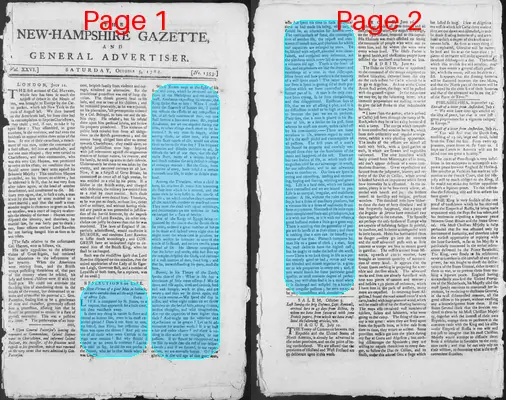
Literary
October 5, 1782
The New Hampshire Gazette And General Advertiser
Portsmouth, Exeter, Rockingham County, New Hampshire
What is this article about?
This philosophical essay reflects on the brevity, miseries, and virtues of human life, compiling quotes and anecdotes from sources like Pope, Pliny, Xerxes, Artabanus, Thracians, an Egyptian king, Burnet, Epictetus, Plato, and Plutarch to explore mortality, moral living, and preparation for the afterlife.
Merged-components note: Merged as continuation of the essay 'Reflections on Life' across pages 1 and 2, with sequential reading order and direct textual flow.
Clippings
1 of 2
OCR Quality
95%
Excellent
Full Text
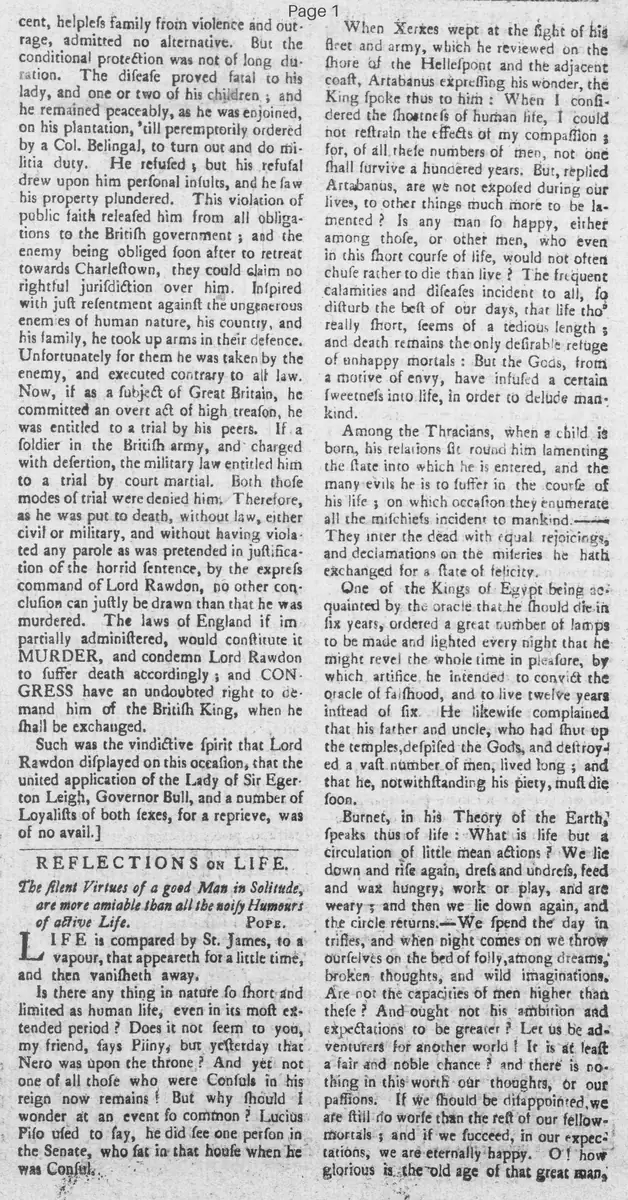
REFLECTIONS ON LIFE.
The silent Virtues of a good Man in Solitude, are more amiable than all the noisy Humours of active Life.
POPE.
Life is compared by St. James, to a vapour, that appeareth for a little time, and then vanisheth away.
Is there any thing in nature so short and limited as human life, even in its most extended period? Does it not seem to you, my friend, says Pliny, but yesterday that Nero was upon the throne? And yet not one of all those who were Consuls in his reign now remains! But why should I wonder at an event so common? Lucius Piso used to say, he did see one person in the Senate, who sat in that house when he was Consul.
When Xerxes wept at the sight of his fleet and army, which he reviewed on the shore of the Hellespont and the adjacent coast, Artabanus expressing his wonder, the King spoke thus to him: When I considered the shortness of human life, I could not restrain the effects of my compassion; for, of all these numbers of men, not one shall survive a hundred years. But, replied Artabanus, are we not exposed during our lives, to other things much more to be lamented? Is any man so happy, either among those, or other men, who even in this short course of life, would not often choose rather to die than live? The frequent calamities and diseases incident to all, so disturb the best of our days, that life though really short, seems of a tedious length; and death remains the only desirable refuge of unhappy mortals: But the Gods, from a motive of envy, have infused a certain sweetness into life, in order to delude mankind.
Among the Thracians, when a child is born, his relations sit round him lamenting the state into which he is entered, and the many evils he is to suffer in the course of his life: on which occasion they enumerate all the mischiefs incident to mankind. They inter the dead with equal rejoicings, and declamations on the miseries he hath exchanged for a state of felicity.
One of the Kings of Egypt being acquainted by the oracle that he should die in six years, ordered a great number of lamps to be made and lighted every night that he might revel the whole time in pleasure, by which artifice, he intended to convict the oracle of falsehood, and to live twelve years instead of six. He likewise complained that his father and uncle, who had shut up the temples, despised the Gods, and destroyed a vast number of men, lived long; and that he, notwithstanding his piety, must die soon.
Burnet, in his Theory of the Earth speaks thus of life: What is life but a circulation of little mean actions? We lie down and rise again, dress and undress, feed and wax hungry; work or play, and are weary; and then we lie down again, and the circle returns. We spend the day in trifles, and when night comes on we throw ourselves on the bed of folly, among dreams, broken thoughts, and wild imaginations.
Are not the capacities of men higher than these? And ought not his ambition and expectations to be greater? Let us be adventurers for another world! It is at least a fair and noble chance? and there is nothing in this worth our thoughts, or our passions. If we should be disappointed, we are still no worse than the rest of our fellow-mortals; and if we succeed in our expectations, we are eternally happy. O! how glorious is the old age of that great man;
Who has spent his time in such complications as had made his being what only it should be, an education for heaven.
The consciousness of fame, the contemplation of another life, the respect and commerce of honest men, and pleasures for which our capacities are enlarged by years. To be saluted with respect, attended with cheerfulness, and consulted with deference, are the pleasures which never fail to accompany a virtuous old age. Youth is the fever of life, and its pleasures are like the dreams and ramblings of a man in that distemper.
How sweet and how pleasant is the memory of a well spent youth! The latter half of our lives is spent in getting rid of those prejudices which we have contracted in the former part of it. A man is the only creature born crying, so he lives complaining, and dies disappointed. Epictetus says of life, that we are all acting a play, and it is no distinction in itself to be high or low, but to become the part we are to perform.
Plato says, that a man is placed in his station of life, as a soldier on his post, from whence he must not move, unless called off by his commander. There are some occasions in life, wherein regard to man's self is the most pitiful and contemptible of all passions. The first years of a man's life should be properly and carefully employed, since they lay the foundation of the merit and happiness of the rest. There are but two seasons of life, in which truth distinguishes itself for our advantage: in youth, for our instruction, and in our advanced years to comfort us. Our lives are spent in erring and correcting, losing and recovering, hoping and fearing, rejoicing and grieving. Life is a fatal debt, which our fathers have contracted and we are bound to pay.
Life is an unequal, irregular, and multiform motion: A life, without the rules of morality, is but a series of transitory pleasures; but a virtuous life is a series of reasonable & uniform enjoyments. Shortness of life is the common complaint of fools and philosophers, but it is with our lives, as it is with our estates, a good husband makes a little go a great way.
There is nothing that the generality of people are so lavish of as their times; and there is nothing that a man can be honestly covetous of but that. Plutarch compares human life to a game of chess; a man, says he, may desire to have the highest cast but he ought to make the best of the worst.
There is no such thing in life as a person entirely good or bad: virtue and vice are blended and mixed together in a greater or less proportion in every one; and, if you would search for some particular good quality, or most eminent degree of perfection, you will often find it in a mind where it is darkened and eclipsed by a hundred other irregular passions; for men are apt to be very inconsistent with themselves.
The silent Virtues of a good Man in Solitude, are more amiable than all the noisy Humours of active Life.
POPE.
Life is compared by St. James, to a vapour, that appeareth for a little time, and then vanisheth away.
Is there any thing in nature so short and limited as human life, even in its most extended period? Does it not seem to you, my friend, says Pliny, but yesterday that Nero was upon the throne? And yet not one of all those who were Consuls in his reign now remains! But why should I wonder at an event so common? Lucius Piso used to say, he did see one person in the Senate, who sat in that house when he was Consul.
When Xerxes wept at the sight of his fleet and army, which he reviewed on the shore of the Hellespont and the adjacent coast, Artabanus expressing his wonder, the King spoke thus to him: When I considered the shortness of human life, I could not restrain the effects of my compassion; for, of all these numbers of men, not one shall survive a hundred years. But, replied Artabanus, are we not exposed during our lives, to other things much more to be lamented? Is any man so happy, either among those, or other men, who even in this short course of life, would not often choose rather to die than live? The frequent calamities and diseases incident to all, so disturb the best of our days, that life though really short, seems of a tedious length; and death remains the only desirable refuge of unhappy mortals: But the Gods, from a motive of envy, have infused a certain sweetness into life, in order to delude mankind.
Among the Thracians, when a child is born, his relations sit round him lamenting the state into which he is entered, and the many evils he is to suffer in the course of his life: on which occasion they enumerate all the mischiefs incident to mankind. They inter the dead with equal rejoicings, and declamations on the miseries he hath exchanged for a state of felicity.
One of the Kings of Egypt being acquainted by the oracle that he should die in six years, ordered a great number of lamps to be made and lighted every night that he might revel the whole time in pleasure, by which artifice, he intended to convict the oracle of falsehood, and to live twelve years instead of six. He likewise complained that his father and uncle, who had shut up the temples, despised the Gods, and destroyed a vast number of men, lived long; and that he, notwithstanding his piety, must die soon.
Burnet, in his Theory of the Earth speaks thus of life: What is life but a circulation of little mean actions? We lie down and rise again, dress and undress, feed and wax hungry; work or play, and are weary; and then we lie down again, and the circle returns. We spend the day in trifles, and when night comes on we throw ourselves on the bed of folly, among dreams, broken thoughts, and wild imaginations.
Are not the capacities of men higher than these? And ought not his ambition and expectations to be greater? Let us be adventurers for another world! It is at least a fair and noble chance? and there is nothing in this worth our thoughts, or our passions. If we should be disappointed, we are still no worse than the rest of our fellow-mortals; and if we succeed in our expectations, we are eternally happy. O! how glorious is the old age of that great man;
Who has spent his time in such complications as had made his being what only it should be, an education for heaven.
The consciousness of fame, the contemplation of another life, the respect and commerce of honest men, and pleasures for which our capacities are enlarged by years. To be saluted with respect, attended with cheerfulness, and consulted with deference, are the pleasures which never fail to accompany a virtuous old age. Youth is the fever of life, and its pleasures are like the dreams and ramblings of a man in that distemper.
How sweet and how pleasant is the memory of a well spent youth! The latter half of our lives is spent in getting rid of those prejudices which we have contracted in the former part of it. A man is the only creature born crying, so he lives complaining, and dies disappointed. Epictetus says of life, that we are all acting a play, and it is no distinction in itself to be high or low, but to become the part we are to perform.
Plato says, that a man is placed in his station of life, as a soldier on his post, from whence he must not move, unless called off by his commander. There are some occasions in life, wherein regard to man's self is the most pitiful and contemptible of all passions. The first years of a man's life should be properly and carefully employed, since they lay the foundation of the merit and happiness of the rest. There are but two seasons of life, in which truth distinguishes itself for our advantage: in youth, for our instruction, and in our advanced years to comfort us. Our lives are spent in erring and correcting, losing and recovering, hoping and fearing, rejoicing and grieving. Life is a fatal debt, which our fathers have contracted and we are bound to pay.
Life is an unequal, irregular, and multiform motion: A life, without the rules of morality, is but a series of transitory pleasures; but a virtuous life is a series of reasonable & uniform enjoyments. Shortness of life is the common complaint of fools and philosophers, but it is with our lives, as it is with our estates, a good husband makes a little go a great way.
There is nothing that the generality of people are so lavish of as their times; and there is nothing that a man can be honestly covetous of but that. Plutarch compares human life to a game of chess; a man, says he, may desire to have the highest cast but he ought to make the best of the worst.
There is no such thing in life as a person entirely good or bad: virtue and vice are blended and mixed together in a greater or less proportion in every one; and, if you would search for some particular good quality, or most eminent degree of perfection, you will often find it in a mind where it is darkened and eclipsed by a hundred other irregular passions; for men are apt to be very inconsistent with themselves.
What sub-type of article is it?
Essay
What themes does it cover?
Death Mortality
Moral Virtue
Religious
What keywords are associated?
Reflections On Life
Shortness Of Life
Human Mortality
Virtuous Living
Philosophical Quotes
Afterlife Hope
Moral Reflection
Literary Details
Title
Reflections On Life.
Key Lines
The Silent Virtues Of A Good Man In Solitude, Are More Amiable Than All The Noisy Humours Of Active Life.
Life Is Compared By St. James, To A Vapour, That Appeareth For A Little Time, And Then Vanisheth Away.
When I Considered The Shortness Of Human Life, I Could Not Restrain The Effects Of My Compassion; For, Of All These Numbers Of Men, Not One Shall Survive A Hundred Years.
Let Us Be Adventurers For Another World! It Is At Least A Fair And Noble Chance?
A Life, Without The Rules Of Morality, Is But A Series Of Transitory Pleasures; But A Virtuous Life Is A Series Of Reasonable & Uniform Enjoyments.