Thank you for visiting SNEWPapers!
Sign up free
Editorial
May 4, 1859
The Hillsborough Recorder
Hillsboro, Orange County, North Carolina
What is this article about?
This editorial laments the rise in vice and crime due to idleness among youth, attributing it to a societal shift viewing labor as disgraceful. It invokes the biblical commandment to labor six days, natural law, and warns that idleness leads to devil's work, urging useful employment for virtue and happiness.
Clipping
OCR Quality
88%
Good
Full Text
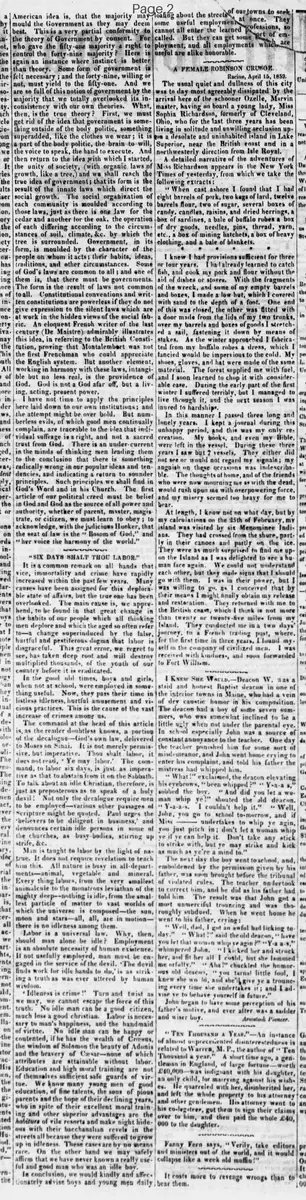
"SIX DAYS SHALT THOU LABOR."
It is a common remark on all hands that vice, immorality and crime have rapidly increased within the past few years. Many causes have been assigned for this deplorable state of affairs, but the true one has been overlooked. The main cause is, we apprehend, to be found in that great change in the habits of our people which all thinking men deplore and which the aged so often refer to—a change superinduced by the false, hurtful and pestiferous dogma that labor is disgraceful. This great error, we regret to see, has taken deep root and will destroy multiplied thousands of the youth of our country before it is eradicated.
In the good old times, boys and girls, when not at school, were employed in something useful. Now, they pass their time in listless idleness, hurtful amusement and vicious practices. This is the cause of the vast increase of crimes among us.
The command at the head of this article is, as the reader doubtless knows, a portion of the decalogue—God's own law, delivered to Moses on Sinai. It is not merely permissive, but imperative. Thou shalt "labor," it does not read, Ye may labor. The command, to labor six days, is just as imperative as that to abstain from it on the Sabbath. To talk about an idle Christian, therefore, is just as preposterous as to speak of a holy devil! Not only the decalogue requires men to be employed—various other passages of Scripture might be quoted. Paul urges the believers to be diligent in business, and denounces certain idle persons in some of the churches, as busy-bodies, stirring up strife, &c.
Man is taught to labor by the light of nature. It does not require revelation to teach him this. All nature is busy in all departments—animal, vegetable and mineral. Every thing labors, from the very smallest animalcule to the monstrous leviathan of the mighty deep—nothing is idle, from the smallest particle of matter to vast worlds of which the universe is composed—the sun, moon and stars—all, all, are in motion—there is no idleness among them.
Labor is a universal law. Why, then, should man alone be idle? Employment is an absolute necessity of human existence. If not usefully employed, man must be engaged in the service of the devil. The devil finds work for idle hands to do, is as striking a truth as was ever uttered by human wisdom.
Idleness is crime! Turn and twist as we may, we cannot escape the force of this truth: No idle man can be a good citizen, much less a good christian. Labor is necessary to man's happiness, and the handmaid of virtue. No idle man can be happy or contented, if he has the wealth of Croesus, the wisdom of Solomon the beauty of Adonis and the bravery of Caesar—none of which attributes are attainable without labor. Education and high moral training are not of themselves sufficient safe guards of virtue. We know many young men of good education, of fine talents, the sons of pious parents and the hope of their declining years, who in spite of their excellent moral training and other superior advantages are the habitues of vile resorts and make night hideous with their bacchanalian revel in the streets all because they were suffered to grow up in idleness. These cases are by no means rare. On the other hand we may safely affirm that we have never known a really useful and good man who was an idle boy.
In conclusion, we would kindly and affectionately advise boys and young men to find some useful employment. Whatever their professions. But they can get some employment, and all employments which are useful are alike honorable.
It is a common remark on all hands that vice, immorality and crime have rapidly increased within the past few years. Many causes have been assigned for this deplorable state of affairs, but the true one has been overlooked. The main cause is, we apprehend, to be found in that great change in the habits of our people which all thinking men deplore and which the aged so often refer to—a change superinduced by the false, hurtful and pestiferous dogma that labor is disgraceful. This great error, we regret to see, has taken deep root and will destroy multiplied thousands of the youth of our country before it is eradicated.
In the good old times, boys and girls, when not at school, were employed in something useful. Now, they pass their time in listless idleness, hurtful amusement and vicious practices. This is the cause of the vast increase of crimes among us.
The command at the head of this article is, as the reader doubtless knows, a portion of the decalogue—God's own law, delivered to Moses on Sinai. It is not merely permissive, but imperative. Thou shalt "labor," it does not read, Ye may labor. The command, to labor six days, is just as imperative as that to abstain from it on the Sabbath. To talk about an idle Christian, therefore, is just as preposterous as to speak of a holy devil! Not only the decalogue requires men to be employed—various other passages of Scripture might be quoted. Paul urges the believers to be diligent in business, and denounces certain idle persons in some of the churches, as busy-bodies, stirring up strife, &c.
Man is taught to labor by the light of nature. It does not require revelation to teach him this. All nature is busy in all departments—animal, vegetable and mineral. Every thing labors, from the very smallest animalcule to the monstrous leviathan of the mighty deep—nothing is idle, from the smallest particle of matter to vast worlds of which the universe is composed—the sun, moon and stars—all, all, are in motion—there is no idleness among them.
Labor is a universal law. Why, then, should man alone be idle? Employment is an absolute necessity of human existence. If not usefully employed, man must be engaged in the service of the devil. The devil finds work for idle hands to do, is as striking a truth as was ever uttered by human wisdom.
Idleness is crime! Turn and twist as we may, we cannot escape the force of this truth: No idle man can be a good citizen, much less a good christian. Labor is necessary to man's happiness, and the handmaid of virtue. No idle man can be happy or contented, if he has the wealth of Croesus, the wisdom of Solomon the beauty of Adonis and the bravery of Caesar—none of which attributes are attainable without labor. Education and high moral training are not of themselves sufficient safe guards of virtue. We know many young men of good education, of fine talents, the sons of pious parents and the hope of their declining years, who in spite of their excellent moral training and other superior advantages are the habitues of vile resorts and make night hideous with their bacchanalian revel in the streets all because they were suffered to grow up in idleness. These cases are by no means rare. On the other hand we may safely affirm that we have never known a really useful and good man who was an idle boy.
In conclusion, we would kindly and affectionately advise boys and young men to find some useful employment. Whatever their professions. But they can get some employment, and all employments which are useful are alike honorable.
What sub-type of article is it?
Moral Or Religious
Social Reform
Labor
What keywords are associated?
Idleness
Labor
Vice
Crime
Morality
Biblical Command
Youth Employment
Social Habits
Editorial Details
Primary Topic
Idleness As Cause Of Vice And Crime, Necessity Of Labor
Stance / Tone
Strong Moral Exhortation Advocating Industriousness
Key Arguments
Idleness Among Youth Leads To Increased Vice, Immorality, And Crime.
Societal View Of Labor As Disgraceful Is A Harmful Error.
Biblical Decalogue Commands Labor Six Days Imperatively, Like Sabbath Observance.
Nature Demonstrates Universal Labor In All Creation.
Idle Hands Serve The Devil; Employment Is Necessary For Human Existence.
No Idle Person Can Be A Good Citizen Or Christian; Labor Ensures Happiness And Virtue.
Education Alone Insufficient Without Labor; Idle Boys Become Vices, Industrious Ones Good Men.