Thank you for visiting SNEWPapers!
Sign up free
Editorial
May 2, 1941
The Weekly Echo
Meridian, Lauderdale County, Mississippi
What is this article about?
This editorial urges workers to stay mentally engaged with their jobs beyond work hours, emphasizing perseverance, attention to small details like appearance and speech, and constant dedication to advance in industrial careers while remaining fair to colleagues.
Clipping
OCR Quality
92%
Excellent
Full Text
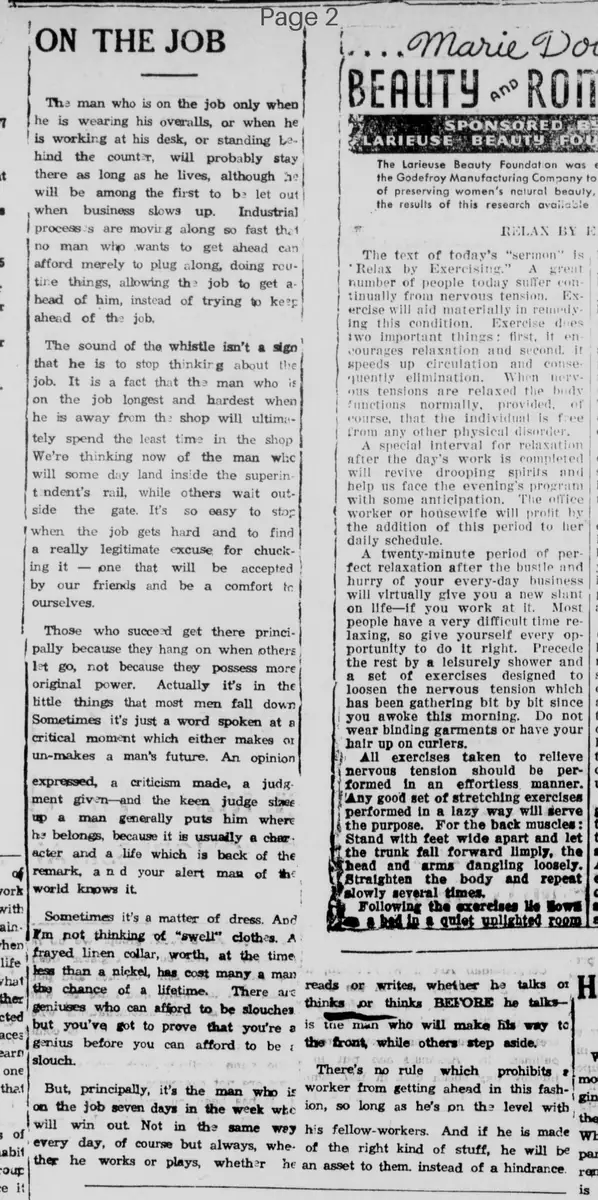
ON THE JOB
The man who is on the job only when
he is wearing his overalls, or when he
is working at his desk, or standing behind the counter, will probably stay
there as long as he lives, although he
will be among the first to be let out
when business slows up.
Industrial
processes are moving along so fast that
no man who wants to get ahead can
afford merely to plug along, doing routine things, allowing the job to get ahead of him, instead of trying to keep
ahead of the job.
The sound of the whistle isn't a sign
that he is to stop thinking about the
job. It is a fact that the man who is
on the job longest and hardest when
he is away from the shop will ultimately spend the least time in the shop.
We're thinking now of the man who
will some day land inside the superintendent's rail, while others wait outside the gate. It's so easy to stop
when the job gets hard and to find
a really legitimate excuse for chucking it—one that will be accepted
by our friends and be a comfort to
ourselves.
Those who succeed get there principally because they hang on when others
let go, not because they possess more
original power. Actually it's in the
little things that most men fall down.
Sometimes it's just a word spoken at a
critical moment which either makes or
unmakes a man's future. An opinion
expressed, a criticism made, a judgment given—and the keen judge sizes
up a man generally puts him where
he belongs, because it is usually a character and a life which is back of the
remark, and your alert man of the
world knows it.
Sometimes it's a matter of dress. And
I'm not thinking of "swell" clothes. A
frayed linen collar, worth less than a nickel, has cost many a man
the chance of a lifetime. There are
geniuses who can afford to be slouches
but you've got to prove that you're a
genius before you can afford to be a
slouch.
But, principally, it's the man who is
on the job seven days in the week who
will win out. Not in the same way
every day, of course but always, whether he works or plays, whether he
reads or writes, whether he talks or
thinks or thinks BEFORE he talks—is the man who will make his way to
the front while others step aside.
BC
There's no rule which prohibits
a worker from getting ahead in this fashion, so long as he's on the level with
his fellow-workers. And if he is made
of the right kind of stuff, he will be
an asset to them, instead of a hindrance.
The man who is on the job only when
he is wearing his overalls, or when he
is working at his desk, or standing behind the counter, will probably stay
there as long as he lives, although he
will be among the first to be let out
when business slows up.
Industrial
processes are moving along so fast that
no man who wants to get ahead can
afford merely to plug along, doing routine things, allowing the job to get ahead of him, instead of trying to keep
ahead of the job.
The sound of the whistle isn't a sign
that he is to stop thinking about the
job. It is a fact that the man who is
on the job longest and hardest when
he is away from the shop will ultimately spend the least time in the shop.
We're thinking now of the man who
will some day land inside the superintendent's rail, while others wait outside the gate. It's so easy to stop
when the job gets hard and to find
a really legitimate excuse for chucking it—one that will be accepted
by our friends and be a comfort to
ourselves.
Those who succeed get there principally because they hang on when others
let go, not because they possess more
original power. Actually it's in the
little things that most men fall down.
Sometimes it's just a word spoken at a
critical moment which either makes or
unmakes a man's future. An opinion
expressed, a criticism made, a judgment given—and the keen judge sizes
up a man generally puts him where
he belongs, because it is usually a character and a life which is back of the
remark, and your alert man of the
world knows it.
Sometimes it's a matter of dress. And
I'm not thinking of "swell" clothes. A
frayed linen collar, worth less than a nickel, has cost many a man
the chance of a lifetime. There are
geniuses who can afford to be slouches
but you've got to prove that you're a
genius before you can afford to be a
slouch.
But, principally, it's the man who is
on the job seven days in the week who
will win out. Not in the same way
every day, of course but always, whether he works or plays, whether he
reads or writes, whether he talks or
thinks or thinks BEFORE he talks—is the man who will make his way to
the front while others step aside.
BC
There's no rule which prohibits
a worker from getting ahead in this fashion, so long as he's on the level with
his fellow-workers. And if he is made
of the right kind of stuff, he will be
an asset to them, instead of a hindrance.
What sub-type of article is it?
Work Ethic
Industrial Success
What keywords are associated?
Work Ethic
Industrial Progress
Perseverance
Career Advancement
Dedication
Success Habits
Editorial Details
Primary Topic
Constant Dedication To Work For Career Advancement
Stance / Tone
Motivational Encouragement For Perseverance
Key Arguments
Stay Mentally On The Job Even When Away From Work
Persevere When Others Quit To Achieve Success
Attention To Small Details Like Speech And Dress Matters
Constant Effort Seven Days A Week Leads To Promotion
Fair Play With Colleagues Enhances Value