Thank you for visiting SNEWPapers!
Sign up free
Editorial
November 6, 1840
Daily Cincinnati Republican
Cincinnati, Hamilton County, Ohio
What is this article about?
The editorial from the Philadelphia Centinel celebrates the rapid, peaceful growth of the United States in population, wealth, and enterprise, unmatched in history. It highlights the development of cities like New York and Philadelphia, American innovations in steam and locomotives, and projects a future population of billions, foreseeing the transfer of global civilization to the Americas.
Clipping
OCR Quality
95%
Excellent
Full Text
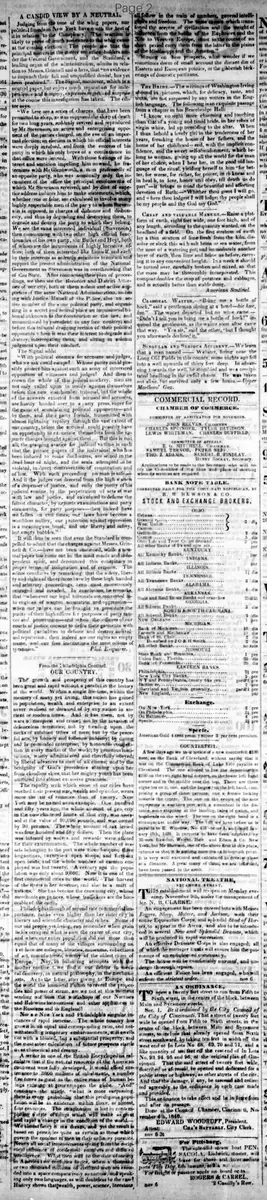
From the Philadelphia Centinel.
OUR COUNTRY.
The growth and prosperity of this country has been great and rapid without a parallel in the history of the world. Within a single lifetime, within the memory of many yet living, this nation has gained in population, wealth and enterprise to an extent never realised or dreamed of by any nation in ancient or modern times. And it has risen, not by war or conquest and crime; not by the invasion of defenceless territories; not by treading upon the necks of subdued tribes of men; but by the peaceful arts, by homely and toilsome industry; by daring and large-minded enterprise; by honorable competition in every market of the world; by generous institutions, wisely administered and cheerfully obeyed; by liberal advances to men of all climes; and by the benignity of God's providence shining upon her from cloudless skies, that her mighty youth has been nurtured into almost excessive greatness.
The rapidity with which some of our cities have reached their present size, wealth and splendor, wears more the air of romance than of history. New York may be named as an example. One hundred and sixty years ago, the whole amount of property in the now chartered limits of that city, was assessed at the value of £90,000, and was owned by 30 persons. The whole amount of tax levied was four hundred and fifty dollars. Then the place was infested by wolves, and rewards were offered for their extermination. The whole number of vessels belonging to the port were three barques, three brigantines, twenty-six open sloops, and forty-six open boats; and the whole number of carmen employed was but twenty. A century ago the population was only about 9,000. Now it is one of the first commercial cities in the world. The harvest of the rivers is her revenue; and she is a mart of nations. She has become the crowning city, whose merchants are princes, whose traffickers are the honorable of the earth.
Philadelphia though of second rate commercial importance, ranks even higher than her sister city in literary and scientific character and riches. Some of our old people yet living, can remember when grain ricks occupied what is now the centre of our city, and when our entire population did not more than equal that of many of the villages surrounding us. Yet here are colleges, libraries, museums, collections of art, manufactures, worthy of the oldest cities of Europe.
Nay, in balancing accounts with the mother continent, we find it our debtor in medical discovery, in natural philosophy, in the mechanic arts. As to the latter, after giving to Europe and the world the immortal Fulton to reveal the properties and power of steam, are we not at this moment sending out from the workshops of our Norrises and Baldwins locomotives and other appliances to the Russians and to England!
Nor are New York and Philadelphia singular instances of rapid increase. The whole country has grown in an equal and corresponding ratio, and notwithstanding temporary embarrassments, still swells with a bloated, but a substantial prosperity, and the most sober calculation of future prospects startles us as chimerical and dreamy.
A writer in one of the British Encyclopedias calculates that if the natural resources of the American continent were fully developed, it would afford sustenance to 3600 millions of inhabitants, a number five times as great as the entire mass of human beings existing at present upon the globe. "And," continues the article, "what is more surpassing, there is every probability that this prodigious population will be in existence within three, or almost four centuries."
The imagination is lost in contemplating state of things which will make so great and rapid a change in the condition of the world. We almost fancy it is a dream, and yet the result is based on principles quite as certain as those which govern the conduct of men in their ordinary pursuits.
Nearly all social improvements spring from the reciprocal influence of condensed numbers and diffused intelligence? What then will be the state of society in America two centuries hence, when a thousand or two thousand millions of civilized men are crowded into a space comparatively so narrow, and speaking only two languages, as will doubtless be the case
History shows that wealth, power, science, literature all follow in the train of numbers, general intelligence and freedom. The same causes which transferred the sceptre of civilization and the weight of influence from the banks of the Euphrates and the Nile to Western Europe, must in the course of no short period carry them from the latter to the plains of the Mississippi and the Amazon."
OUR COUNTRY.
The growth and prosperity of this country has been great and rapid without a parallel in the history of the world. Within a single lifetime, within the memory of many yet living, this nation has gained in population, wealth and enterprise to an extent never realised or dreamed of by any nation in ancient or modern times. And it has risen, not by war or conquest and crime; not by the invasion of defenceless territories; not by treading upon the necks of subdued tribes of men; but by the peaceful arts, by homely and toilsome industry; by daring and large-minded enterprise; by honorable competition in every market of the world; by generous institutions, wisely administered and cheerfully obeyed; by liberal advances to men of all climes; and by the benignity of God's providence shining upon her from cloudless skies, that her mighty youth has been nurtured into almost excessive greatness.
The rapidity with which some of our cities have reached their present size, wealth and splendor, wears more the air of romance than of history. New York may be named as an example. One hundred and sixty years ago, the whole amount of property in the now chartered limits of that city, was assessed at the value of £90,000, and was owned by 30 persons. The whole amount of tax levied was four hundred and fifty dollars. Then the place was infested by wolves, and rewards were offered for their extermination. The whole number of vessels belonging to the port were three barques, three brigantines, twenty-six open sloops, and forty-six open boats; and the whole number of carmen employed was but twenty. A century ago the population was only about 9,000. Now it is one of the first commercial cities in the world. The harvest of the rivers is her revenue; and she is a mart of nations. She has become the crowning city, whose merchants are princes, whose traffickers are the honorable of the earth.
Philadelphia though of second rate commercial importance, ranks even higher than her sister city in literary and scientific character and riches. Some of our old people yet living, can remember when grain ricks occupied what is now the centre of our city, and when our entire population did not more than equal that of many of the villages surrounding us. Yet here are colleges, libraries, museums, collections of art, manufactures, worthy of the oldest cities of Europe.
Nay, in balancing accounts with the mother continent, we find it our debtor in medical discovery, in natural philosophy, in the mechanic arts. As to the latter, after giving to Europe and the world the immortal Fulton to reveal the properties and power of steam, are we not at this moment sending out from the workshops of our Norrises and Baldwins locomotives and other appliances to the Russians and to England!
Nor are New York and Philadelphia singular instances of rapid increase. The whole country has grown in an equal and corresponding ratio, and notwithstanding temporary embarrassments, still swells with a bloated, but a substantial prosperity, and the most sober calculation of future prospects startles us as chimerical and dreamy.
A writer in one of the British Encyclopedias calculates that if the natural resources of the American continent were fully developed, it would afford sustenance to 3600 millions of inhabitants, a number five times as great as the entire mass of human beings existing at present upon the globe. "And," continues the article, "what is more surpassing, there is every probability that this prodigious population will be in existence within three, or almost four centuries."
The imagination is lost in contemplating state of things which will make so great and rapid a change in the condition of the world. We almost fancy it is a dream, and yet the result is based on principles quite as certain as those which govern the conduct of men in their ordinary pursuits.
Nearly all social improvements spring from the reciprocal influence of condensed numbers and diffused intelligence? What then will be the state of society in America two centuries hence, when a thousand or two thousand millions of civilized men are crowded into a space comparatively so narrow, and speaking only two languages, as will doubtless be the case
History shows that wealth, power, science, literature all follow in the train of numbers, general intelligence and freedom. The same causes which transferred the sceptre of civilization and the weight of influence from the banks of the Euphrates and the Nile to Western Europe, must in the course of no short period carry them from the latter to the plains of the Mississippi and the Amazon."
What sub-type of article is it?
Economic Policy
Social Reform
Science Or Medicine
What keywords are associated?
National Growth
Urban Development
American Prosperity
Scientific Innovation
Future Population
Civilization Transfer
What entities or persons were involved?
New York
Philadelphia
Robert Fulton
Norrises
Baldwins
British Encyclopedias
Editorial Details
Primary Topic
Rapid Growth And Future Prosperity Of The United States
Stance / Tone
Celebratory And Optimistic
Key Figures
New York
Philadelphia
Robert Fulton
Norrises
Baldwins
British Encyclopedias
Key Arguments
The Nation's Growth Has Been Rapid And Peaceful, Unmatched In History.
Cities Like New York And Philadelphia Have Developed Dramatically In Size, Wealth, And Culture.
America Leads In Medical, Philosophical, And Mechanical Innovations, Exporting To Europe.
The Entire Country Prospers Substantially Despite Temporary Issues.
The American Continent Could Sustain 3,600 Million People Within Centuries.
Social Improvements Arise From Population Density And Intelligence.
Wealth, Power, And Civilization Will Shift To The Americas Due To Numbers, Intelligence, And Freedom.