Thank you for visiting SNEWPapers!
Sign up free
Norfolk Gazette And Publick Ledger
Norfolk, Virginia
What is this article about?
Reports on British military actions against Jeswunt Rao Holkar in the Doab region of India during late 1804, including Holkar's crossing of the Jumna, failed attack on a British detachment, and subsequent pursuit by Commander-in-Chief Lake.
Clipping
OCR Quality
Full Text
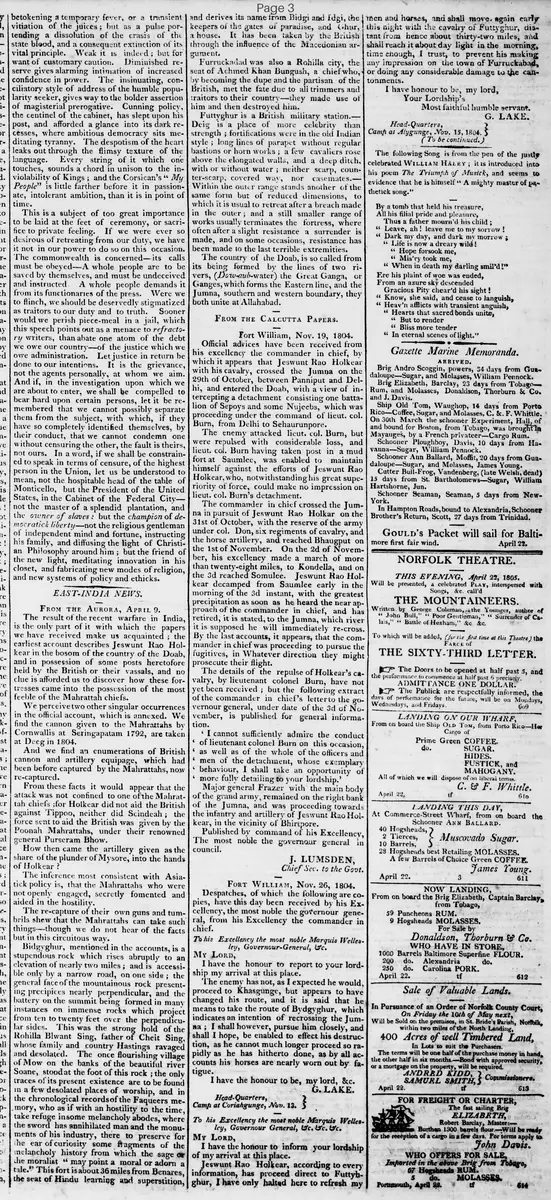
FROM THE AURORA, APRIL 9.
The result of the recent warfare in India, is the only part of it with which the papers we have received make us acquainted; the earliest account describes Jeswunt Rao Holkar in the bosom of the country of the Doab, and in possession of some posts heretofore held by the British or their vassals, and no clue is afforded us to discover how these fortresses came into the possession of the most feeble of the Mahrattah chiefs. We perceive two other singular occurrences in the official account, which is annexed. We find the cannon given to the Mahrattahs by Cornwallis at Seringapatam 1792, are taken at Deeg in 1804. And we find an enumeration of British cannon and artillery equipage, which had been before captured by the Mahrattahs, now re-captured. From these facts it would appear that the attack was not confined to one of the Mahrattah chiefs; for Holkar did not aid the British against Tippoo, neither did Scindeah; the force sent to aid the British was given by the Poonah Mahrattahs, under their renowned general Purseram Bhow. How then came the artillery given as the share of the plunder of Mysore, into the hands of Holkar? The inference most consistent with Asiatic policy is, that the Mahrattahs who were not openly engaged, secretly fomented and aided in the hostility. The re-capture of their own guns and tumbrils shew that the Mahrattahs can take such things--though we do not hear of the facts but in this circuitous way. Bidgyghur, mentioned in the accounts, is a stupendous rock which rises abruptly to an elevation of nearly two miles; and is accessible only by a narrow road, on one side; the general face of the mountainous rock presenting precipices nearly perpendicular, and the battery on the summit being formed in many instances on immense rocks which project from ten to twenty feet over the perpendicular sides. This was the strong hold of the Rohilla Blwant Sing, father of Cheit Sing, whose family and country Hastings ravaged and desolated. The once flourishing village of Mow on the banks of the beautiful river Soane, stood at the foot of this rock; the only traces of its present existence are to be found in a few desolated places of worship, and in the chronological records of the Faqueers memory, who as if with an hostility to the time, take refuge in some melancholy abodes, where the sword has annihilated man and the monuments of his industry, there to preserve for the ear of curiosity some fragments of the melancholy history from which the sage or the moralist "may point a moral or adorn a tale." This fort is about 36 miles from Benares, the seat of Hindu learning and superstition, and derives its name from Bidgi and Idgi, the keepers of the gates of paradise, and (Ghur, a house. It has been taken by the British through the influence of the Macedonian argument. Furruckadad was also a Rohilla city, the seat of Achmed Khan Bungush, a chief who, by becoming the dupe and the partisan of the British, met the fate due to all trimmers and traitors to their country--they made use of him and then destroyed him. Futtyghur is a British military station.-- Deig is a place of more celebrity than strength; fortifications were in the old Indian style; long lines of parapet without regular bastions or horn works; a few cavaliers rose above the elongated walls, and a deep ditch, with or without water; neither scarp, counter-scarp, covered way, nor casemates.-- Within the outer range stands another of the same form but of reduced dimensions, to which it is usual to retreat after a breach made in the outer; and a still smaller range of works usually terminates the fortress, where often after a slight resistance a surrender is made, and on some occasions, resistance has been made to the last terrible extremities. The country of the Doab, is so called from its being formed by the lines of two rivers, (Dow-aub-water) the Great Ganga, or Ganges, which forms the Eastern line, and the Jumna, southern and western boundary, they both unite at Allahabad.
From the Calcutta Papers.
Fort William, Nov. 19, 1804.
Official advices have been received from his excellency the commander in chief, by which it appears that Jeswunt Rao Holkar with his cavalry, crossed the Jumna on the 29th of October, between Panniput and Delhi, and entered the Doab, with a view of intercepting a detachment consisting one battalion of Sepoys and some Nujeebs, which was proceeding under the command of lieut. col. Burn, from Delhi to Sehaurunpore. The enemy attacked lieut. col. Burn, but were repulsed with considerable loss, and lieut. col. Burn having taken post in a mud fort at Saumlee, was enabled to maintain himself against the efforts of Jeswunt Rao Holkar, who, notwithstanding his great superiority of force, could make no impression on lieut. col. Burn's detachment. The commander in chief crossed the Jumna in pursuit of Jeswunt Rao Holkar on the 31st of October, with the reserve of the army under col. Don, six regiments of cavalry, and the horse artillery, and reached Bhaugput on the 1st of November. On the 2d of November, his excellency made a march of more than twenty-eight miles, to Kondella, and on the 3d reached Somulee. Jeswunt Rao Holkar decamped from Saumlee early in the morning of the 3d instant, with the greatest precipitation as soon as he heard the near approach of the commander in chief, and has retired, it is stated, to the Jumna, which river it is supposed he will immediately re-cross. By the last accounts, it appears, that the commander in chief was proceeding to pursue the fugitives, in whatever direction they might prosecute their flight. The details of the repulse of Holkar's cavalry, by lieutenant colonel Burn, have not yet been received; but the following extract of the commander in chief's letter to the governour general, under date of the 3d of November, is published for general information. I cannot sufficiently admire the conduct of lieutenant colonel Burn on this occasion, 'as well as of the whole of the officers and men of the detachment, whose exemplary behaviour, I shall take an opportunity of more fully detailing to your lordship. Major general Frazer with the main body of the grand army, remained on the right bank of the Jumna, and was proceeding towards the infantry and artillery of Jeswunt Rao Holkar, in the vicinity of Bhirtpore. Published by command of his Excellency, The most noble the governour general in council.
J. LUMSDEN,
Chief Sec. to the Govt.
FORT WILLIAM, NOV. 26, 1804.
Despatches, of which the following are copies, have this day been received by his Excellency, the most noble the governour general, from his Excellency the commander in chief. To his Excellency the most noble Marquis Wellesley, Governour-General, &c.
My Lord,
I have the honour to report to your lordship my arrival at this place. The enemy has not, as I expected he would, proceed to Khasgunge, but appears to have changed his route, and it is said that he means to take the route of Bydgyghur, which indicates an intention of recrossing the Jumna; I shall however, pursue him closely, and shall I hope, be enabled to effect his destruction, as he cannot much longer proceed so rapidly as he has hitherto done, as by all accounts his horses are nearly worn out by fatigue. I have the honour to be, my lord, &c.
G.LAKE.
Head-Quarters,
Camp at Coriahgunge, Nov. 13.
To his Excellency the most noble Marquis Wellesley,
Governour General, &c. &c. Fc.
My Lord,
I have the honour to inform your lordship of my arrival at this place. Jeswunt Rao Holkear, according to every information, has proceed direct to Futtyghur, I have only halted here to refresh my men and horses, and shall move again early this night with the cavalry of Futtyghur, distant from hence about thirty-two miles, and shall reach it about day light in the morning, time enough, I trust, to prevent his making any impression on the town of Furruckabad or doing any considerable damage to the cantonments. I have honour to be, my lord, Your Lordship's Most faithful buunble servant.
G. LAKE.
Head-Quarters,
Camph at Alygunge, Nov. 15, 1804.
(To be continued.)
What sub-type of article is it?
What keywords are associated?
What entities or persons were involved?
Where did it happen?
Foreign News Details
Primary Location
Doab, India
Event Date
October November 1804
Key Persons
Outcome
holkar's cavalry repulsed with considerable loss; no impression made on british detachment; holkar decamped in precipitation; british forces pursuing holkar's fugitives.
Event Details
Jeswunt Rao Holkar crossed the Jumna on October 29, 1804, entered the Doab, and attacked a British detachment under Lieut. Col. Burn, but was repulsed. Burn held position at Saumlee mud fort. Commander in Chief G. Lake pursued with reserve forces, reaching Somulee on November 3; Holkar fled towards Jumna. Later despatches indicate continued pursuit towards Futtyghur and Furruckabad to prevent damage.