Thank you for visiting SNEWPapers!
Sign up free
The Newberry Herald And News
Newberry, Newberry County, South Carolina
What is this article about?
In a January 1, 1894, letter from Madison, GA, farmer P.G. Walker urges Georgians to buy local farm products for self-sufficiency, critiques prejudice against Georgia goods, shares his prosperous 12-year farming life on inherited land, and encourages young men to stay on farms for independence and family.
Clipping
OCR Quality
Full Text
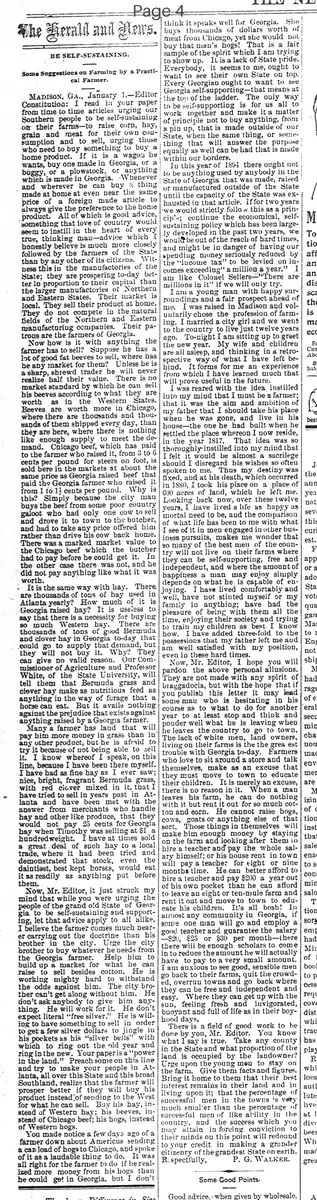
BE SELF-SUSTAINING.
Some Suggestions on Farming by a Practical Farmer:
Madison, GA., January 1.-Editor Constitution: I read in your paper from time to time articles urging our Southern people to be self-sustaining on their farms-to raise corn, hay, grain and meat for their own consumption and to sell, urging those who need to buy something to buy a home product. If it is a wagon he wants, buy one made in Georgia, or a buggy, or a plowstock, or anything which is made in Georgia. Whenever and wherever he can buy a thing made at home at even near the same price of a foreign made article to always give the preference to the home product. All of which is good advice, something that love of country would seem to instill in the heart of every true, thinking man-advice which I honestly believe is much more closely followed by the farmers of the State than by any other of its citizens. Witness this in the manufactories of the State; they are prospering to-day better in proportion to their capital than the larger manufactories of Northern and Eastern States. Their market is local. They sell their product at home. They do not compete in the natural fields of the Northern and Eastern manufacturing companies. Their patrons are the farmers of Georgia.
Now how is it with anything the farmer has to sell? Suppose he has a lot of good fat beeves to sell. where has he any market for them? Unless he is a sharp, shrewd trader he will never realize half their value. There is no market standard by which he can sell his beeves according to what they are worth as in the Western States. Beeves are worth more in Chicago, where there are thousands and thousands of them shipped every day, than they are here, where there is nothing like enough supply to meet the demand. Chicago beef, which has paid to the farmer who raised it, from 3 to 6 cents per pound for steers on foot, is sold here in the markets at about the same price as Georgia raised beef that paid the Georgia farmer who raised it from 1 to 1 1/2 cents per pound. Why is this? Simply because the city man buys the beef from some poor country galoot who had only one cow to sell and drove it to town to the butcher, and had to take any price offered him rather than drive his cow back home. There was a marked market value to the Chicago beef which the butcher had to pay before he could get it. In the other case there was not, and he did not pay anything like what it was worth.
It is the same way with hay. There are thousands of tons of hay used in Atlanta yearly? How much of it is Georgia raised hay? It is useless to say that there is a necessity for buying so much Western hay. There are thousands of tons of good Bermuda and clover hay in Georgia to-day that could go to supply that demand, but they will not buy it. Why? They can give no valid reason. Our Commissioner of Agriculture and Professor White, of the State University, will tell them that Bermuda grass and clover hay make as nutritious feed as anything in the way of forage that a horse can eat. But it avails nothing against the prejudice that exists against anything raised by a Georgia farmer.
Many a farmer has land that will pay him more money in grass than in any other product, but he is afraid to try it because of not being able to sell it. I know whereof I speak, on this line, because I have been there myself. I have had as fine hay as I ever saw: nice, bright, fragrant Bermuda grass, with red clover mixed in it, that I have tried to sell in years past in Atlanta and have been met with the answer from merchants who handle hay and other like produce, that they would not pay 25 cents for Georgia hay when Timothy was selling at $1 a hundredweight. I have at times sold a great deal of such hay to a local trade, where it had been tried and demonstrated that stock, even the daintiest, best kept horses, would eat it as readily as anything put before them.
Now, Mr. Editor, it just struck my mind that while you were urging the people of the grand old State of Georgia to be self-sustaining and supporting, let that advice apply to all alike. I believe the farmer comes much nearer carrying out the doctrine than his brother in the city. Urge the city brother to buy whatever he needs from the Georgia farmer. Help him to build up a market for what he can raise to sell besides cotton. He is working mighty hard to withstand the odds against him. The city brother can't get along without him. He doesn't ask anybody to give him anything. He will work for it. He doesn't expect literal "free silver." He is willing to have something to sell in order to get a few silver dollars to jingle in his pockets as his "silver bells" with which to ring out the old year and ring in the new. Your paper is a "power in the land." Preach some on this line and try to make your people in Atlanta, all over this State and this broad Southland, realize that the farmer will prosper better if they will buy his product instead of sending to the West for what he can sell. Buy his hay, instead of Western hay; his beeves, instead of Chicago beef; his hogs, instead of Western hogs.
You made notice a few days ago of a farmer down about Americus sending a car load of hogs to Chicago, and spoke of it as a laudable thing to do. It was all right for the farmer to do if he realized more money from his hogs than he could get in Georgia, but I don't think it speaks well for Georgia. She buys thousands of dollars worth of meat from Chicago, yet she would not buy that man's hogs! That is a fair sample of the spirit which I am trying to show up. It is a lack of State pride. Everybody, it seems to me, ought to want to see their own State on top. Every Georgian ought to want to see Georgia self-supporting-that means at the top of the ladder. The only way to be self-supporting is for us all to work together and make it a matter of principle not to buy anything, from a pin up, that is made outside of our State, when the same thing, or something that will answer the purpose equally as well can be had that is made within our borders.
In this year of 1894 there ought not to be anything used by anybody in the State of Georgia that was made, raised or manufactured outside of the State until the capacity of the State was exhausted in that article. If for two years we would strictly follow this as a principle; continue the economical, self-sustaining policy which has been largely developed in the past two years, we would be out of the reach of hard times, and might be in danger of having our spending money seriously reduced by the "income tax" to be levied on incomes exceeding "a million a year." I am like Colonel Sellers-"There are millions in it" if we will only try.
I am a young man with happy surroundings and a fair prospect ahead of me. I was raised in Madison and voluntarily chose the profession of farming. I married a city girl and we went to the country to live just twelve years ago. To-night I am sitting up to greet the new year. My wife and children are all asleep, and thinking in a retrospective way of what I have left behind. It forms for me an experience from which I have learned much that will prove useful in the future.
I was reared with the idea instilled into my mind that I must be a farmer; that it was the aim and ambition of my father that I should take his place when he was gone, and live in his house-the one he had built when he settled the place whereon I now reside, in the year 1817. That idea was so thoroughly instilled into my mind that I felt it would be almost a sacrilege should I disregard his wishes so often spoken to me. Thus my destiny was fixed, and at his death, which occurred in 1880, I took his place on a place of 600 acres of land, which he left me.
Looking back now, over these twelve years, I have lived a life as happy as mortal need to be, and the comparison of what life has been to me with what I see of it in men engaged in other business pursuits, makes me wonder that so many of the best men of the country will not live on their farms where they can be self-supporting, free and independent, and where the amount of happiness a man may enjoy simply depends on what he is capable of enjoying. I have lived comfortably and well, have not stinted myself or my family in anything; have had the pleasure of being with them all the time, enjoying their society and trying to train my children as best I know how. I have added three-fold to the possessions that my father left me and am well satisfied with my position, even in these hard times.
Now, Mr. Editor, I hope you will pardon the above personal allusions. They are not made with any spirit of braggadocia, but with the hope that if you publish this letter it may lead some man who is hesitating in his course as to what to do for another year to at least stop and think and ponder well what he is leaving when he leaves the country to go to town. The lack of white men, land owners, living on their farms is the greatest trouble with Georgia to-day. Farmers who love to sit around a store and talk themselves, make as an excuse that they must move to town to educate their children. It is merely an excuse, there is no reason in it. When a man leaves his farm, he can do nothing with it but rent it out for so much cotton and corn. He cannot raise hogs, cows, goats or anything else of that sort. Those things in themselves will make him enough money by staying on the farm and looking after them to hire a teacher and pay the whole salary himself; or his house rent in town will pay a teacher for eight or nine months time. He can better afford to hire a teacher and pay $200 a year out of his own pocket than he can afford to leave an eight or ten-mule farm and rent it out and move to town to educate his children. It's all bosh! In almost any community in Georgia, if some one man will go and employ a good teacher and guarantee the salary $20, $25 or $30 per month-there will be enough scholars to come in to reduce the amount he will actually have to pay to a very small amount.
I am anxious to see good, sensible men go back to their farms, quit the crowded, overrun towns and go back where they can be free and independent and easy. Where they can get up with the sun, feeling fresh and invigorated, buoyant and full of life as in their boyhood days. There is a field of good work to be done by you, Mr. Editor. You know what I say is true. Take any county in the State and what proportion of the land is occupied by the landowner? Urge upon the young men to stay on the farm. Give them facts and figures. Bring it home to them that their best interest remains in their land and in living upon it; that the percentage of successful men in the towns is very much smaller than the percentage of successful men of like ability in the country, and the success which you may attain in forcing conviction to their minds on this point will redound to your credit in making a grander citizenry of the grandest State on earth.
Respectfully,
P. G. WALKER.
What sub-type of article is it?
What themes does it cover?
What keywords are associated?
What entities or persons were involved?
Where did it happen?
Story Details
Key Persons
Location
Madison, Ga., Georgia, Atlanta
Event Date
January 1, 1894
Story Details
P. G. Walker, a Georgia farmer, writes to the editor urging self-sustainability by buying local farm products like hay, beef, and hogs instead of from the West or Chicago. He shares his personal success in farming since 1880, inheriting 600 acres, marrying a city girl, raising a family, and prospering despite hard times. He criticizes farmers leaving farms for towns and advocates staying on the land for independence and education.