Thank you for visiting SNEWPapers!
Sign up free
Editorial
March 26, 1835
Litchfield Enquirer
Litchfield, Litchfield County, Connecticut
What is this article about?
The editorial criticizes the credit system as a burdensome evil on workers, particularly mechanics and newspaper publishers, creating a cycle of debt collection. It suggests public opinion and a 'law of honor' as remedies instead of legal enforcement.
Clipping
OCR Quality
95%
Excellent
Full Text
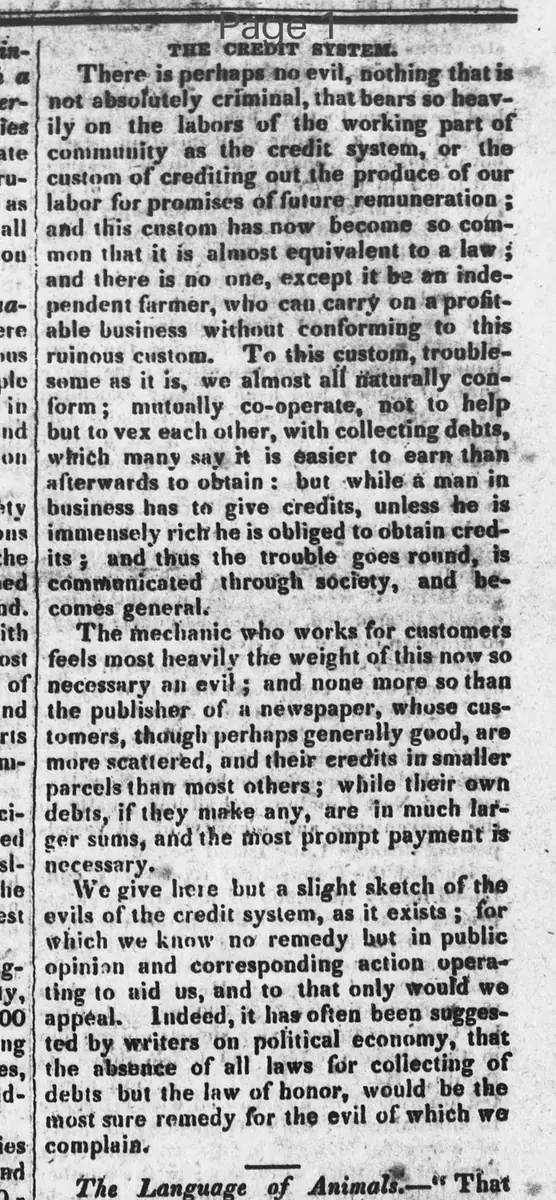
There is perhaps no evil, nothing that is not absolutely criminal, that bears so heavily on the labors of the working part of community as the credit system, or the custom of crediting out the produce of our labor for promises of future remuneration; and this custom has now become so common that it is almost equivalent to a law; and there is no one, except it be an independent farmer, who can carry on a profitable business without conforming to this ruinous custom. To this custom, troublesome as it is, we almost all naturally conform; mutually co-operate, not to help but to vex each other, with collecting debts, which many say it is easier to earn than afterwards to obtain: but while a man in business has to give credits, unless he is immensely rich he is obliged to obtain credits; and thus the trouble goes round, is communicated through society, and becomes general.
The mechanic who works for customers feels most heavily the weight of this now so necessary an evil; and none more so than the publisher of a newspaper, whose customers, though perhaps generally good, are more scattered, and their credits in smaller parcels than most others; while their own debts, if they make any, are in much larger sums, and the most prompt payment is necessary.
We give here but a slight sketch of the evils of the credit system, as it exists; for which we know no remedy but in public opinion and corresponding action operating to aid us, and to that only would we appeal. Indeed, it has often been suggested by writers on political economy, that the absence of all laws for collecting of debts but the law of honor, would be the most sure remedy for the evil of which we complain.
The mechanic who works for customers feels most heavily the weight of this now so necessary an evil; and none more so than the publisher of a newspaper, whose customers, though perhaps generally good, are more scattered, and their credits in smaller parcels than most others; while their own debts, if they make any, are in much larger sums, and the most prompt payment is necessary.
We give here but a slight sketch of the evils of the credit system, as it exists; for which we know no remedy but in public opinion and corresponding action operating to aid us, and to that only would we appeal. Indeed, it has often been suggested by writers on political economy, that the absence of all laws for collecting of debts but the law of honor, would be the most sure remedy for the evil of which we complain.
What sub-type of article is it?
Economic Policy
Trade Or Commerce
Labor
What keywords are associated?
Credit System
Debt Collection
Working Community
Newspaper Publisher
Public Opinion
Law Of Honor
Editorial Details
Primary Topic
Evils Of The Credit System
Stance / Tone
Critical Of Credit System As Ruinous Evil
Key Arguments
Credit System Burdens Working Community Like A Criminal Evil
Custom Of Crediting Produce For Future Payment Is Nearly Law Like And Ruinous
Businesses Must Conform To Give And Receive Credits, Creating Debt Collection Cycle
Mechanics And Newspaper Publishers Suffer Most From Scattered Small Credits And Large Debts
Remedy Lies In Public Opinion And Action
Suggested By Political Economists: Replace Debt Collection Laws With Law Of Honor