Thank you for visiting SNEWPapers!
Sign up free
The Charlotte Journal
Charlotte, Mecklenburg County, North Carolina
What is this article about?
A newspaper contrasts the concise response of Judge White, denying Congress's power to abolish slavery in the District of Columbia, with the lengthy, equivocal reply of Vice President Van Buren, who hesitates to deny the power but opposes its exercise against slave-holding states' wishes.
Clipping
OCR Quality
Full Text
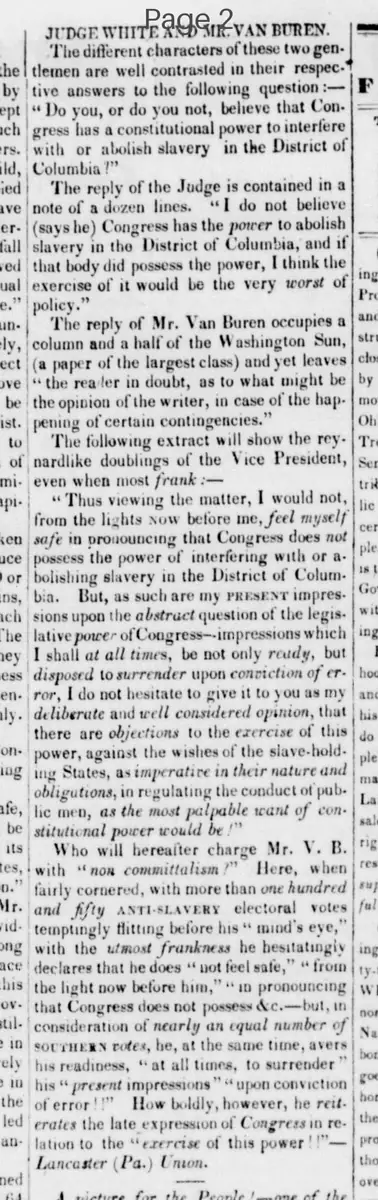
The different characters of these two gentlemen are well contrasted in their respective answers to the following question: -
"Do you, or do you not, believe that Congress has a constitutional power to interfere with or abolish slavery in the District of Columbia?"
The reply of the Judge is contained in a note of a dozen lines. "I do not believe (says he) Congress has the power to abolish slavery in the District of Columbia, and if that body did possess the power, I think the exercise of it would be the very worst of policy."
The reply of Mr. Van Buren occupies a column and a half of the Washington Sun, (a paper of the largest class) and yet leaves "the reader in doubt, as to what might be the opinion of the writer, in case of the happening of certain contingencies."
The following extract will show the chameleon-like doublings of the Vice President, even when most frank: -
"Thus viewing the matter, I would not, from the lights now before me, feel myself safe in pronouncing that Congress does not possess the power of interfering with or abolishing slavery in the District of Columbia. But, as such are my present impressions upon the abstract question of the legislative power of Congress—impressions which I shall at all times, be not only ready, but disposed to surrender upon conviction of error, I do not hesitate to give it to you as my deliberate and well considered opinion, that there are objections to the exercise of this power, against the wishes of the slave-holding States, as imperative in their nature and obligations, in regulating the conduct of public men, as the most palpable want of constitutional power would be!"
Who will hereafter charge Mr. V. B. with "non committalism" Here, when fairly cornered, with more than one hundred and fifty ANTI-SLAVERY electoral votes temptingly flitting before his "mind's eye," with the utmost frankness he hesitatingly declares that he does "not feel safe," "from the light now before him," "in pronouncing that Congress does not possess &c.—but, in consideration of nearly an equal number of Southern votes, he, at the same time, avers his readiness, "at all times, to surrender" his "present impressions" "upon conviction of error'!" How boldly, however, he reiterates the late expression of Congress in relation to the "exercise of this power'!"—Lancaster (Pa.) Union.
What sub-type of article is it?
What keywords are associated?
What entities or persons were involved?
Domestic News Details
Key Persons
Event Details
The text contrasts Judge White's brief denial of Congress's constitutional power to abolish slavery in the District of Columbia and his view that exercising it would be poor policy, with Vice President Van Buren's longer, equivocal response that avoids definitively denying the power but strongly opposes its exercise against slave-holding states' wishes, amid considerations of electoral votes.