Thank you for visiting SNEWPapers!
Sign up free
Phenix Gazette
Alexandria, Virginia
What is this article about?
In late 1825, the Colombian privateer Rayo wrecked on Dog Keys with 43 crew; 7 drowned, 36 stranded and mostly starved to death over 60 days, surviving on bird blood and flesh. Rescuers from schooner General Warren were abandoned, faced perils, and reached Matanzas. U.S. schooner Grampus found 35 dead, one weak survivor.
Clipping
OCR Quality
Full Text
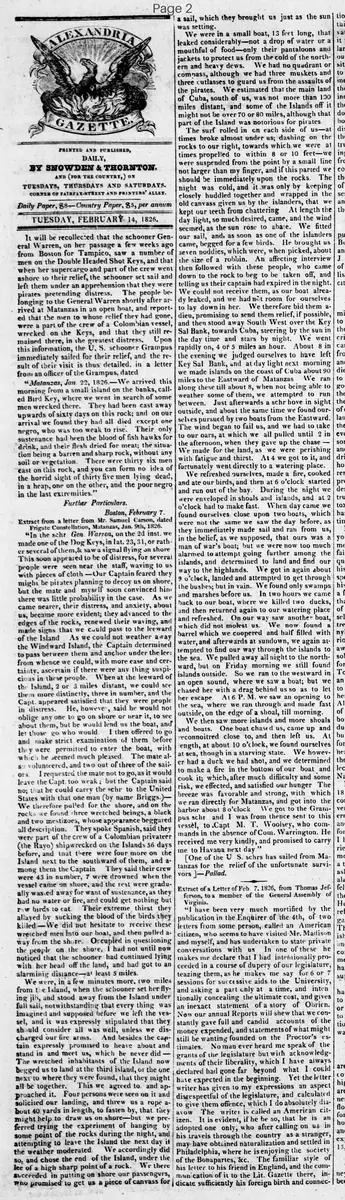
The people belonging to the General Warren shortly after arrived at Matanzas in an open boat, and reported that the men to whose relief they had gone, were a part of the crew of a Colombian vessel, wrecked on the Keys, and that they still remained there, in the greatest distress.
Upon this information, the U. S. schooner Grampus immediately sailed for their relief, and the result of their visit is thus detailed in a letter from an officer of the Grampus, dated
"Matanzas, Jan. 22, 1826.--We arrived this morning from a small island on the banks, called Bird Key, where we went in search of some men wrecked there. They had been cast away upwards of sixty days on this rock; and on our arrival we found they had all died except one negro, who was too weak to rise. Their only sustenance had been the blood of fish hawks for drink, and their flesh dried for meat; the situation being a barren and sharp rock, without any soil or vegetation. There were thirty six men cast on this rock, and you can form no idea of the horrid sight of thirty five men lying dead, in a heap, one on the other, and the poor negro in the last extremities."
Further Particulars.
Boston, February 7.
Extract from a letter from Mr. Samuel Carson, dated Frigate Constellation, Matanzas, Jan. 9th, 1826.
"In the schr Gen. Warren, on the 2d inst. we made one of the Dog Keys, in lat. 23, 31, or rather several of them, & saw a signal flying on shore. This soon appeared to be of distress, for several people were seen near the staff, waving to us with pieces of cloth. Our Captain feared they might be pirates planning to decoy us on shore, but the mate and myself soon convinced him there was little probability in the case. As we came nearer, their distress, and anxiety, about us, became more evident; they advanced to the edges of the rocks, renewed their waving, and made signs that we could pass to the leeward of the Island. As we could not weather the Windward Island, the Captain determined to pass between them and anchor under the lee: from whence we could, with more ease and certainty, ascertain if there were any thing suspicious in these people. When at the leeward of the Island, 2 or 3 miles distant, we could see them more distinctly, three in number, and the Capt. appeared satisfied that they were people in distress. He, however, said he would not oblige any one to go on shore or near it, to see about them, but he would lend us the boat, and let those go who would. I then offered to go and make strict examination of them before they were permitted to enter the boat, with which he seemed much pleased. The mate also volunteered, and two out of three of the sailors I requested the mate not to go, as it would leave the Capt. too weak; but the Captain said no; that he could carry the schr to the United States with that one man (by name Briggs.).
We therefore pulled for the shore, and on the rocks we found three wretched beings, a black and two mestizoes, whose appearance beggared all description. They spoke Spanish, said they were part of the crew of a Colombian privateer (the Rayo) shipwrecked on the Islands 56 days before, and that there were four more on the Island next to the southward of them, and among them the Captain. They said their crew were 43 in number, 7 were drowned when the vessel came on shore, and the rest were gradually wasted away for want of sustenance, as they had no water or fire, and could get nothing but raw birds to eat. Their extreme thirst they allayed by sucking the blood of the birds they killed. We did not hesitate to receive these wretched men into our boat, and then pulled away from the shore. Occupied in questioning the people on the shore, I had not until now noticed that the schooner had continued lying with her head off the land, and had got to an alarming distance--at least 5 miles.
We were, in a few minutes more, two miles from the Island, when the schooner set her flying jib, and stood away from the Island under full sail, notwithstanding that every thing was imagined and supposed before we left the vessel, and it was expressly stipulated that they should consider all was well, unless we discharged our fire arms. And besides the captain expressly promised to heave about and stand in and meet us, which he never did.
The wretched inhabitants of the Island now begged us to land at the third island, or the one next to where they were found, that they might all be together. This we agreed to, and approached it. Four persons were seen on it and solicited our landing, and threw us a rope about 40 yards in length, to fasten by, that they might help to draw us on shore--but we preferred trying the experiment of hanging by some point of the rocks during the night, and attempting to leave the Island the next day if the weather moderated. We accordingly did so, and chose the end of the Island, under the lee of a high sharp point of a rock. We there succeeded in putting on shore our passengers, who promised to get us a piece of canvass for a sail, which they brought us just as the sun was setting.
We were in a small boat, 13 feet long, that leaked considerably--not a drop of water or a mouthful of food--only their pantaloons and jackets to protect us from the cold of the northern and heavy dews. We had no quadrant or compass, although we had three muskets and three cutlasses to guard us from the assaults of the pirates. We estimated that the main land of Cuba, south of us, was not more than 100 miles distant, and some of the Islands off it might not be over 70 or 80 miles, although that part of the Island was notorious for pirates.
The surf rolled in on each side of us--at times broke almost under us; dashing on the rocks to our right, towards which we were at times propelled to within 8 or 10 feet--we were suspended from the point by a small line not larger than my finger, and if this parted we should be immediately upon the rocks. The night was cold, and it was only by keeping closely huddled together and wrapped in the old canvass given us by the islanders, that we kept our teeth from chattering. At length the day light, so much desired, came, and the wind seemed, as the sun rose to abate. We fitted our sail, and, as soon as one of the islanders came, begged for a few birds. He brought us seven noddies, which were, when picked, about the size of a robin. An affecting interview then followed with these people, who came down to the rock to beg to be taken off, and telling us their captain had expired in the night.
We could not receive them, as our boat already leaked, and we had not room for ourselves to lay down in her. We therefore bid them adieu, promising to send them relief, if possible, and then stood away South West over the Key Sal Bank, towards Cuba, steering by the sun in the day time and stars by night. We went rapidly on, 4 or 5 miles an hour. About 8 in the evening we judged ourselves to have left Key Sal Bank, and at day light next morning we made islands on the coast of Cuba about 90 miles to the Eastward of Matanzas. We ran along these till about 8, when not being able to weather some of them, we attempted to run between. Just afterwards a schr hove in sight outside, and about the same time we found ourselves pursued by two boats from the Eastward.
The wind began to fail us, and we had to take to our oars, at which we all pulled until 2 in the afternoon, when they gave up the chase. We made for the land, as we were perishing with fatigue and thirst. At 4 we got to it, and fortunately went directly to a watering place. We refreshed ourselves, made a fire, cooked and ate our birds, and then at 6 o'clock started and run out of the bay. During the night we were enveloped in shoals and islands, and at 2 o'clock had to make fast. When day came we found ourselves close upon two boats, which were not the same we saw the day before, as they immediately made sail and ran from us, in the belief, as we supposed, that ours was a man of war's boat; but we were now too much alarmed to attempt going further among the islands, and determined to land and find our way to the highlands. We got in again about 9 o'clock, landed and attempted to get through the bushes; but in vain. We found only swamps and marshes before us. In two hours we came back to our boat, where we killed two ducks, and then returned again to our watering place and refreshed. On our way saw another boat, which did not molest us. We now found a barrel which we coopered and half filled with water, and afterwards at sundown, we again attempted to find our way through the islands to the sea. We pulled away all night to the northward, but on Friday morning we still found islands outside. So we ran to the westward in an open sound, where we saw a boat; but we chased her with a drag behind us so as to let her escape. At 6 P. M. we saw an opening to the sea, where we ran through and made fast outside, on the edge of a shoal, till morning.
We then saw more islands and more shoals and boats. One boat chased us, came up and reconnoitred close to, and then let us. At length, at about 10 o'clock, we found ourselves at sea, though in a starving state. We however had a duck we had shot, and we determined to make a fire in the bottom of our boat and cook it; which, after much difficulty and some risk, we effected, and satisfied our hunger. The breeze was favorable and strong, with which we ran directly for Matanzas, and got into the harbor about 8 o'clock. I got to the Grampus schr and I was from thence sent to this vessel, to Capt M. T. Woolsey, who commands in the absence of Com. Warrington. He received me very kindly, and promised to carry me to Havana next day."
[One of the U. S. schrs has sailed from Matanzas for the relief of the unfortunate survivors.]--Pallad.
What sub-type of article is it?
What keywords are associated?
What entities or persons were involved?
Where did it happen?
Foreign News Details
Primary Location
Dog Keys
Event Date
56 60 Days Before January 22, 1826
Key Persons
Outcome
colombian privateer rayo wrecked with 43 crew; 7 drowned, 36 stranded on rocks; 35 died of starvation, 1 negro survivor found weak by grampus; rescuers from general warren abandoned but reached matanzas safely.
Event Details
Schooner General Warren sighted distressed men on Dog Keys (lat. 23°31'), suspected pirates, but supercargo and crew went ashore, finding 3 survivors from wrecked Colombian privateer Rayo (56 days prior); captain sailed away abandoning them. Rescuers took 3, went to another island for 4 more but left them due to boat limits, endured night on rocks, then perilous journey to Cuba evading boats, reached Matanzas Jan 9, 1826. Grampus rescued remaining but found 35 dead, 1 alive on Bird Key Jan 22, 1826.