Thank you for visiting SNEWPapers!
Sign up free
Letter to Editor
December 5, 1771
The Virginia Gazette
Richmond, Williamsburg, Richmond County, Virginia
What is this article about?
Phocion responds to Aristides' address, defending Governor Tryon's decisive actions against the Regulators in North Carolina as necessary for security, refuting exaggerated grievances and misrepresentations, and expressing hope for peace and oblivion of past feuds. Dated November 19, 1771.
Clipping
OCR Quality
95%
Excellent
Full Text
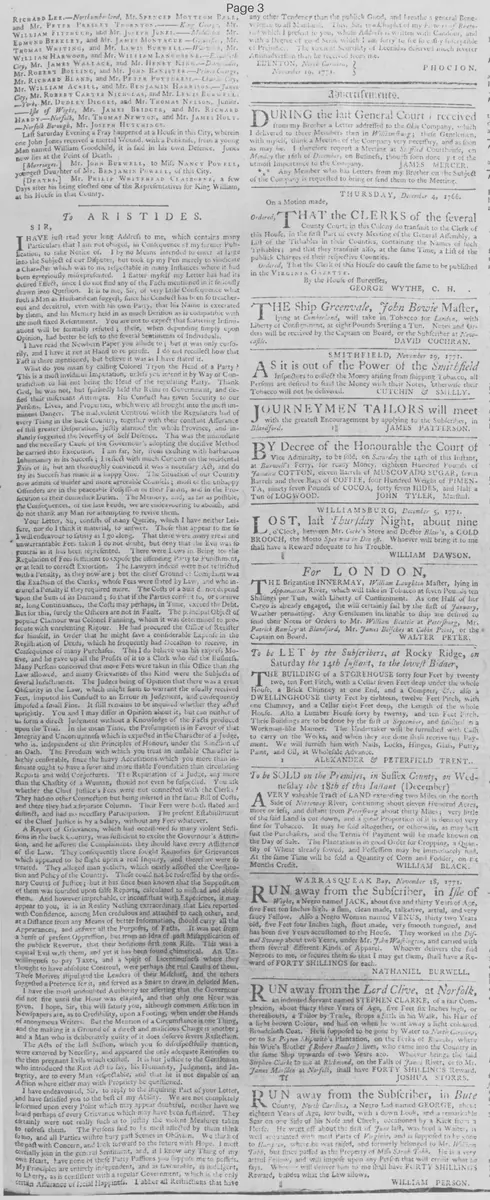
TO ARISTIDES.
SIR,
I HAVE just read your long Address to me, which contains many Particulars that I am not obliged, in Consequence of my former Publication, to take Notice of. I by no Means intended to enter at large into the Subject of our Disputes, but took up my Pen merely to vindicate a Character which was too respectable in many Instances where it had been egregiously misrepresented. I flatter myself my Letter has had its desired Effect, since I do not find any of the Facts mentioned in it seriously drawn into Question. It is to me, Sir, of very little Consequence what such a Man as Husband can suggest, since his Conduct has been so treacherous and deceitful, even with his own Party, that his Name is execrated by them, and his Memory held in as much Derision as is compatible with the most fixed Resentment. You are not to expect that flattering Insinuations will be formally refuted; these, when depending simply upon Opinion, had better be left to the several Sentiments of Individuals.
I have read the Newbern Paper you allude to; but it was only cursorily, and I have it not at Hand to re-peruse. I do not recollect how that Fact is there mentioned, but believe it was as I have stated it.
What do you mean by calling Colonel Tryon the Head of a Party? This is a most invidious Imputation, unless you intend it by Way of Contradiction to his not being the Head of the regulating Party. Thank God, he was not, but spiritedly held the Reins of Government, and defied their miscreant Attempts. His Conduct has given Security to our Persons, Lives, and Properties, which were all brought into the most imminent Danger. The malevolent Controul which the Regulators had of every Thing in the back Country, together with their constant Assurance of still greater Desperation, justly alarmed the whole Province, and instantly suggested the Necessity of Self Defence. This was the immediate and the necessary Cause of the Governour's adopting the decisive Method he carried into Execution. I am far, Sir, from exulting with barbarous Inhumanity in its Success; I reflect with much Concern on the incidental Evils of it, but am thoroughly convinced it was a necessary Act, and do say its Success has made it a happy One. The Situation of our Country now admits of milder and more agreeable Counsels; most of the unhappy Offenders are in the peaceable Possession of their Farms, and in the Prosecution of their domestick Duties. The Memory, and, as far as possible, the Consequences, of the late Feuds, we are endeavouring to abolish, and do not thank any Man for attempting to revive them.
Your Letter, Sir, consists of many Queries, which I have neither Leisure, nor do I think it material, to answer. Those that appear to me so I will endeavour to satisfy as I go along. That there were many great and unwarrantable Fees taken I do not doubt, but deny that the Evil was so general as it has been represented. There were Laws in Being for the Regulation of Fees sufficient to expose the offending Party to Punishment, or at least to correct Extortion. The Lawyers indeed were not restricted with a Penalty, as they now are; but the chief Ground of Complaint was the Exaction of the Clerks, whose Fees were stated by Law, and who incurred a Penalty if they required more. The Costs of a Suit do not depend upon the Sum of its Demand; so that if the Parties consent to, or connive at, long Continuances, the Costs may perhaps, in Time, exceed the Debt. But for this, surely the Officers are not in Fault. The principal Object of popular Clamour was Colonel Fanning, whom it was determined to prosecute with unrelenting Rigour. He had procured the Office of Register for himself, in Order that he might save a considerable Expence in the Registration of Deeds, which he frequently had occasion to receive, in Consequence of many Purchases. This I do believe was his express Motive, and he gave up all the Profits of it to a Clerk who did the Business. Many Persons conceived that more Fees were taken in this Office than the Law allowed, and many Grievances of this Kind were the Subjects of several Indictments. The Judges being of Opinion that there was a great Obscurity in the Law, which might seem to warrant the usually received Fees, imputed his Conduct to an Error in Judgment, and consequently imposed a small Fine. It still remains to be inquired whether they acted uprightly. You and I may differ in Opinion about it, but can neither of us form a direct Judgment without a Knowledge of the Facts produced upon the Trial. In the mean Time, the Presumption is in Favour of that Integrity and Uncorrputness which is expected in the Character of a Judge, who is, independent of the Principles of Honour, under the Sanction of an Oath. The Freedom with which you treat an amiable Character is highly censurable, since the heavy Accusations which you more than insinuate ought to have a surer and more stable Foundation than circulating Reports and wild Conjectures. The Reputation of a Judge, any more than the Chastity of a Woman, should not even be suspected. You ask whether the Chief Justice's Fees were not connected with the Clerks? They had no other Connection but being inserted in the same Bill of Costs, and there they had a separate Column. Their Fees were both stated and distinct, and had no necessary Participation. The present Establishment of the Chief Justice is by a Salary, without any Fees whatever.
A Report of Grievances, which had occasioned so many violent Seditions in the back Country, was sufficient to excite the Governour's Attention, and he assured the Complainants they should have every Assistance of the Law. They consequently there sought Remedies for Grievances which appeared to be slight upon a real Inquiry, and therefore were so treated. They alleged many others, which nearly affected the Constitution and Policy of the Country. These could not be redressed by the ordinary Courts of Justice; but it has since been known that the Supposition of them was founded upon false Reports, calculated to mislead and abuse them. And however improbable, or inconsistent with Experience, it may appear to you, it is in Reality Nothing extraordinary that Lies reported with Confidence, among Men credulous and attached to each other, and at a Distance from any Means of better Information, should carry all the Appearances, and answer all the Purposes, of Facts. It was not from a Sense of present Oppression, but from an Idea of past Misapplication of the publick Revenue, that their Seditions first took Rise. This was a capital Evil with them, and yet it has been found chimerical. An Unwillingness to pay Taxes, and a Spirit of Licentiousness where they thought to have absolute Controul, were perhaps the real Causes of them. These Motives stimulated the Leaders of their Mischief, and the others suggested a Pretence for it, and served as a Snare to draw in deluded Men.
I have the most undoubted Authority for asserting that the Governour did not fire until the Hour was elapsed, and that only one Hour was given. I hope, Sir, this will satisfy you, although common Assertion in Newspapers are, as to Credibility, upon a Footing, when under the Hands of anonymous Writers. But the Mention of a Circumstance is one Thing, and the making it a Ground of a direct and malicious Charge is another; and a Man who is deliberately guilty of it does deserve severe Reflection.
The Acts of the last Session, which you so disrespectfully mention, were extorted by Necessity, and appeared the only adequate Remedies to the then pregnant Evils which existed. It is but Justice to the Gentleman who introduced the Riot Act to say, his Humanity, Judgment, and Integrity, are to every Man respectable, and that he is not capable of an Action where either may with Propriety be questioned.
I have endeavoured, Sir, to reply to the inquiring Part of your Letter, and have satisfied you to the best of my Ability; We are not completely informed upon every Point which may appear doubtful, neither have we heard perhaps of every Grievance which may have been sustained. They certainly were not really such as to justify the violent Measures taken to redress them. The Persons said to be most affected by them think so too, and all Parties wish to bury past Scenes in Oblivion. We think of the past with Concern, and look forward to the future with Hope. I most cordially join in the general Sentiment, and, if I know any Thing of my own Heart, have none of those Party Passions you suppose me to possess. My Principles are entirely independent, and as favourable, as indulgent, to Liberty, as is consistent with a regular Government, which is the only certain Assurance of social Happiness. I abhor all Restrictions that have any other Tendency than the publick Good, and I breathe a general Benevolence to all Mankind. This, Sir, is a Chapter of my Faith I present to you, whose Address is written with Candour, and with a Degree of good Sense which I am sorry to be so easily susceptible of Prejudice. The virulent Scurrility of Leonidas deserved much severer Animadversion than he received from me.
PHOCION.
NORTH CAROLINA, November 19, 1771.
SIR,
I HAVE just read your long Address to me, which contains many Particulars that I am not obliged, in Consequence of my former Publication, to take Notice of. I by no Means intended to enter at large into the Subject of our Disputes, but took up my Pen merely to vindicate a Character which was too respectable in many Instances where it had been egregiously misrepresented. I flatter myself my Letter has had its desired Effect, since I do not find any of the Facts mentioned in it seriously drawn into Question. It is to me, Sir, of very little Consequence what such a Man as Husband can suggest, since his Conduct has been so treacherous and deceitful, even with his own Party, that his Name is execrated by them, and his Memory held in as much Derision as is compatible with the most fixed Resentment. You are not to expect that flattering Insinuations will be formally refuted; these, when depending simply upon Opinion, had better be left to the several Sentiments of Individuals.
I have read the Newbern Paper you allude to; but it was only cursorily, and I have it not at Hand to re-peruse. I do not recollect how that Fact is there mentioned, but believe it was as I have stated it.
What do you mean by calling Colonel Tryon the Head of a Party? This is a most invidious Imputation, unless you intend it by Way of Contradiction to his not being the Head of the regulating Party. Thank God, he was not, but spiritedly held the Reins of Government, and defied their miscreant Attempts. His Conduct has given Security to our Persons, Lives, and Properties, which were all brought into the most imminent Danger. The malevolent Controul which the Regulators had of every Thing in the back Country, together with their constant Assurance of still greater Desperation, justly alarmed the whole Province, and instantly suggested the Necessity of Self Defence. This was the immediate and the necessary Cause of the Governour's adopting the decisive Method he carried into Execution. I am far, Sir, from exulting with barbarous Inhumanity in its Success; I reflect with much Concern on the incidental Evils of it, but am thoroughly convinced it was a necessary Act, and do say its Success has made it a happy One. The Situation of our Country now admits of milder and more agreeable Counsels; most of the unhappy Offenders are in the peaceable Possession of their Farms, and in the Prosecution of their domestick Duties. The Memory, and, as far as possible, the Consequences, of the late Feuds, we are endeavouring to abolish, and do not thank any Man for attempting to revive them.
Your Letter, Sir, consists of many Queries, which I have neither Leisure, nor do I think it material, to answer. Those that appear to me so I will endeavour to satisfy as I go along. That there were many great and unwarrantable Fees taken I do not doubt, but deny that the Evil was so general as it has been represented. There were Laws in Being for the Regulation of Fees sufficient to expose the offending Party to Punishment, or at least to correct Extortion. The Lawyers indeed were not restricted with a Penalty, as they now are; but the chief Ground of Complaint was the Exaction of the Clerks, whose Fees were stated by Law, and who incurred a Penalty if they required more. The Costs of a Suit do not depend upon the Sum of its Demand; so that if the Parties consent to, or connive at, long Continuances, the Costs may perhaps, in Time, exceed the Debt. But for this, surely the Officers are not in Fault. The principal Object of popular Clamour was Colonel Fanning, whom it was determined to prosecute with unrelenting Rigour. He had procured the Office of Register for himself, in Order that he might save a considerable Expence in the Registration of Deeds, which he frequently had occasion to receive, in Consequence of many Purchases. This I do believe was his express Motive, and he gave up all the Profits of it to a Clerk who did the Business. Many Persons conceived that more Fees were taken in this Office than the Law allowed, and many Grievances of this Kind were the Subjects of several Indictments. The Judges being of Opinion that there was a great Obscurity in the Law, which might seem to warrant the usually received Fees, imputed his Conduct to an Error in Judgment, and consequently imposed a small Fine. It still remains to be inquired whether they acted uprightly. You and I may differ in Opinion about it, but can neither of us form a direct Judgment without a Knowledge of the Facts produced upon the Trial. In the mean Time, the Presumption is in Favour of that Integrity and Uncorrputness which is expected in the Character of a Judge, who is, independent of the Principles of Honour, under the Sanction of an Oath. The Freedom with which you treat an amiable Character is highly censurable, since the heavy Accusations which you more than insinuate ought to have a surer and more stable Foundation than circulating Reports and wild Conjectures. The Reputation of a Judge, any more than the Chastity of a Woman, should not even be suspected. You ask whether the Chief Justice's Fees were not connected with the Clerks? They had no other Connection but being inserted in the same Bill of Costs, and there they had a separate Column. Their Fees were both stated and distinct, and had no necessary Participation. The present Establishment of the Chief Justice is by a Salary, without any Fees whatever.
A Report of Grievances, which had occasioned so many violent Seditions in the back Country, was sufficient to excite the Governour's Attention, and he assured the Complainants they should have every Assistance of the Law. They consequently there sought Remedies for Grievances which appeared to be slight upon a real Inquiry, and therefore were so treated. They alleged many others, which nearly affected the Constitution and Policy of the Country. These could not be redressed by the ordinary Courts of Justice; but it has since been known that the Supposition of them was founded upon false Reports, calculated to mislead and abuse them. And however improbable, or inconsistent with Experience, it may appear to you, it is in Reality Nothing extraordinary that Lies reported with Confidence, among Men credulous and attached to each other, and at a Distance from any Means of better Information, should carry all the Appearances, and answer all the Purposes, of Facts. It was not from a Sense of present Oppression, but from an Idea of past Misapplication of the publick Revenue, that their Seditions first took Rise. This was a capital Evil with them, and yet it has been found chimerical. An Unwillingness to pay Taxes, and a Spirit of Licentiousness where they thought to have absolute Controul, were perhaps the real Causes of them. These Motives stimulated the Leaders of their Mischief, and the others suggested a Pretence for it, and served as a Snare to draw in deluded Men.
I have the most undoubted Authority for asserting that the Governour did not fire until the Hour was elapsed, and that only one Hour was given. I hope, Sir, this will satisfy you, although common Assertion in Newspapers are, as to Credibility, upon a Footing, when under the Hands of anonymous Writers. But the Mention of a Circumstance is one Thing, and the making it a Ground of a direct and malicious Charge is another; and a Man who is deliberately guilty of it does deserve severe Reflection.
The Acts of the last Session, which you so disrespectfully mention, were extorted by Necessity, and appeared the only adequate Remedies to the then pregnant Evils which existed. It is but Justice to the Gentleman who introduced the Riot Act to say, his Humanity, Judgment, and Integrity, are to every Man respectable, and that he is not capable of an Action where either may with Propriety be questioned.
I have endeavoured, Sir, to reply to the inquiring Part of your Letter, and have satisfied you to the best of my Ability; We are not completely informed upon every Point which may appear doubtful, neither have we heard perhaps of every Grievance which may have been sustained. They certainly were not really such as to justify the violent Measures taken to redress them. The Persons said to be most affected by them think so too, and all Parties wish to bury past Scenes in Oblivion. We think of the past with Concern, and look forward to the future with Hope. I most cordially join in the general Sentiment, and, if I know any Thing of my own Heart, have none of those Party Passions you suppose me to possess. My Principles are entirely independent, and as favourable, as indulgent, to Liberty, as is consistent with a regular Government, which is the only certain Assurance of social Happiness. I abhor all Restrictions that have any other Tendency than the publick Good, and I breathe a general Benevolence to all Mankind. This, Sir, is a Chapter of my Faith I present to you, whose Address is written with Candour, and with a Degree of good Sense which I am sorry to be so easily susceptible of Prejudice. The virulent Scurrility of Leonidas deserved much severer Animadversion than he received from me.
PHOCION.
NORTH CAROLINA, November 19, 1771.
What sub-type of article is it?
Persuasive
Political
Reflective
What themes does it cover?
Politics
Crime Punishment
Constitutional Rights
What keywords are associated?
Regulators
Governor Tryon
Grievances
North Carolina
Fees Extortion
Riot Act
Self Defense
Party Disputes
What entities or persons were involved?
Phocion
Aristides
Letter to Editor Details
Author
Phocion
Recipient
Aristides
Main Argument
defends governor tryon's actions against the regulators as necessary self-defense against threats to security, denies the severity of grievances like excessive fees, and argues that the uprising stemmed from misinformation, tax reluctance, and licentiousness rather than real oppression.
Notable Details
References To Colonel Tryon As Spirited Governor
Defense Of Colonel Fanning's Motives And Judicial Handling
Mention Of Newbern Paper
Critique Of Husband And Leonidas
Emphasis On Burying Past Feuds