Thank you for visiting SNEWPapers!
Sign up free
Gazette Of The United States, & Philadelphia Daily Advertiser
Philadelphia, Philadelphia County, Pennsylvania
What is this article about?
In the U.S. House on December 15, debate concluded on amending the response to the President's speech to balance expressions of peace with France and firm defense of national honor. Amendment by Sitgreaves passed after votes: 49-30 for previous question, 67-12 for amended address.
Merged-components note: Continuation of the congressional debate on the address, split across pages but same topic and flow.
Clippings
1 of 2
OCR Quality
Full Text
Thursday, December 15
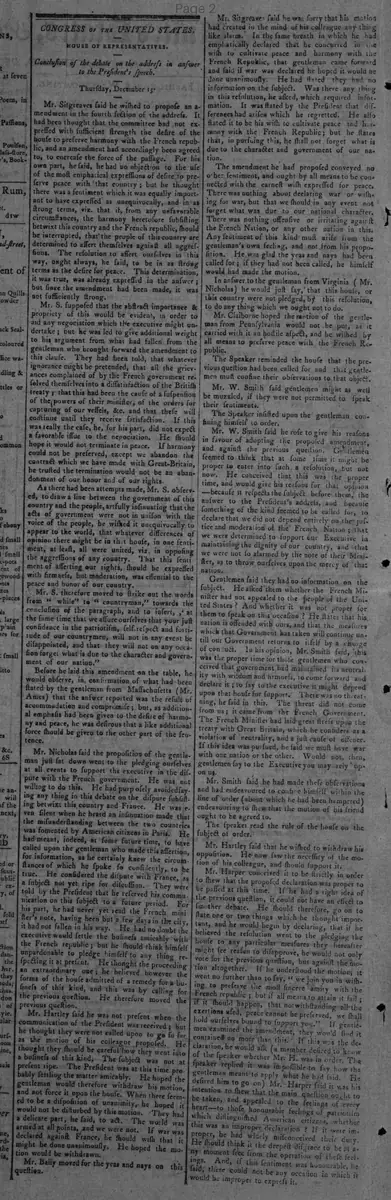
Mr. Sitgreaves said he wished to propose an amendment in the fourth section of the address. It had been thought that the committee had not expressed with sufficient strength the desire of the house to preserve harmony with the French republic, and an amendment had accordingly been agreed to, to increase the force of the passage. For his own part, he said, he had no objection to the use of the most emphatical expressions of desire to preserve peace with that country; but he thought there was a sentiment which it was equally important to have expressed as unequivocally, and in as strong terms, viz. that if, from any unfavorable circumstances, the harmony heretofore subsisting betwixt this country and the French republic, should be interrupted, that the people of this country are determined to assert themselves against all aggressions. The resolution to assert ourselves in this way, ought always, he said, to be in as strong terms as the desire for peace. This determination, it was true, was already expressed in the answer; but since the amendment had been made, it was not sufficiently strong.
Mr. S. supposed that the abstract importance & propriety of this would be evident, in order to aid any negociation which the executive might undertake; but he was led to give additional weight to his argument from what had fallen from the gentleman who brought forward the amendment to this clause. They had been told, that whatever ignorance might be pretended, that all the grievances complained of by the French government resolved themselves into a dissatisfaction of the British treaty; that this had been the cause of a suspension of the powers of their minister, of the orders for capturing of our vessels, &c. and that these will continue until they receive satisfaction. If this was really the case, he, for his part, did not expect a favorable issue to the negociation. He should hope it would not terminate in peace. If harmony could not be preserved, except we abandon the contract which we have made with Great-Britain, he trusted the termination would not be an abandonment of our honor and of our rights.
As there had been attempts made, Mr. S. observed, to draw a line between the government of this country and the people, artfully insinuating that the acts of government were not in union with the voice of the people, he wished it unequivocally to appear to the world, that whatever differences of opinion there might be in that house, in one sentiment, at least, all were united, viz. in opposing the aggressions of any country. That this sentiment of asserting our rights, should be expressed with firmness, but moderation, was essential to the peace and honor of our country.
Mr. S. therefore moved to strike out the words from "we while" to "countryman," towards the conclusion of the paragraph, and to insert, "at the same time that we assure ourselves that your just confidence in the patriotism, self-respect and fortitude of our countrymen, will not in any event be disappointed, and that they will not on any occasion forget what is due to the character and government of our nation."
Before he laid this amendment on the table, he would observe, in confirmation of what had been stated by the gentleman from Massachusetts (Mr. Ames) that the answer reported was the result of accommodation and compromise; but, as additional emphasis had been given to the desire of harmony and peace, he was desirous that a like additional force should be given to the other part of the sentence.
Mr. Nicholas said the proposition of the gentleman just sat down went to the pledging ourselves at all events to support the executive in the dispute with the French government. He was not willing to do this. He had purposely avoided saying any thing in this debate on the dispute subsisting betwixt this country and France. He was even silent when he heard an insinuation made that the misunderstanding between the two countries was fomented by American citizens in Paris. He had meant, indeed, at some future time, to have called upon the gentleman who made this assertion, for information, as he certainly knew the circumstances of which he spoke so confidently, to be true. He considered the dispute with France, as a subject not yet ripe for discussion.- They were told by the President that he reserved his communication on this subject to a future period. For his part, he had never yet read the French minister's note, having been but a few days in the city, it had not fallen in his way. He had no doubt the executive would settle the business amicably with the French republic; but he should think himself unpardonable to pledge himself to any thing respecting it at present. He thought the proceeding an extraordinary one; he believed however the forms of the house admitted of a remedy for a business of this kind, and this was by calling for the previous question. He therefore moved the previous question.
Mr. Hartley said he was not present when the communication of the President was received; but he thought they were not called upon to go so far as the motion of his colleague proposed. He thought they should be careful how they went into a business of this kind, The subject was not at present ripe. The President was at this time probably settling the matter amicably. He hoped the gentleman would therefore withdraw his motion, and not force it upon the house. When there seemed to be a disposition of unanimity, he hoped it would not be disturbed by this motion. They had a delicate part, he said, to act. The world was armed at all points, and we were not. If war was declared against France, he should wish that it might be done unanimously. He hoped the motion would be withdrawn.
Mr. Baily moved for the yeas and nays on this question.
Mr. Sitgreaves said he was sorry that his motion had created in the mind of his colleague any thing like alarm. In the same breath in which he had emphatically declared that he concurred in the wish to cultivate peace and harmony with the French Republic, that gentleman came forward and said if war was declared he hoped it would be done unanimously. He had stated they had no information on the subject. Was there any thing in this resolution, he asked, which required information. It was stated by the President that differences had arisen which he regretted. He also stated it to be his wish to cultivate peace and harmony with the French Republic; but he states that, in pursuing this, he shall not forget what is due to the character and government of our nation.
The amendment he had proposed conveyed no other sentiment, and ought by all means to be connected with the earnest wish expressed for peace There was nothing about declaring war or wishing for war, but that we should in any event not forget what was due to our national character.
There was nothing offensive or irritating against the French Nation, or any other nation in this. Any sentiment of this kind must arise from the gentleman's own feeling, and not from his proposition. He was glad the yeas and nays had been called for; if they had not been called, he himself would have made the motion.
In answer to the gentleman from Virginia (Mr. Nicholas) he would just say, that this house, or this country were not pledged, by this resolution, to do any thing which we ought not to do.
Mr. Claiborne hoped the motion of the gentleman from Pennsylvania would not be put, as it carried with it a hostile aspect, and he wished by all means to preserve peace with the French Republic.
The Speaker reminded the house that the previous question had been called for and that gentlemen must confine their observations to that object.
Mr. W. Smith said gentlemen might as well be muzzled, if they were not permitted to speak their sentiments.
The Speaker insisted upon the gentleman confining himself to order.
Mr. W. Smith said he rose to give his reasons in favour of adopting the proposed amendment, and against the previous question. Gentlemen seemed to think that at some time it might be proper to enter into such a resolution, but not now. He conceived that this was the proper time, and would give his reasons for that opinion --because it respects the subject before them, the answer to the President's address, and because something of the kind seemed to be called for, to declare that we did not depend entirely on the justice and moderation of the French Nation ; that we were determined to support our Executive in maintaining the dignity of our country, and that we were not so alarmed by the note of their Minister, as to throw ourselves upon the mercy of that nation.
Gentlemen said they had no information on the subject. He asked them whether the French Minister had not appealed to the people of the United States ? And whether it was not proper for them to speak on this occasion ? He states that his nation is offended with ours, and that the measures which that Government has taken will continue until our Government returns to itself by a change of conduct. In his opinion, Mr. Smith said, this was the proper time for those gentlemen who conceived that government had maintained its neutrality with wisdom and firmness, to come forward and declare it ; to say to the executive it might depend upon that house for support. There was no threatening, he said in this. The threat did not come from us; it came from the French Government.
The French Minister had laid great stress upon the treaty with Great Britain, which he considers as a violation of neutrality, and a just cause of offence. If this idea was pursued, he said we must have war with one nation or the other. Would not, then, gentlemen say to the Executive you may rely upon us.
Mr. Smith said he had made these observations and had endeavoured to confine himself within the line of order (about which he had been hampered) endeavouring to show that the motion of his friend ought to be agreed to.
The speaker read the rule of the house on the subject of order.
Mr. Hartley said that he wished to withdraw his opposition. He now saw the necessity of the motion of his colleague, and should support it.
Mr. Harper conceived it to be strictly in order to show that the proposed declaration was proper to be passed at this time. If he had a right idea of the previous question, it could not have an effect to smother debate. He should therefore, go on to state one or two things which he thought important, and he would begin by declaring, that if he believed the resolution went to the pledging the house to any particular measures they hereafter might see reason to disapprove, he would not only vote for the previous question, but against the motion altogether. If he understood the motion it went no further than to say, " we join you in wishing to preserve the most sincere amity with the French republic ; but if all means to attain it fail ; if it should happen, that notwithstanding all the exertions used, peace cannot be preserved, we shall hold ourselves bound to support you." If gentlemen examined the amendment, they would find it contained no more than this. " If this was the declaration, he would ask (a member desired to know of the speaker whether Mr. H. was in order. The speaker replied it was impossible to say how the gentleman meant to apply what he had said. He desired him to go on) Mr. Harper said it was his intention to show that the main question ought to be taken, and appealed to the feelings of every heart--to those honourable feelings of patriotism which distinguished American citizens, whether this was an improper declaration ? If it were improper, he had widely misconceived their duty.
He should think it the deepest disgrace to be at any moment free from the operation of these feelings. And, if this sentiment was honourable, he said, there could not be any occasion in which it would be improper to express it.
Mr. H. said, if he believed all that had been said of our inability, of that submissive spirit which had been spoken of, he would join with gentlemen in their opinion. So weak, so outcast a set of men, should no disgrace such sentiments by uttering them. But he believed they should do right to utter them (Mr. W. Lyman called Mr. Harper to order.)
The Speaker said the gentleman was out of order. Mr. H. was about to go on, but the Speaker informed him he could rise only to explain. (The Speaker read the rule on this subject.) Mr. Harper rose, and the Speaker wished to know whether he appealed from the chair to the house. He answered in the affirmative; and on leave being given, he explained to the house, that he meant to show that the main question ought to be put, as a proper declaration to be made at this time. He complained of this strictness against him, which was closing his mouth on an important question=he however submitted to the house. The sense of the house being taken, he was declared out of order, 50 votes being against him.
The previous question was then taken by yeas and nays, and carried 49 to 30.
On motion of Mr. Blount, the yeas and nays were next taken on striking out the last sentence, and lost, 54 to 24; and on motion of the same gentleman, they were also taken upon the answer as amended, and carried, 67 to 12. The yeas and nays have already appeared in the minutes of the day.
What sub-type of article is it?
What keywords are associated?
What entities or persons were involved?
Where did it happen?
Domestic News Details
Primary Location
House Of Representatives
Event Date
Thursday, December 15
Key Persons
Outcome
the previous question was carried 49 to 30. motion to strike out the last sentence lost 54 to 24. the answer as amended carried 67 to 12.
Event Details
Debate on amendment to the address in response to the President's speech, emphasizing desire for peace with France while asserting national rights and support for the executive against aggressions. Mr. Sitgreaves proposed amendment to strengthen resolve. Objections raised by Mr. Nicholas and others; previous question called and carried. Amendment ultimately adopted.