Thank you for visiting SNEWPapers!
Sign up free
New Hampshire Statesman And State Journal
Concord, Merrimack County, New Hampshire
What is this article about?
This letter, part of a series addressed to young men of New Hampshire, argues that Andrew Jackson is not a true republican, citing his historical actions like voting against voting rights in Tennessee and supporting amalgamation with federalists, while praising Henry Clay as a steadfast republican defender against federalism and British influence.
Clipping
OCR Quality
Full Text
No. 3.
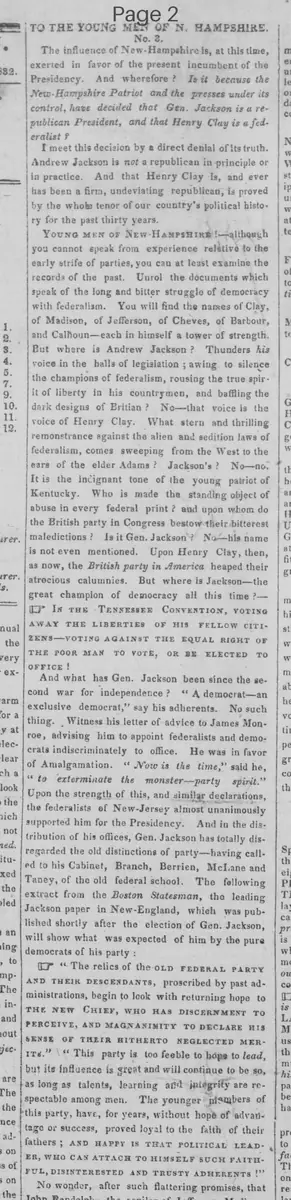
The influence of New-Hampshire is, at this time, exerted in favor of the present incumbent of the Presidency. And wherefore? Is it because the New-Hampshire Patriot and the presses under its control, have decided that Gen. Jackson is a republican President, and that Henry Clay is a federalist?
I meet this decision by a direct denial of its truth. Andrew Jackson is not a republican in principle or in practice. And that Henry Clay is, and ever has been a firm, undeviating republican, is proved by the whole tenor of our country's political history for the past thirty years.
Young Men of New-Hampshire!—although you cannot speak from experience relative to the early strife of parties, you can at least examine the records of the past. Unrol the documents which speak of the long and bitter struggle of democracy with federalism. You will find the names of Clay, of Madison, of Jefferson, of Cheves, of Barbour, and Calhoun—each in himself a tower of strength. But where is Andrew Jackson? Thunders his voice in the halls of legislation; awing to silence the champions of federalism, rousing the true spirit of liberty in his countrymen, and baffling the dark designs of Britain? No—that voice is the voice of Henry Clay. What stern and thrilling remonstrance against the alien and sedition laws of federalism, comes sweeping from the West to the ears of the elder Adams? Jackson's? No—no. It is the indignant tone of the young patriot of Kentucky. Who is made the standing object of abuse in every federal print? and upon whom do the British party in Congress bestow their bitterest maledictions? Is it Gen. Jackson? No—his name is not even mentioned. Upon Henry Clay, then, as now, the British party in America heaped their atrocious calumnies. But where is Jackson—the great champion of democracy all this time?—In the Tennessee Convention, voting AWAY THE LIBERTIES OF HIS FELLOW CITIZENS—VOTING AGAINST THE EQUAL RIGHT OF THE POOR MAN TO VOTE, OR BE ELECTED TO OFFICE!
And what has Gen. Jackson been since the second war for independence? "A democrat—an exclusive democrat," say his adherents. No such thing. Witness his letter of advice to James Monroe, advising him to appoint federalists and democrats indiscriminately to office. He was in favor of Amalgamation. "Now is the time," said he, "to exterminate the monster—party spirit."
Upon the strength of this, and similar declarations, the federalists of New-Jersey almost unanimously supported him for the Presidency. And in the distribution of his offices, Gen. Jackson has totally disregarded the old distinctions of party—having called to his Cabinet, Branch, Berrien, McLane and Taney, of the old federal school. The following extract from the Boston Statesman, the leading Jackson paper in New-England, which was published shortly after the election of Gen. Jackson, will show what was expected of him by the pure democrats of his party:
"The relics of the OLD FEDERAL PARTY AND THEIR DESCENDANTS, proscribed by past administrations, begin to look with returning hope to THE NEW CHIEF, WHO HAS DISCERNMENT TO PERCEIVE, AND MAGNANIMITY TO DECLARE HIS SENSE OF THEIR HITHERTO NEGLECTED MERITS." This party is too feeble to hope to lead, but its influence is great and will continue to be so, as long as talents, learning and integrity are respectable among men. The younger members of this party, have, for years, without hope of advantage or success, proved loyal to the faith of their FATHERS: AND HAPPY IS THAT POLITICAL LEADER, WHO CAN ATTACH TO HIMSELF SUCH FAITHFUL, DISINTERESTED AND TRUSTY ADHERENTS!"
No wonder, after such flattering promises, that John Randolph—the reviler of Jefferson, Madison, and Monroe, raised his cracked voice in the "hurrah for Jackson!" or that Timothy Pickering, who had for years been regarded only as an original and curious specimen of primitive federalism, exerted the remnant of his strength in tossing up his three-cornered scraper to the glory of Old Hickory!
Look at the course pursued by the advocates of Gen. Jackson. They have taken the very ground occupied by the tories of the revolution and the friends of Great Britain during the administration of Jefferson and Madison. They are opposed to the American System, and in favor of the British. They are for starving our mechanics for the benefit of those of England. They would place our country under the control of the manufacturing interest of England, rather than have her "free, sovereign and independent." Like the tories of the revolution, they would not demand justice of Great Britain, but, as in the case of the West India Trade, buy it as a favor. Like the cringing sycophants of Britain in "the times which tried men's souls," they acknowledged at the foot of the British throne that our country is in the wrong. Like them, they reverse the republican rule that the people alone should govern. Like them, they call one man everything and the people nothing. Like them, they favor the determination of one man to oppose the known will of a majority of the nation. And as in the dark days of our fathers, the British King filled every office of honor and emolument with his creatures—so has the President of the United States surrounded himself with a band of pensioned office-holders, who retain their situation only upon the condition of making use of the facilities of their office for the benefit of the giver.
What sub-type of article is it?
What themes does it cover?
What keywords are associated?
What entities or persons were involved?
Letter to Editor Details
Recipient
To The Young Men Of N. Hampshire.
Main Argument
andrew jackson is not a republican in principle or practice, having historically voted against equal voting rights and supported amalgamation with federalists, while henry clay has been a firm republican defender of democracy against federalism for thirty years.
Notable Details