Thank you for visiting SNEWPapers!
Sign up free
Literary
July 9, 1845
Morning Star
Limerick, York County, Maine
What is this article about?
This essay, part of a series on books and reading, argues that reading's benefits depend on orderly habits—regular times and amounts—like mental digestion. It promotes consistent reading for improved interest, memory, reflection, and understanding, addressing time constraints.
Clipping
OCR Quality
95%
Excellent
Full Text
Books....Reading.
We commenced our first number under this caption without any design of writing such a series as the result is showing. And hence it is that the sentiments they contain, are so poorly arranged, &c. In our last, we attempted to show that the benefits and vice versa of reading, depended very much upon the character and quality of books, &c. read. We will now remark,
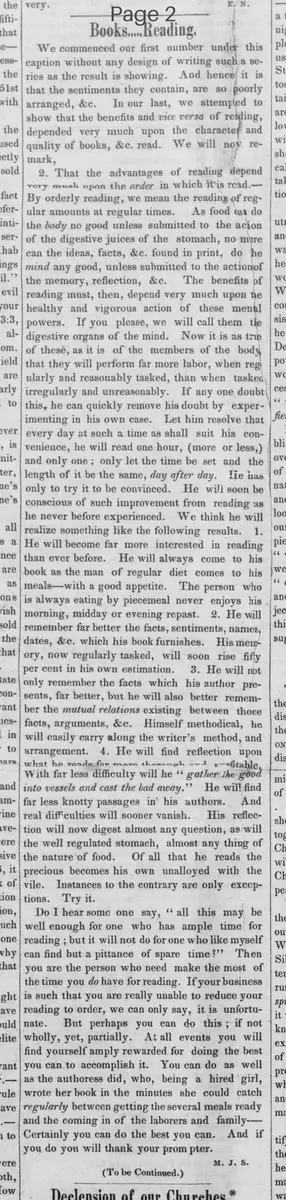
2. That the advantages of reading depend very much upon the order in which it is read.—By orderly reading, we mean the reading of regular amounts at regular times. As food can do the body no good unless submitted to the action of the digestive juices of the stomach, no more can the ideas, facts, &c. found in print, do the mind any good, unless submitted to the action of the memory, reflection, &c. The benefits of reading must, then, depend very much upon the healthy and vigorous action of these mental powers. If you please, we will call them the digestive organs of the mind. Now it is as true of these, as it is of the members of the body that they will perform far more labor, when regularly and reasonably tasked, than when tasked irregularly and unreasonably. If any one doubt this, he can quickly remove his doubt by experimenting in his own case. Let him resolve that every day at such a time as shall suit his convenience, he will read one hour, (more or less,) and only one; only let the time be set and the length of it be the same, day after day. He has only to try it to be convinced. He will soon be conscious of such improvement from reading as he never before experienced. We think he will realize something like the following results. 1. He will become far more interested in reading than ever before. He will always come to his book as the man of regular diet comes to his meals—with a good appetite. The person who is always eating by piecemeal never enjoys his morning, midday or evening repast. 2. He will remember far better the facts, sentiments, names, dates, &c. which his book furnishes. His memory, now regularly tasked, will soon rise fifty per cent in his own estimation. 3. He will not only remember the facts which his author presents, far better, but he will also better remember the mutual relations existing between those facts, arguments, &c. Himself methodical, he will easily carry along the writer's method, and arrangement. 4. He will find reflection upon what he read for more thorough and profitable. With far less difficulty will he "gather the good into vessels and cast the bad away." He will find far less knotty passages in his authors. And real difficulties will sooner vanish. His reflection will now digest almost any question, as will the well regulated stomach, almost anything of the nature of food. Of all that he reads the precious becomes his own unalloyed with the vile. Instances to the contrary are only exceptions. Try it.
Do I hear some one say, "all this may be well enough for one who has ample time for reading; but it will not do for one who like myself can find but a pittance of spare time?" Then you are the person who need make the most of the time you do have for reading. If your business is such that you are really unable to reduce your reading to order, we can only say, it is unfortunate. But perhaps you can do this; if not wholly, yet, partially. At all events you will find yourself amply rewarded for doing the best you can to accomplish it. You can do as well as the authoress did, who, being a hired girl, wrote her book in the minutes she could catch regularly between getting the several meals ready and the coming in of the laborers and family—Certainly you can do the best you can. And if you do you will thank your prompter.
M. J. S.
(To be Continued.)
We commenced our first number under this caption without any design of writing such a series as the result is showing. And hence it is that the sentiments they contain, are so poorly arranged, &c. In our last, we attempted to show that the benefits and vice versa of reading, depended very much upon the character and quality of books, &c. read. We will now remark,
2. That the advantages of reading depend very much upon the order in which it is read.—By orderly reading, we mean the reading of regular amounts at regular times. As food can do the body no good unless submitted to the action of the digestive juices of the stomach, no more can the ideas, facts, &c. found in print, do the mind any good, unless submitted to the action of the memory, reflection, &c. The benefits of reading must, then, depend very much upon the healthy and vigorous action of these mental powers. If you please, we will call them the digestive organs of the mind. Now it is as true of these, as it is of the members of the body that they will perform far more labor, when regularly and reasonably tasked, than when tasked irregularly and unreasonably. If any one doubt this, he can quickly remove his doubt by experimenting in his own case. Let him resolve that every day at such a time as shall suit his convenience, he will read one hour, (more or less,) and only one; only let the time be set and the length of it be the same, day after day. He has only to try it to be convinced. He will soon be conscious of such improvement from reading as he never before experienced. We think he will realize something like the following results. 1. He will become far more interested in reading than ever before. He will always come to his book as the man of regular diet comes to his meals—with a good appetite. The person who is always eating by piecemeal never enjoys his morning, midday or evening repast. 2. He will remember far better the facts, sentiments, names, dates, &c. which his book furnishes. His memory, now regularly tasked, will soon rise fifty per cent in his own estimation. 3. He will not only remember the facts which his author presents, far better, but he will also better remember the mutual relations existing between those facts, arguments, &c. Himself methodical, he will easily carry along the writer's method, and arrangement. 4. He will find reflection upon what he read for more thorough and profitable. With far less difficulty will he "gather the good into vessels and cast the bad away." He will find far less knotty passages in his authors. And real difficulties will sooner vanish. His reflection will now digest almost any question, as will the well regulated stomach, almost anything of the nature of food. Of all that he reads the precious becomes his own unalloyed with the vile. Instances to the contrary are only exceptions. Try it.
Do I hear some one say, "all this may be well enough for one who has ample time for reading; but it will not do for one who like myself can find but a pittance of spare time?" Then you are the person who need make the most of the time you do have for reading. If your business is such that you are really unable to reduce your reading to order, we can only say, it is unfortunate. But perhaps you can do this; if not wholly, yet, partially. At all events you will find yourself amply rewarded for doing the best you can to accomplish it. You can do as well as the authoress did, who, being a hired girl, wrote her book in the minutes she could catch regularly between getting the several meals ready and the coming in of the laborers and family—Certainly you can do the best you can. And if you do you will thank your prompter.
M. J. S.
(To be Continued.)
What sub-type of article is it?
Essay
What themes does it cover?
Moral Virtue
What keywords are associated?
Orderly Reading
Reading Habits
Mental Digestion
Memory Improvement
Self Discipline
Regular Study
What entities or persons were involved?
M. J. S.
Literary Details
Author
M. J. S.
Subject
Advantages Of Orderly Reading
Key Lines
As Food Can Do The Body No Good Unless Submitted To The Action Of The Digestive Juices Of The Stomach, No More Can The Ideas, Facts, &C. Found In Print, Do The Mind Any Good, Unless Submitted To The Action Of The Memory, Reflection, &C.
He Will Always Come To His Book As The Man Of Regular Diet Comes To His Meals—With A Good Appetite.
His Reflection Will Now Digest Almost Any Question, As Will The Well Regulated Stomach, Almost Anything Of The Nature Of Food.