Thank you for visiting SNEWPapers!
Sign up free
The Virginia Gazette
Richmond, Williamsburg, Richmond County, Virginia
What is this article about?
S. Davies continues his letter defending his religious poetry from a critic's charges of blasphemy, explaining biblical inspirations and accusing the critic of mocking Scripture with impious levity. He urges the critic to reveal his identity.
Merged-components note: Merged letter to the editor with following printer's note due to spatial overlap in bounding boxes and contextual connection as part of the same publication piece.
Clipping
OCR Quality
Full Text
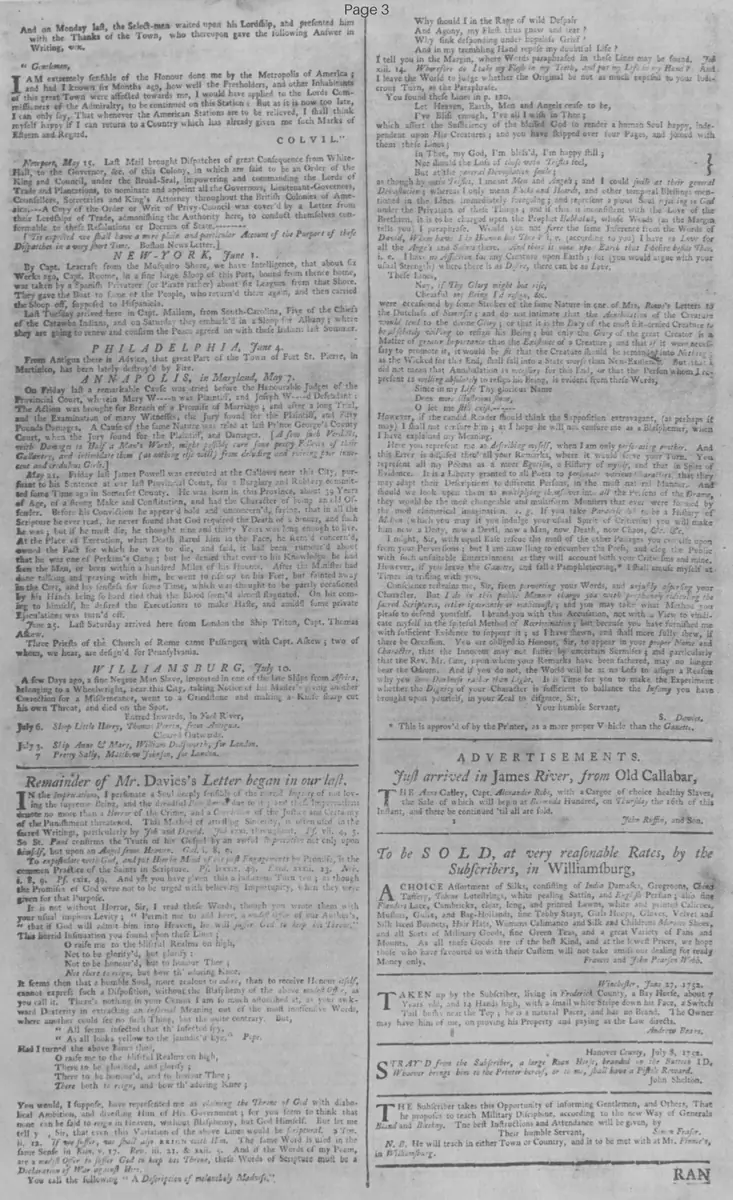
IN the Imprecations, I personate a Soul deeply sensible of the great Sin of not loving the supreme Being, and the dreadful Punishment due to it; and these Imprecations denote no more than a Horror of the Crime, and a Conviction of the Justice and Certainty of the Punishment threatened. This Method of expressing Sincerity, is often used in the sacred Writings, particularly by Job and David. Yadox thro' out. I s. vii. 4, 5.
So St. Paul confirms the Truth of his Gospel by an awful Imprecation not only upon Himself, but upon an Angel from Heaven. Gal. i. 8, 9.
To expostulate with God, and put Him in Mind of his great Promises by Prayer, in the common Practice of the Saints in Scripture. Ps. lxx. 49. Isa. lxiii. 13. Neh. i. 8, 9. Ps. cxix. 49. And yet you have given this a ludicrous Turn too; as though the Promises of God were not to be urged with believing Importunity, than they were given for that Purpose.
It is not without Horror, Sir, I read these Words, though you wrote them with your usual impious Levity; "Permit me to add here, a Model Offer of our Author's, that if God will admit him into Heaven, he will quit God of keeping his Liver."
This horrid Insinuation you found upon these Lines;
O raise me to the blissful Realms on high,
Not to be glorif y'd, but glorify:
Not to be honour'd, but to honour Thee;
Not there to reign, but bow th'adoring Knee.
It seems then that a humble Soul, more zealous to adore, than to receive Honour itself cannot express such a Disposition, without the Blasphemy of the above Paraphrase, as you call it. There's nothing in your Criticism I am so much astonished at, as your awkward Dexterity in extracting an infernal Meaning out of the most innocent Words, where another could see no such Thing, but quite the contrary.
But,
"All seems infected that th'Infected spy.
As all looks yellow to the jaundic'd Eye."
Had I turned the above Hints thus.
O raise me to the blissful Realms on high,
There to be glorified, and glorify;
There to be honour'd, and to honour Thee;
There both to reign, and bow th'adoring Knee;
You would, I suppose, have represented me as claiming the Throne of God with diabolical Ambition, and divesting Him of His Government; for you seem to think that none can be said to reign in Heaven, without Blasphemy, but God Himself. But let me tell you, Sir, that even this Variation of the above Lines would be scriptural. 2 Tim. ii. 12. If we suffer, we shall also reign with him. The same Word is used in the same Sense in Rom. v. 17. Rev. xx. 6. & xxii. 5. And if the Words of my Poem, are a worse Offence to juster Ears than these Words of Scripture must be a Declaration of War against Him.
You call the following "A Description of melancholy Madness."
Why Should I in the Rage of wild Despair
And Agony, my Flesh thus gnaw and tear?
Why sink deponding under hopeless Grief?
And in my trembling Hand repose my doubtful Life?
I tell you in the Margin, where Words paraphrased in these Lines may be found. Job xii. 14. Wherefore do I take my Flesh in my Teeth, and put my Life in my Hand? And.
I leave the World to judge whether the Original be not as much exposed to your ludicrous Turn, as the Paraphrase.
You found these Lines in p. 120.
Let Heaven, Earth, Men and Angels cease to be.
I've Bliss enough, I've all I wish in Thee;
which assert the Sufficiency of the blessed God to render a human Soul happy. independent upon His Creatures; and you have skipped over four Pages, and joined with them these Lines;
In Thee, my God, I'm blest, I'm happy still;
Nor should the Loss of those vain Trifles feel,
But at the general Devastation smile;
as though by vain Trifles, I meant Men and Angels; and I could smile at their general Devastation; whereas I only mean Flocks and Herds, and other temporal Blessings mentioned in the Lines immediately foregoing; and represent a pious Soul rejoicing in God under the Privation of these Things; and if this is inconsistent with the Law of the Brethren. it is to be charged upon the Prophet Habakkuk, whose Words (as the Margin tells you) I paraphrase. Would you not force the same Inference from the Words of David, Whom have I in Heaven but Thee? i.e. (according to you) I have no Love for all the Angels and Saints there. And there is none upon Earth that I desire beside Thee.
i.e. I have no Affection for any Creature upon Earth; for (you would argue with your usual Strength) where there is no Desire, there can be no Love.
These Lines,
Nay, if Thy Glory might but rise,
Cheerful I'd bring Life's ransom, &c.
were occasioned by some Strokes of the same Nature in one of Mr. B---rd's Letters to the Dutchess of Som---t: and do not intimate that the Annihilation of the Creature would tend to the divine Glory; or that it is the Duty of the most self-denied Creature to be absolutely willing to resign his Being; but only the Glory of the great Creator is a Matter of greater Importance than the Existence of a Creature; and that if it were necessary to promote it, it would be fit that the Creature should be summoned into Non-Being; as the Wicked for this End, shall fall into a State worse than Non-Existence. But that I did not mean that Annihilation is necessary for this End, or that the Person whom I represent is willing absolutely to resign his Being, is evident from these Words,
Since in my Life Thy glorious Name
Does more illustrious shine,
O let me still enjoy.---..
However, if the candid Reader should think the Supposition extravagant, (as perhaps it may) I shall not censure him; as I hope he will not censure me as a Blasphemer, when I have explained my Meaning.
Here you represent me as describing myself, when I am only personating another. And this Error is diffused thro'all your Remarks, where it would serve your Turn. You represent all my Poems as a meer Egoism, a History of myself, and that in Spite of Evidence. It is a Liberty granted to all Poets to personate various characters. that they may adapt their Descriptions to different Persons, in the most natural Manner. And should we look upon them as manifesting themselves in all the Persons of the Drama, they would be the most changeable and multiform Monsters that ever were formed by the most chimerical imagination. e.g. If you take Paradise to be a History of M---n (which you may if you indulge your usual Spirit of Criticism) you will make him now a Deity, now a Devil, now a Man, now Death, now Chaos, &c. &c.
I might, Sir, with equal Ease rescue the most of the other Passages you cite upon from your Perversions; but I am now willing to encumber the Press, and clog the Public with such unsuitable Entertainment as they will account both your Criticisms and mine.
However, if you leave the Gazette, and fall a Pamphleteering, I shall amuse myself at Times in trifling with you.
Conscience restrains me, Sir, from perverting your Words, and wantonly bespattering your Character. But I do in this public Manner charge you with profanely ridiculing the sacred Scriptures, either ignorantly or maliciously; and you may take what Method you please to defend yourself. I brand you with this Accusation, not with a View to vindicate myself in the spiteful Method of Recrimination; but because you have furnished me with sufficient Evidence to support it; as I have shewn, and shall more fully shew, if there be Occasion. You are obliged in Honour, Sir, to appear in your Proper Name and Character, that the Innocent may not suffer by uncertain Surmises; and particularly that the Rev. Mr. C---m, upon whom your Remarks have been fathered, may no longer bear the Odium. And if you do not, the World will be at no Loss to assign a Reason why you here Darkness rather than Light. It is Time for you to make the Experiment whether the Dignity of your Character is sufficient to balance the Infamy you have brought upon yourself, in your Zeal to disgrace, Sir,
Your humble Servant,
S. Davies.
This is approv'd of by the Printer, as a more proper Vehicle than the Gazette.
What sub-type of article is it?
What themes does it cover?
What keywords are associated?
What entities or persons were involved?
Letter to Editor Details
Author
S. Davies
Recipient
Sir
Main Argument
the author defends his religious poetry against accusations of blasphemy by explaining that his expressions are drawn from and aligned with scripture, while accusing the critic of impious levity and profanely ridiculing the sacred writings.
Notable Details