Thank you for visiting SNEWPapers!
Sign up free
Gazette Of The United States
Philadelphia, Philadelphia County, Pennsylvania
What is this article about?
In February, Europe faces anxiety over war preparations and peace talks; France demands major conquests while allies mobilize large forces along Rhine. Analysis suggests mutual ambitions abated, economic resilience, and European powers' positions favor eventual peace without further bloodshed.
Clipping
OCR Quality
Full Text
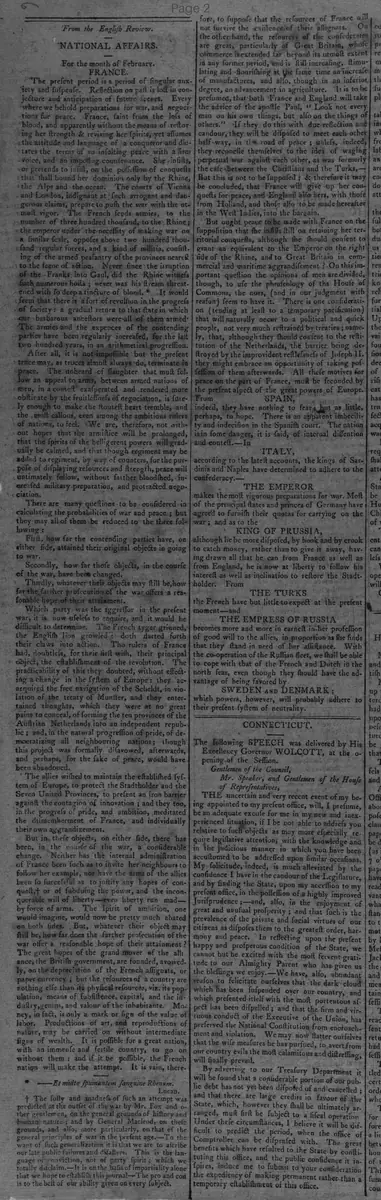
NATIONAL AFFAIRS.
For the month of February.
FRANCE.
The present period is a period of singular anxiety and suspense. Reflection on past is lost in conjecture and anticipation of future scenes. Everywhere we behold preparations for war, and negotiations for peace. France, faint from the loss of blood, and apparently without the means of restoring her strength & reviving her spirits, yet assumes the attitude and language of a conqueror and dictates the terms of an insulting peace with a firm voice, and an imposing countenance. She insists, or pretends to insist, on the possession of conquests that shall bound her dominion only by the Rhine, the Alps and the ocean. The courts of Vienna and London, indignant at such arrogant and dangerous claims, prepare to push the war with the utmost vigor. The French expeds armies, to the number of three hundred thousand, to the Rhine; the emperor under the necessity of making war on a similar scale, opposes above two hundred thousand regular forces, and a kind of militia, consisting of the armed peasantry of the provinces nearest to the scene of action. Never since the irruption of the Franks into Gaul, did the Rhine witness such numerous hosts: never was his stream threatened with so deep a tincture of blood. It would seem that there is a sort of revulsion in the progress of society: a gradual return to that state in which our barbarous ancestors were all of them armed. The armies and the expenses of the contending parties have been regularly increased, for the last two hundred years, in an arithmetical progression. After all, it is not impossible but the present truce may, as truces almost always do, terminate in peace. The unheard of slaughter that must follow an appeal to arms, between armed nations of men, in a contest exasperated and rendered more obstinate by the fruitlessness of negotiation, is surely enough to make the stoutest heart tremble, and the most callous, even among the ambitious rulers of nations, to feel. We are, therefore, not without hopes that the armistice will be prolonged, that the spirits of the belligerent powers will gradually be calmed, and that though regiment may be added to regiment, by way of counters, for the purpose of displaying resources and strength, peace will ultimately, follow, without farther bloodshed, increased military preparation, and protracted negotiation.
There are many questions to be considered in calculating the probabilities of war and peace; but they may all of them be reduced to the three following:
First, how far the contending parties have, on either side, attained their original objects in going to war.
Secondly, how far those objects, in the course of the war, have been changed.
Thirdly, whatever their objects may still be, how far the farther prosecution of the war offers a reasonable hope of their attainment.
Which party was the aggressor in the present war, it is now useless to enquire, and it would be difficult to determine. The French tyger grinned, the English lion growled: both darted forth their claws into action. Those rulers of France had, doubtless, for their first wish, their principal object, the establishment of the revolution. The practicability of this they doubted, without effecting a change in the system of Europe: they acquiesced the free navigation of the Scheldt, in violation of the treaty of Munster, and they entertained thoughts, which they were at no great pains to conceal, of forming the ten provinces of the Austrian Netherlands into an independent republic; and, in the natural progression of pride, of democratizing all neighbouring nations; though this project was formally disavowed, afterwards, and perhaps, for the sake of peace, would have been abandoned.
The allies wished to maintain the established system of Europe, to protect the Stadtholder and the Seven United Provinces, to present an iron barrier against the contagion of innovation; and they too, in the progress of pride, and ambition, meditated the dismemberment of France, and individually their own aggrandizement.
But in these objects, on either side, there has been, in the course of the war, a considerable change. Neither has the internal administration of France been such as to invite her neighbours to follow her example, nor have the arms of the allies been so successful as to justify any hopes of conquest, or of subduing the power, and the unconquerable will of liberty—even liberty run mad—by force of arms. The spirit of ambition, one would imagine, would now be pretty much abated on both sides. But, whatever their object may still be, how far does the farther prosecution of the war offer a reasonable hope of their attainment?
The great hopes of the grand mover of the alliance, the British government, are founded, avowedly, on the depreciation of the French assignats, or paper currency; but the resources of a country are nothing else than its physical resources, viz. its population, means of subsistence, capital, and the industry, genius, and valour of the inhabitants. Money, in fact, is only a mark or sign of the value of labor. Productions of art, and reproductions of nature, may be carried on without intermediate signs of wealth. It is possible for a great nation, with an immense and fertile country, to go on without them: and if it be possible, the French nation will make the attempt. It is vain, therefore, to suppose that the resources of France will not survive the existence of their assignats. On the other hand, the resources of the confederates are great, particularly of Great Britain, whose commerce is extended far beyond its utmost extent in any former period, and is still increasing, stimulating and nourishing at the same time an increase of manufactures, and also, though in an inferior degree, an advancement in agriculture. It is to be presumed, that both France and England will take the advice of the apostle Paul, "Look not every man on his own things, but also on the things of others." If they do this with due reflection and candour, they will be disposed to meet each other half way, in the road of peace; unless, indeed they reconcile themselves to the idea of waging perpetual war against each other, as was formerly the case between the Christians and the Turks. But this is not to be supposed; & therefore it may be concluded, that France will give up her conquests for peace, and England also hers, with those from Holland, and those also to be made hereafter in the West Indies, into the bargain.
But ought peace to be made with France on the supposition that she insists still on retaining her territorial conquests, although she should consent to grant an equivalent to the Emperor on the right side of the Rhine, and to Great Britain in commercial and maritime aggrandizement? On this important question the opinions of men are divided, though, to use the phraseology of the House of Commons, the noes, (and in our judgment with reason) seem to have it. There is one consideration (tending at least to a temporary pacification) that will naturally occur to a political and quick people, not very much restrained by treaties; namely, that, although they should consent to the restitution of the Netherlands, the barrier being destroyed by the improvident restlessness of Joseph II. they might embrace an opportunity of taking possession of them afterwards. All these motives for peace on the part of France, must be seconded by the present aspect of the great powers of Europe.
From SPAIN, indeed, they have nothing to fear but as little, perhaps, to hope. There is an apparent imbecility and indecision in the Spanish court. The nation is in some danger, it is said, of internal dissention and contest.
In ITALY, according to the latest accounts, the kings of Sardinia and Naples have determined to adhere to the confederacy.
THE EMPEROR makes the most vigorous preparations for war. Most of the principal states and princes of Germany have agreed to furnish their quotas for carrying on the war; and as to the
KING OF PRUSSIA, although he be more disposed, by hook and by crook to catch money, rather than to give it away, having drawn all that he can from France as well as from England, he is now at liberty to follow his interest as well as inclination to restore the Stadtholder.
From THE TURKS the French have but little to expect at the present moment—and
THE EMPRESS OF RUSSIA becomes more and more in earnest in her profession of good will to the allies, in proportion as She finds that they stand in need of her assistance. With the co-operation of the Russian fleet, we shall be able to cope with that of the French and Dutch in the north seas, even though they should have the advantage of being favored by
SWEDEN AND DENMARK: which powers, however, will probably adhere to their present system of neutrality.
What sub-type of article is it?
What keywords are associated?
What entities or persons were involved?
Where did it happen?
Foreign News Details
Primary Location
France
Event Date
For The Month Of February
Key Persons
Outcome
hopes for peace without further bloodshed; potential for armistice prolongation and negotiations leading to peace despite military preparations
Event Details
France prepares for war while negotiating peace, insisting on conquests bounded by Rhine, Alps, and ocean. Allies including Vienna and London prepare vigorous opposition with large armies on Rhine. Analysis of war objectives, changes, and prospects for attainment suggests mutual exhaustion and economic considerations may lead to peace. Updates on stances of Spain, Italy, Emperor, Prussia, Turks, Russia, Sweden, and Denmark.