Thank you for visiting SNEWPapers!
Sign up free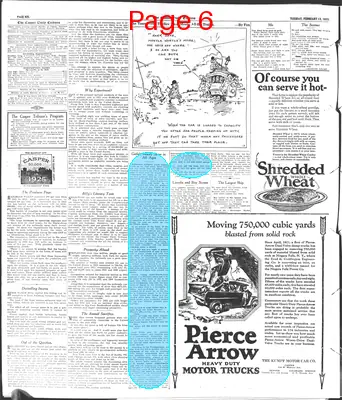
Literary
February 13, 1923
Casper Daily Tribune
Casper, Natrona County, Wyoming
What is this article about?
This essay reflects on the modern appearance of ancient Egyptian Queen Ankh-Nes-Pa-Aten and Roman emperors, suggesting timeless human beauty and brotherhood. It draws on Pythagorean reincarnation to speculate on past figures' present lives and quotes Villon's poem on vanished beauties.
Clipping
OCR Quality
98%
Excellent
Full Text
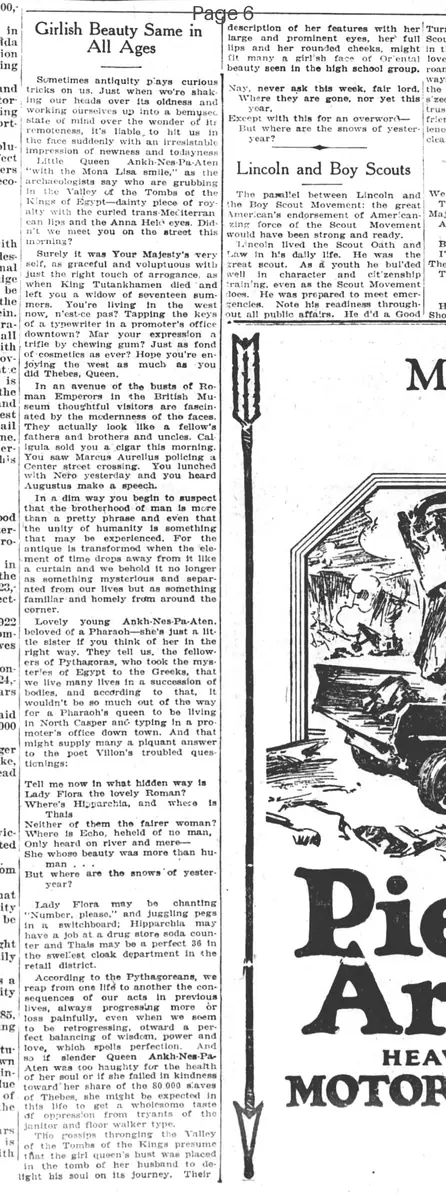
Girlish Beauty Same in All Ages
Sometimes antiquity plays curious tricks on us. Just when we're shaking our heads over its oldness and working ourselves up into a bemused state of mind over the wonder of its remoteness, it's liable to hit us in the face suddenly with an irresistible impression of newness and todayness Little Queen Ankh-Nes-Pa-Aten 'with the Mona Lisa smile,' as the archaeologists say who are grubbing in the Valley of the Tombs of the Kings of Egypt-dainty piece of royalty with the curled trans-Mediterranean lips and the Anna Held eyes. Didn't we meet you on the street this morning?
Surely it was Your Majesty's very self, as graceful and voluptuous with just the right touch of arrogance, as when King Tutankhamen died and left you a widow of seventeen summers. You're living in the west now, n'est-ce pas? Tapping the keys of a typewriter in a promoter's office downtown? Mar your expression a trifle by chewing gum? Just as fond of cosmetics as ever? Hope you're enjoying the west as much as you did Thebes, Queen.
In an avenue of the busts of Roman Emperors in the British Museum thoughtful visitors are fascinated by the modernness of the faces. They actually look like a fellow's fathers and brothers and uncles. Caligula sold you a cigar this morning. You saw Marcus Aurelius policing a Center street crossing. You lunched with Nero yesterday and you heard Augustus make a speech.
In a dim way you begin to suspect that the brotherhood of man is more than a pretty phrase and even that the unity of humanity is something that may be experienced. For the antique is transformed when the element of time drops away from it like a curtain and we behold it no longer as something mysterious and separated from our lives but as something familiar and homely from around the corner.
Lovely young Ankh-Nes-Pa-Aten, beloved of a Pharaoh-she's just a little sister if you think of her in the right way. They tell us, the followers of Pythagoras, who took the mysteries of Egypt to the Greeks, that we live many lives in a succession of bodies, and according to that, it wouldn't be so much out of the way for a Pharaoh's queen to be living in North Casper and typing in a promoter's office down town. And that might supply many a piquant answer to the poet Villon's troubled questionings:
Tell me now in what hidden way is Lady Flora the lovely Roman?
Where's Hipparchia, and where Is Thais
Neither of them the fairer woman?
Where is Echo, beheld of no man,
Only heard on river and mere—
She whose beauty was more than human
But where are the snows of yester-year?
Lady Flora may be chanting "Number, please," and juggling pegs in a switchboard; Hipparchia may have a job at a drug store soda counter and Thais may be a perfect 36 in the swellest cloak department in the retail district.
According to the Pythagoreans, we reap from one life to another the consequences of our acts in previous lives, always progressing more or less painfully, even when we seem to be retrogressing, toward a perfect balancing of wisdom, power and love, which spells perfection. And so if slender Queen Ankh-Nes-Pa-Aten was too haughty for the health of her soul or if she failed in kindness toward her share of the 80,000 slaves of Thebes, she might be expected in this life to get a wholesome taste of oppression from tyrants of the janitor and floor walker type.
The gossips thronging the Valley of the Tombs of the Kings presume that the girl queen's bust was placed in the tomb of her husband to delight his soul on its journey. Their description of her features with her large and prominent eyes, her full lips and her rounded cheeks, might fit many a girl's face of Oriental beauty seen in the high school group.
Nay, never ask this week, fair lord,
Where they are gone, nor yet this year,
Except with this for an overword,
But where are the snows of yester-year?
Sometimes antiquity plays curious tricks on us. Just when we're shaking our heads over its oldness and working ourselves up into a bemused state of mind over the wonder of its remoteness, it's liable to hit us in the face suddenly with an irresistible impression of newness and todayness Little Queen Ankh-Nes-Pa-Aten 'with the Mona Lisa smile,' as the archaeologists say who are grubbing in the Valley of the Tombs of the Kings of Egypt-dainty piece of royalty with the curled trans-Mediterranean lips and the Anna Held eyes. Didn't we meet you on the street this morning?
Surely it was Your Majesty's very self, as graceful and voluptuous with just the right touch of arrogance, as when King Tutankhamen died and left you a widow of seventeen summers. You're living in the west now, n'est-ce pas? Tapping the keys of a typewriter in a promoter's office downtown? Mar your expression a trifle by chewing gum? Just as fond of cosmetics as ever? Hope you're enjoying the west as much as you did Thebes, Queen.
In an avenue of the busts of Roman Emperors in the British Museum thoughtful visitors are fascinated by the modernness of the faces. They actually look like a fellow's fathers and brothers and uncles. Caligula sold you a cigar this morning. You saw Marcus Aurelius policing a Center street crossing. You lunched with Nero yesterday and you heard Augustus make a speech.
In a dim way you begin to suspect that the brotherhood of man is more than a pretty phrase and even that the unity of humanity is something that may be experienced. For the antique is transformed when the element of time drops away from it like a curtain and we behold it no longer as something mysterious and separated from our lives but as something familiar and homely from around the corner.
Lovely young Ankh-Nes-Pa-Aten, beloved of a Pharaoh-she's just a little sister if you think of her in the right way. They tell us, the followers of Pythagoras, who took the mysteries of Egypt to the Greeks, that we live many lives in a succession of bodies, and according to that, it wouldn't be so much out of the way for a Pharaoh's queen to be living in North Casper and typing in a promoter's office down town. And that might supply many a piquant answer to the poet Villon's troubled questionings:
Tell me now in what hidden way is Lady Flora the lovely Roman?
Where's Hipparchia, and where Is Thais
Neither of them the fairer woman?
Where is Echo, beheld of no man,
Only heard on river and mere—
She whose beauty was more than human
But where are the snows of yester-year?
Lady Flora may be chanting "Number, please," and juggling pegs in a switchboard; Hipparchia may have a job at a drug store soda counter and Thais may be a perfect 36 in the swellest cloak department in the retail district.
According to the Pythagoreans, we reap from one life to another the consequences of our acts in previous lives, always progressing more or less painfully, even when we seem to be retrogressing, toward a perfect balancing of wisdom, power and love, which spells perfection. And so if slender Queen Ankh-Nes-Pa-Aten was too haughty for the health of her soul or if she failed in kindness toward her share of the 80,000 slaves of Thebes, she might be expected in this life to get a wholesome taste of oppression from tyrants of the janitor and floor walker type.
The gossips thronging the Valley of the Tombs of the Kings presume that the girl queen's bust was placed in the tomb of her husband to delight his soul on its journey. Their description of her features with her large and prominent eyes, her full lips and her rounded cheeks, might fit many a girl's face of Oriental beauty seen in the high school group.
Nay, never ask this week, fair lord,
Where they are gone, nor yet this year,
Except with this for an overword,
But where are the snows of yester-year?
What sub-type of article is it?
Essay
What themes does it cover?
Social Manners
Religious
Death Mortality
What keywords are associated?
Timeless Beauty
Ancient Queens
Pythagorean Reincarnation
Villon Poem
Roman Emperors
Human Unity
Literary Details
Title
Girlish Beauty Same In All Ages
Key Lines
Tell Me Now In What Hidden Way Is Lady Flora The Lovely Roman?
Where's Hipparchia, And Where Is Thais
Neither Of Them The Fairer Woman?
Where Is Echo, Beheld Of No Man,
Only Heard On River And Mere—
She Whose Beauty Was More Than Human
But Where Are The Snows Of Yester Year?
Nay, Never Ask This Week, Fair Lord,
Where They Are Gone, Nor Yet This Year,
Except With This For An Overword,
But Where Are The Snows Of Yester Year?