Thank you for visiting SNEWPapers!
Sign up free
Story
November 19, 1845
Morning Star
Limerick, York County, Maine
What is this article about?
An essay emphasizing the strength and joy derived from harmony in the domestic circle, advocating charity, mutual concessions, forbearance, and cheerfulness to maintain family unity despite differences and imperfections.
Clipping
OCR Quality
95%
Excellent
Full Text
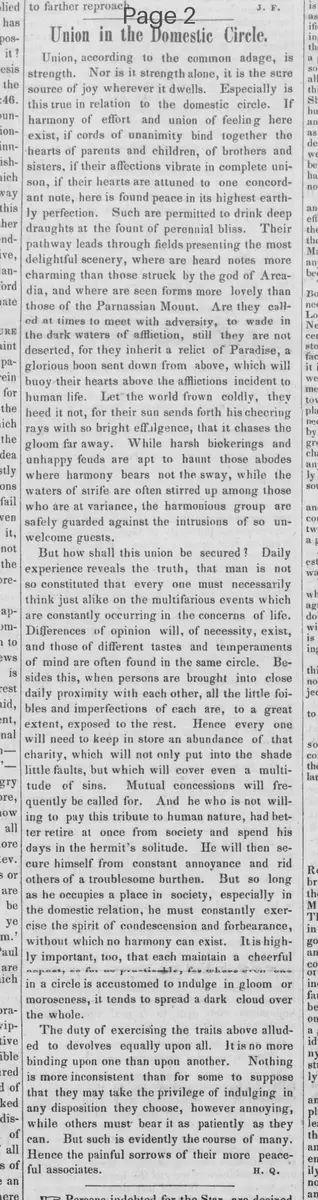
Union in the Domestic Circle.
Union, according to the common adage, is strength. Nor is it strength alone, it is the sure source of joy wherever it dwells. Especially is this true in relation to the domestic circle. If harmony of effort and union of feeling here exist, if cords of unanimity bind together the hearts of parents and children, of brothers and sisters, if their affections vibrate in complete unison, if their hearts are attuned to one concordant note, here is found peace in its highest earthly perfection. Such are permitted to drink deep draughts at the fount of perennial bliss. Their pathway leads through fields presenting the most delightful scenery, where are heard notes more charming than those struck by the god of Arcadia, and where are seen forms more lovely than those of the Parnassian Mount. Are they called at times to meet with adversity, to wade in the dark waters of affliction, still they are not deserted, for they inherit a relict of Paradise, a glorious boon sent down from above, which will buoy their hearts above the afflictions incident to human life. Let the world frown coldly, they heed it not, for their sun sends forth his cheering rays with so bright effulgence, that it chases the gloom far away. While harsh bickerings and unhappy feuds are apt to haunt those abodes where harmony bears not the sway, while the waters of strife are often stirred up among those who are at variance, the harmonious group are safely guarded against the intrusions of so unwelcome guests.
But how shall this union be secured? Daily experience reveals the truth, that man is not so constituted that every one must necessarily think just alike on the multifarious events which are constantly occurring in the concerns of life. Differences of opinion will, of necessity, exist, and those of different tastes and temperaments of mind are often found in the same circle. Besides this, when persons are brought into close daily proximity with each other, all the little foibles and imperfections of each are, to a great extent, exposed to the rest. Hence every one will need to keep in store an abundance of that charity, which will not only put into the shade little faults, but which will cover even a multitude of sins. Mutual concessions will frequently be called for. And he who is not willing to pay this tribute to human nature, had better retire at once from society and spend his days in the hermit's solitude. He will then secure himself from constant annoyance and rid others of a troublesome burthen. But so long as he occupies a place in society, especially in the domestic relation, he must constantly exercise the spirit of condescension and forbearance, without which no harmony can exist. It is highly important, too, that each maintain a cheerful temperament, so far as practicable, for should any one in a circle is accustomed to indulge in gloom or moroseness, it tends to spread a dark cloud over the whole.
The duty of exercising the traits above alluded to devolves equally upon all. It is no more binding upon one than upon another. Nothing is more inconsistent than for some to suppose that they may take the privilege of indulging in any disposition they choose, however annoying, while others must bear it as patiently as they can. But such is evidently the course of many. Hence the painful sorrows of their more peaceful associates.
H. Q.
Union, according to the common adage, is strength. Nor is it strength alone, it is the sure source of joy wherever it dwells. Especially is this true in relation to the domestic circle. If harmony of effort and union of feeling here exist, if cords of unanimity bind together the hearts of parents and children, of brothers and sisters, if their affections vibrate in complete unison, if their hearts are attuned to one concordant note, here is found peace in its highest earthly perfection. Such are permitted to drink deep draughts at the fount of perennial bliss. Their pathway leads through fields presenting the most delightful scenery, where are heard notes more charming than those struck by the god of Arcadia, and where are seen forms more lovely than those of the Parnassian Mount. Are they called at times to meet with adversity, to wade in the dark waters of affliction, still they are not deserted, for they inherit a relict of Paradise, a glorious boon sent down from above, which will buoy their hearts above the afflictions incident to human life. Let the world frown coldly, they heed it not, for their sun sends forth his cheering rays with so bright effulgence, that it chases the gloom far away. While harsh bickerings and unhappy feuds are apt to haunt those abodes where harmony bears not the sway, while the waters of strife are often stirred up among those who are at variance, the harmonious group are safely guarded against the intrusions of so unwelcome guests.
But how shall this union be secured? Daily experience reveals the truth, that man is not so constituted that every one must necessarily think just alike on the multifarious events which are constantly occurring in the concerns of life. Differences of opinion will, of necessity, exist, and those of different tastes and temperaments of mind are often found in the same circle. Besides this, when persons are brought into close daily proximity with each other, all the little foibles and imperfections of each are, to a great extent, exposed to the rest. Hence every one will need to keep in store an abundance of that charity, which will not only put into the shade little faults, but which will cover even a multitude of sins. Mutual concessions will frequently be called for. And he who is not willing to pay this tribute to human nature, had better retire at once from society and spend his days in the hermit's solitude. He will then secure himself from constant annoyance and rid others of a troublesome burthen. But so long as he occupies a place in society, especially in the domestic relation, he must constantly exercise the spirit of condescension and forbearance, without which no harmony can exist. It is highly important, too, that each maintain a cheerful temperament, so far as practicable, for should any one in a circle is accustomed to indulge in gloom or moroseness, it tends to spread a dark cloud over the whole.
The duty of exercising the traits above alluded to devolves equally upon all. It is no more binding upon one than upon another. Nothing is more inconsistent than for some to suppose that they may take the privilege of indulging in any disposition they choose, however annoying, while others must bear it as patiently as they can. But such is evidently the course of many. Hence the painful sorrows of their more peaceful associates.
H. Q.
What sub-type of article is it?
Moral Essay
Domestic Advice
What themes does it cover?
Family
Moral Virtue
Social Manners
What keywords are associated?
Family Harmony
Domestic Union
Charity
Forbearance
Cheerfulness
Mutual Concessions
What entities or persons were involved?
H. Q.
Story Details
Key Persons
H. Q.
Story Details
Essay extolling the benefits of family harmony and prescribing charity, mutual concessions, forbearance, and cheerfulness to overcome differences and imperfections for domestic bliss.